One of the major challenges in modern nuclear physics is understanding how nature produces the heaviest elements in the universe, such as lead and gold. Many of these elements are thought to originate through the process known as ‘rapid neutron capture’, which occurs during extreme astrophysical events such as neutron-star mergers and supernova explosions. Reproducing the exotic nuclei involved in these processes in the laboratory is therefore essential for studying nuclear structure and the cosmic origin of matter. This requires complex accelerator and detector facilities, in which beams of ions are accelerated and made to interact in order to reproduce and observe these processes and their products in detail.
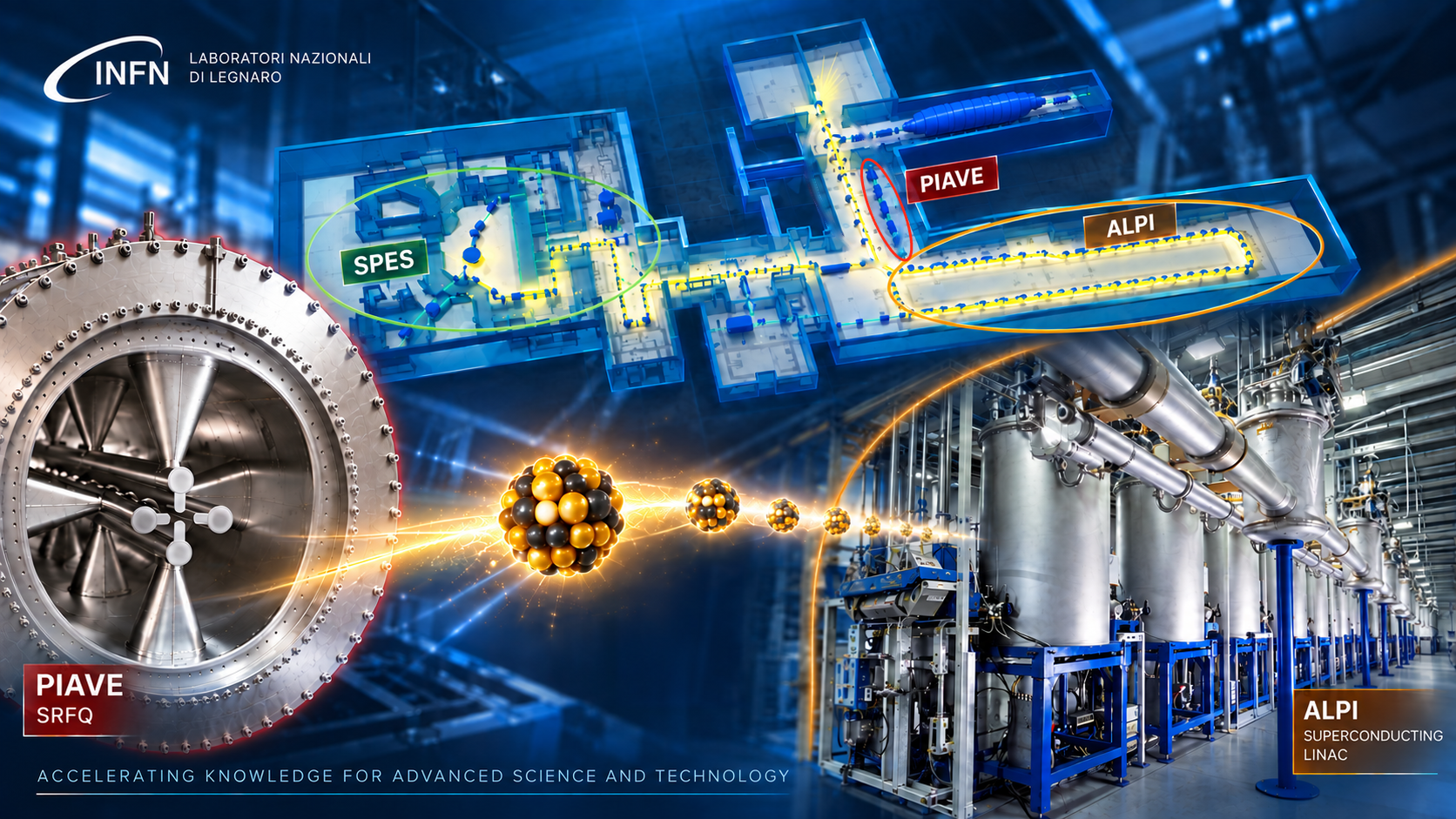
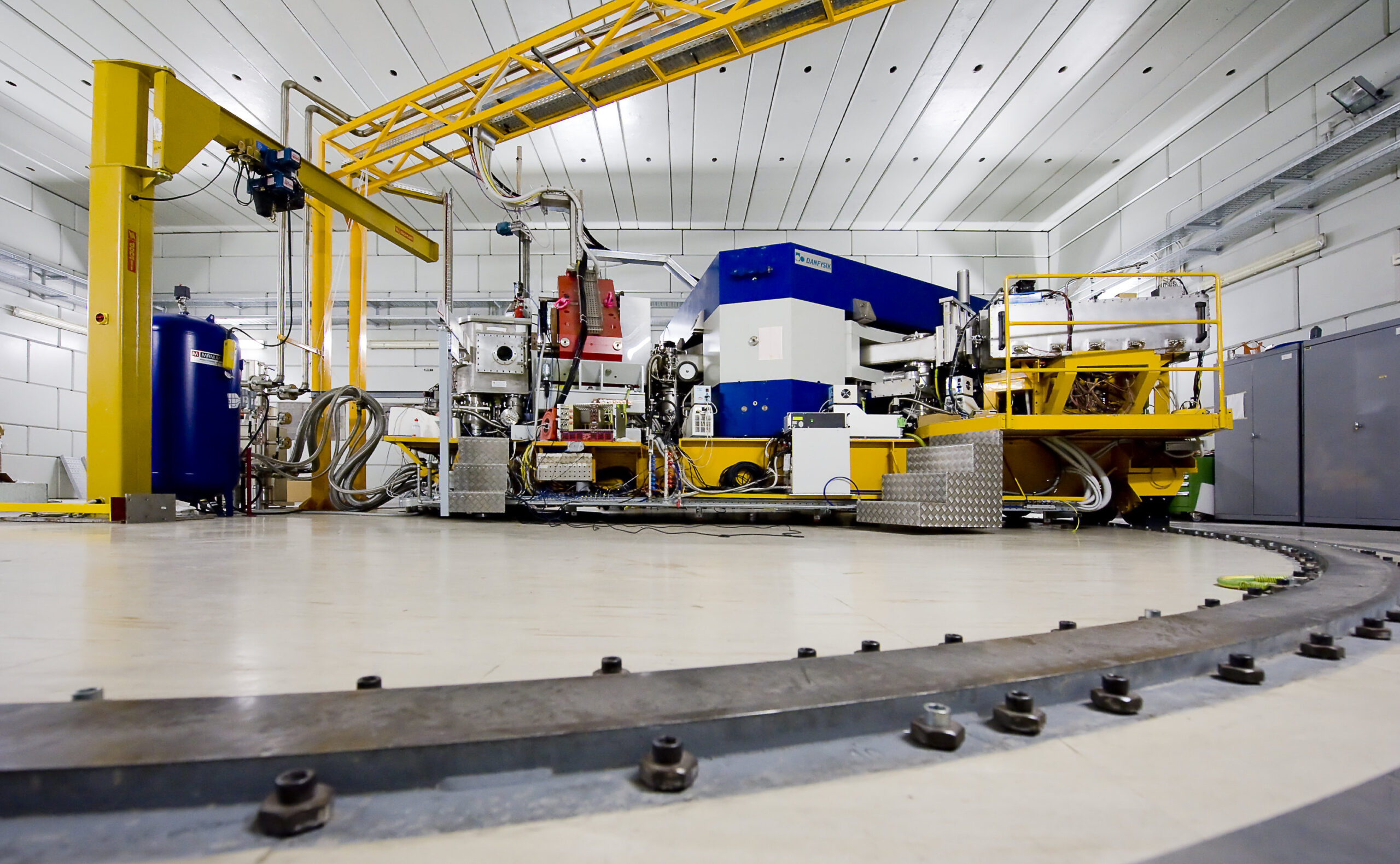
At INFN Legnaro National Laboratories, for the first time, a beam of uranium-238 ions, the most common uranium isotope found in nature, has been accelerated to an energy of 6.2 MeV per nucleon using the PIAVE-ALPI superconducting accelerator complex. This result represents an important technological milestone for the study of exotic nuclei, and is the second such milestone reached at the Legnaro Laboratories following the production of the first exotic-ion beam as part of the SPES project. To achieve this, a very low beam intensity of around one nanoampere of particles was used, typical of low-energy nuclear physics experiments. Over an entire month of experimental activity, only a few micrograms of uranium were accelerated, in experiments in which the beam ions interacted one at a time with the nuclei of an extremely thin metal target. The campaign was made possible by the synergistic use of several instruments — the AGATA gamma-ray detectors, the PRISMA magnetic spectrometer and a dedicated detection system — in an exceptionally powerful experimental configuration.
“Thanks to the accelerator and detector facilities at the Legnaro Laboratories, it was possible to identify and study in detail, through spectroscopy, both the neutron-rich fragments produced when uranium nuclei underwent fission following their collision with the target, and the heavy ions produced through reactions involving the transfer of multiple nucleons”, explains Andrea Gottardo, scientific coordinator of the PIAVE-ALPI accelerators.
Researchers from several European institutions took part in the campaign, addressing fundamental questions ranging from the structure of the neutron-rich nuclei involved in the rapid neutron-capture process to the formation and survival of the heavier reaction products generated in ion-ion collisions.
“In addition to its immediate scientific impact”, emphasises Enrico Fagotti, head of the accelerator division, “the production of the first accelerated uranium-ion beam represents an important strategic achievement for the Legnaro Laboratories, because it demonstrates their ability to operate with complex heavy-ion beams, making full use of a world-class experimental facility”.
This result provides a direct link to the next chapter in research at the Legnaro Laboratories: many of the neutron-rich nuclei studied through uranium-induced reactions lie in the same regions of the nuclide chart that will soon become accessible through the exotic-ion beams produced as part of the SPES project. The expertise gained in operating the accelerators, managing and delivering the beams, and carrying out advanced spectroscopy, together with the successful commissioning of these first experiments with uranium-ion beams, therefore lays the scientific and technological foundations for the SPES experimental programme. The results obtained with stable-ion beams are thus paving the way towards fully exploiting the scientific opportunities offered by the SPES project and opening up new prospects for studying the most exotic atomic nuclei.