Recently, at the COLD (CryOgenic Laboratory for Detectors) laboratory of INFN Frascati National Laboratories, a superconducting 3D transmon qubit made of aluminium, designed and manufactured entirely in Italy, was successfully tested. The device, developed by a collaboration between INFN, the Institute for Photonics and Nanotechnologies of the National Research Council (CNR-IFN), the University of Milano-Bicocca, the University of Milan, TIFPA in Trento, the University of Florence, the University of Pisa and the University of Salerno, was fabricated by CNR-IFN at the NanoMicroFab facility in Rome Tor Vergata.
In 1999, Japanese physicist Yasunobu Nakamura and his collaborators demonstrated for the first time the coherent control of quantum states in a superconducting circuit based on a Josephson junction, the fundamental component of qubits. Since then, research into superconducting qubits has developed several architectures, with the aim of increasing device stability and coherence time. Among these, the transmon architecture, introduced in 2007 and now one of the most widely used for superconducting qubits, has significantly reduced sensitivity to external interference and achieved longer coherence times than previous generations.
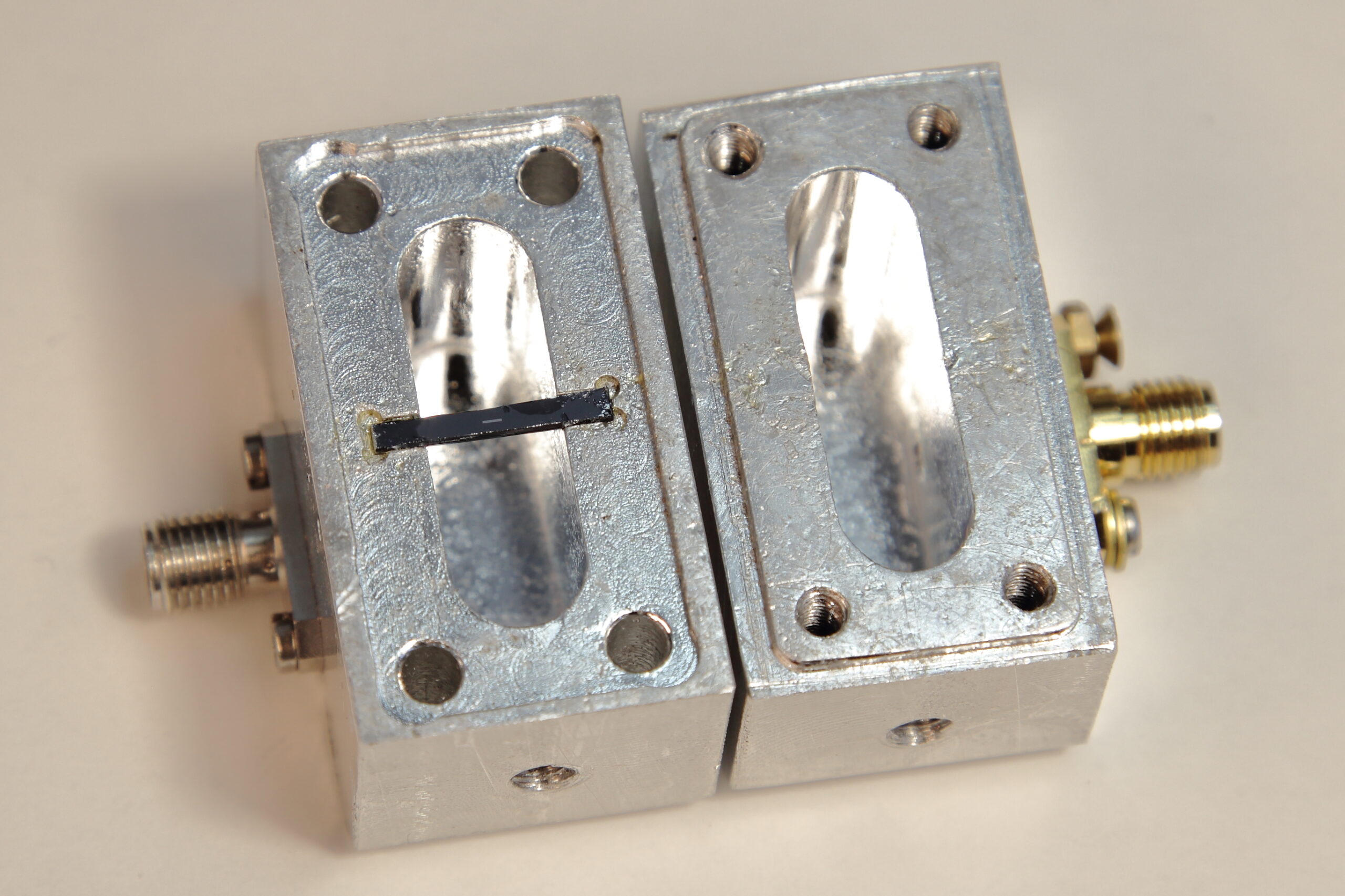
In its 3D configuration – the one tested at Frascati – the qubit is not etched onto a planar chip, as in the 2D architecture, but is placed inside a resonant superconducting cavity, in this case made at INFN Legnaro National Laboratories.
The Italian qubit was cooled to a few thousandths of a degree above absolute zero and placed in a quantum superposition state. Under these conditions, it maintained its coherence for approximately 0.25 microseconds: sufficient time to demonstrate the quantum behaviour of the device and validate the manufacturing process.
“It is the first aluminium transmon qubit made in Italy to show coherent quantum behaviour”, comments Claudio Gatti, head of the COLD laboratory at INFN Frascati National Laboratories. “More than twenty-five years after Nakamura’s demonstration, this result represents an important step forward for Italian research in the field of quantum technologies”.
After numerous cycles of design, fabrication and experimental characterisation, Italy now has a reliable procedure for producing aluminium transmon qubits, thereby joining the – numerous but still limited – group of nations that have independently developed this technology.
“Superconducting qubits are the fundamental elements of quantum circuits, used both to build quantum computers and to develop quantum sensors”, Gatti continues. “For INFN, mastering this technology means being able to develop a new generation of devices dedicated to the study of the fundamental laws of nature: from the search for ultralight dark matter – which makes use of quantum sensors – to quantum simulators for fundamental physics”.
The result was achieved within the framework of the QubIT and Quartet projects of INFN National Scientific Commission V, which grew out of the experience of the previous SIMP (SIngle Microwave Photon) project, dedicated to devices based on Josephson junctions. The activity was also funded by the PNRR ICSC and NQSTI projects and by the ERC Synergy Grant GravNet project conceived by Claudio Gatti, Diego Blas, Dmitry Budker and Matthias Schott.