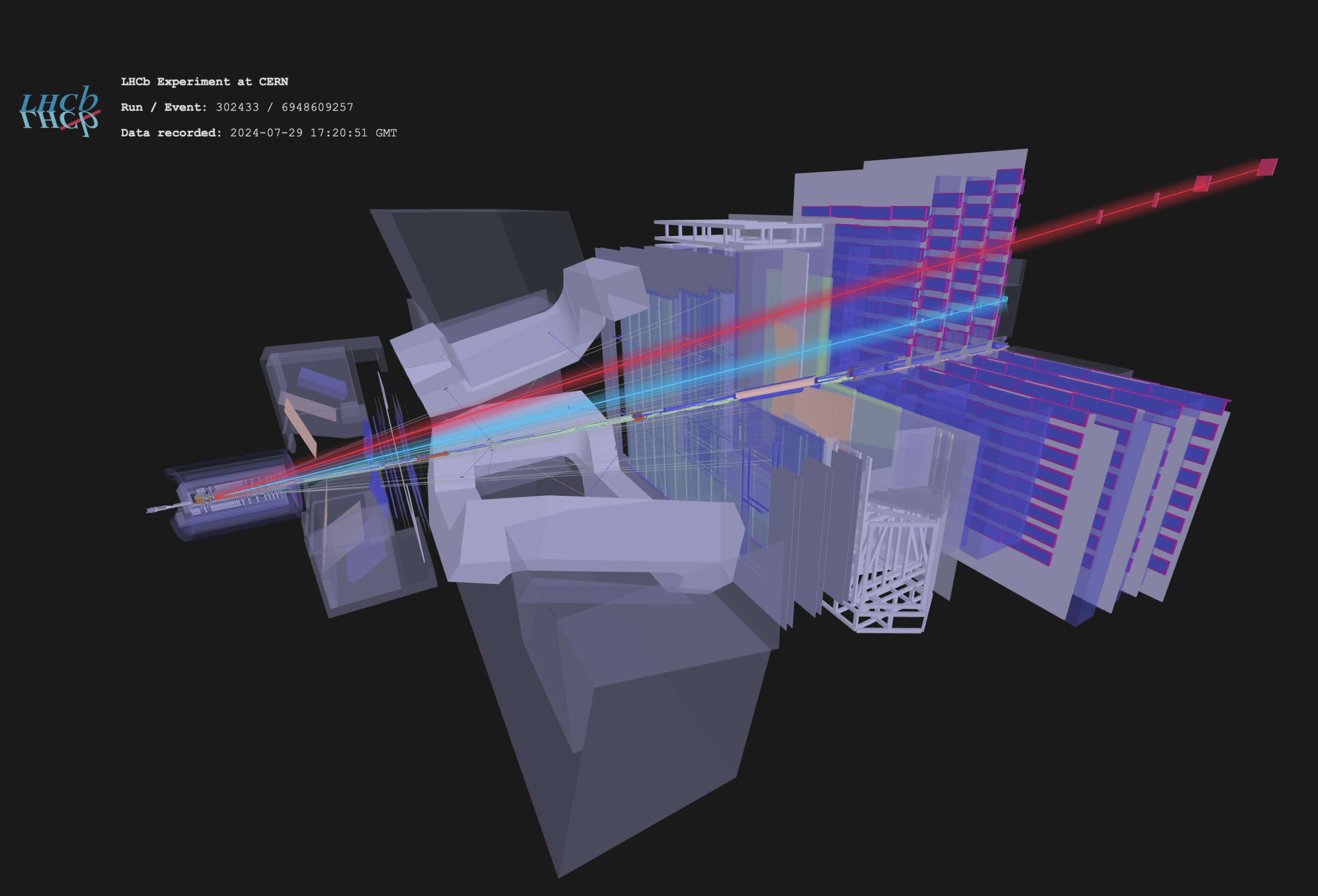
They say good things come to those who wait, and the latest result of the LHCb experiment Collaboration at CERN’s LHC accelerator marks a major milestone in a decades-long search, began in the early 1980s with the CLEO experiment at Cornell (US). As announced at a seminar at CERN today, 3 November 2026, the Collaboration has found evidence of a one-in-ten-billion decay of a beauty particle, becoming the first to do so using data from a single experiment.
The decay is that of a B0 meson, a particle made of a beauty quark and a down antiquark, into a pair of muons. Quantum physics describes how this process is influenced by other particles, meaning that measuring this B⁰ decay precisely could reveal signs of new particles. In general, the more unlikely a decay, the more sensitive it is to the influence of new particles.
The LHCb experiment records hundreds of millions of proton collisions per second, corresponding to a data flux of 4 terabytes per second. This data sample resulted in a signal statistical significance of 3.2 standard deviations, meaning there is only about one-in-1500 chance that this is due to a fluctuation of the background. The result is consistent with the prediction of the Standard Model of particle physics, which once again holds up even for such extraordinarily rare processes.
The data analysis was performed by an international team with a strong Italian presence.
“Physicists have been chasing this decay for more than forty years”, said Marco Santimaria, researcher at the Frascati National Laboratory of INFN who co-led the team. “Extreme precision is required to pick the muons out of the overwhelming background”.
“Seeing evidence for this rare decay is incredibly exciting, opening up new possibilities to probe beyond the direct reach of the LHC”, explained Harry Cliff, LHCb’s Rare Decays Convener and analysis co-lead. “The future LHCb Upgrade will allow us to observe many more of these decays, providing even greater sensitivity to undiscovered particles”.
In 2022, a major upgrade to the LHCb experiment allowed it to collect data at five times the collision rate of its predecessor. INFN and Italian universities have been at the heart of LHCb since its foundations, and were key players in its 2022 transformation, especially in the particle identification and data-acquisition systems.
“The Italian LHCb community is currently working on the upgrade of the experiment, which will increase the data collection rate by a factor of ten in the next decade, opening up exciting prospects to study rare decays and search for new physics”, adds Pasquale Di Nezza, responsible of the Italian LHCb collaboration.