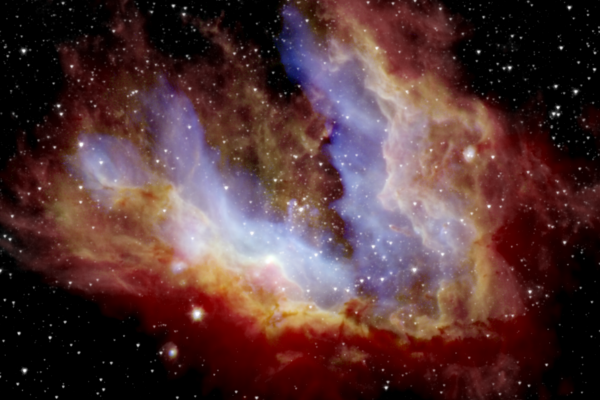
Swan Nebula. Composite infrared image showing hot gas (blue), warm dust (green) and cold dust (red) in the Swan Nebula, together with the stellar background (white). ©NASA/SOFIA/De Buizer/Radomski/Lim; NASA/JPL-Caltech; ESA/Herschel
|
|
|
Listening to the voice of the universe before the stars
|
|
|
“Einstein Telescope will explore the universe through gravitational waves, providing a unique window into cosmic history up to the dark ages, when stars and galaxies have not yet formed. It aims to unravel mysteries of fundamental physics, astrophysics, and cosmology, such as what happens during the merger of neutron stars or at the event horizon of black holes, the nature of dark matter, whether general relativity is modified on cosmological scales, the origins of the universe and its future evolution”. This description, taken from the website einsteintelescope.eu, tells the story of an ambitious and extraordinary scientific project, of an innovative European gravitational-wave observatory capable of taking us back in time and broadening our view of the cosmos and the astrophysical objects that inhabit it. But how will it achieve this? Which technologies will it use? How will it differ from the current interferometers and from the other future gravitational-wave detectors? What will its observational routine be like? What can we expect from the vast and extraordinarily precise body of data that it promises to provide? We put these questions to Marica Branchesi, Professor at the Gran Sasso Science Institute, associate researcher at INFN, member of the Scientific and Technical Committee appointed by the Ministry of Universities and Research to promote Italy’s candidacy to host Einstein Telescope in Sardinia, and already a leading figure — as coordinator between the LIGO/Virgo gravitational-wave interferometer collaboration and the network of electromagnetic telescopes — in one of the defining chapters in the history of gravitational waves: the first detection of gravitational waves produced by the merger of two neutron stars.
|
|
|
|
|
Interview with Marica Branchesi, member of the Scientific and Technical Committee of MUR for the promotion of Italy’s candidacy to host Einstein Telescope, and a leading figure in the first detection of gravitational waves produced by the merger of two neutron stars
|
|
|
Marica Branchesi is a Full Professor of Astrophysics at the Gran Sasso Science Institute, a member of the Accademia dei Lincei and of the Board of Directors of the Italian Space Agency. She is an associate researcher at the National Institute for Nuclear Physics and holds coordinating roles within the Einstein Telescope collaboration. She played a leading role in the discovery of GW170817, which marked the birth of multimessenger astronomy. In 2017, Nature named her one of the ten scientific figures of the year; she has received the Occhialini Prize (2020) and the Into Change Award (2025).
|
|
Just over a year after the historic announcement of 11 February 2016 of the first direct detection of gravitational waves, produced by the merger of two black holes, the LIGO and Virgo collaborations announced, on 16 October 2017, another first observation: that of gravitational waves produced by the merger of two neutron stars. Could you explain why that result was so extraordinary and why it marked the birth of multimessenger astronomy?
It was an exceptional event. We were able to observe the final phase of the inspiral of two neutron stars as they orbited one another until they merged. It was a very long signal, lasting about one minute, much longer than those produced by the merger of binary black hole systems. We therefore immediately realised that this was a different kind of event. What was truly extraordinary was that, at the same time as that signal, the FERMI space telescope also recorded a gamma-ray burst, and the INTEGRAL space telescope did the same. At that point, the most extensive observational campaign in human history began. We observed signals across every band of the electromagnetic spectrum: twelve hours after the gamma-ray signal we observed the optical signal, a few days later the X-ray signal arrived, then the radio signal; and, in essence, observations of the region where the merger took place are still continuing. For the first time, we succeeded in combining signals coming from two “cosmic messengers”, gravitational waves and photons, and this had an enormous scientific impact across many fields of research.
|
|
|
Espacio Fundación Telefónica, C/ Fuencarral 3, Madrid
|
|
|
|
If you can't see the message below correctly, go here
If you receive this newsletter without subscribing, it means that you have been added to a list of recipients who may be interested, or you are an employee or affiliate of INFN.
If you no longer wish to receive this newsletter and are not an employee or affiliate of INFN, you can unsubscribe by sending an email to grafica@lists.infn.it.
Particle Chronicle © 2025 INFN
Newsletter Archive
EDITORIAL BOARD
Coordinator Martina Galli;
Project and contents Martina Bologna, Cecilia Collà Ruvolo, Eleonora Cossi,
Francesca Mazzotta, Antonella Varaschin;
Design and mailing coordinator Francesca Cuicchio; ICT service SSNN INFN
INFN - COMMUNICATIONS OFFICE - Piazza dei Caprettari, 70 - 00186 Roma
www.infn.it - news@lists.infn.it
|
|
|
|