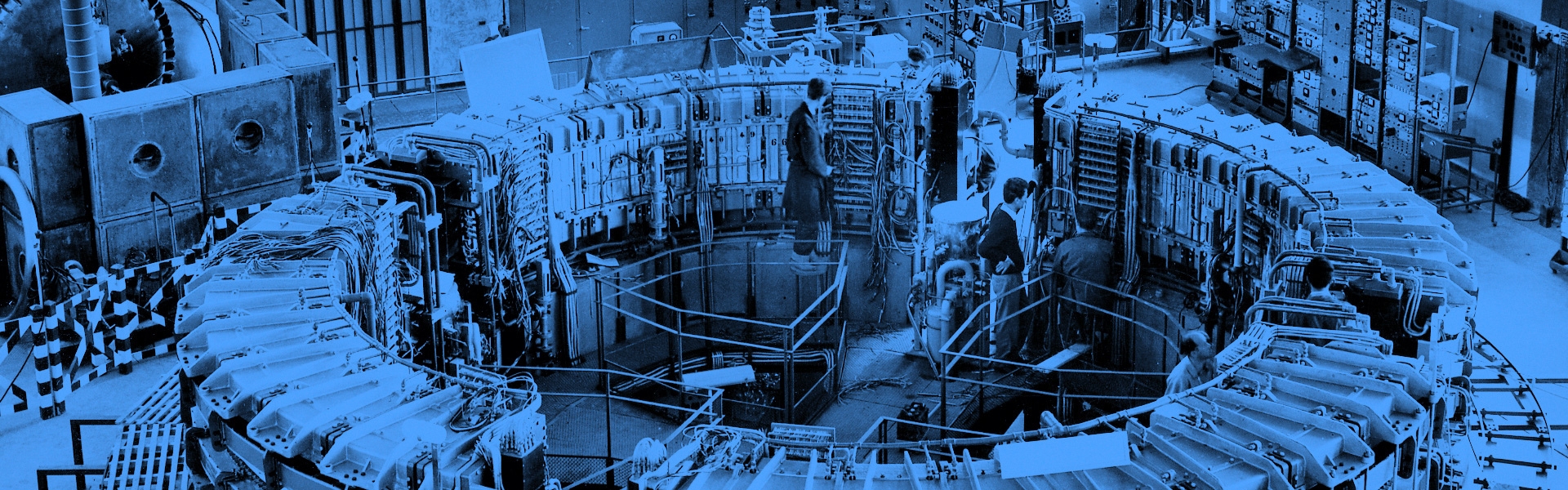
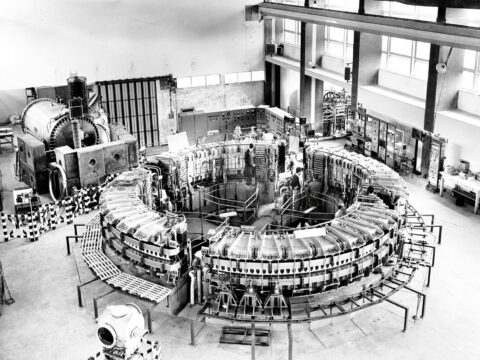
The INFN Frascati National Laboratories’ synchrotron, which began operating in 1959 ©INFN
 n.17 | August 2026
75 years of INFN
What do 75 years amount to? In the context of a human lifetime, millions of decisions made, countless mistakes, hopefully a certain number of successes and satisfactions, dozens of meaningful relationships created or lost. Experiences gained, skills acquired, awareness achieved, versions of oneself left behind. But if we broaden the perspective to an organisation that is today home to more than 8,000 people, what do 75 years amount to? Countless steps forward at the frontier of knowledge, transformations, ideas that have changed our understanding of the universe. Insights, projects, risks, technologies, theories, experiments, results, infrastructures, collaborations; and then researchers, technologists, technicians, administrative staff: all engaged in the great challenges of contemporary physics. For this commemorative issue marking the 75th anniversary of the INFN, the organisation born from the legacy of Enrico Fermi and the Via Panisperna group, we have decided to revisit some pages of its history through the voices of those who have been able to observe its richness and complexity at close hand: Presidents Luciano Maiani, Enzo Iarocci, Fernando Ferroni and Antonio Zoccoli.
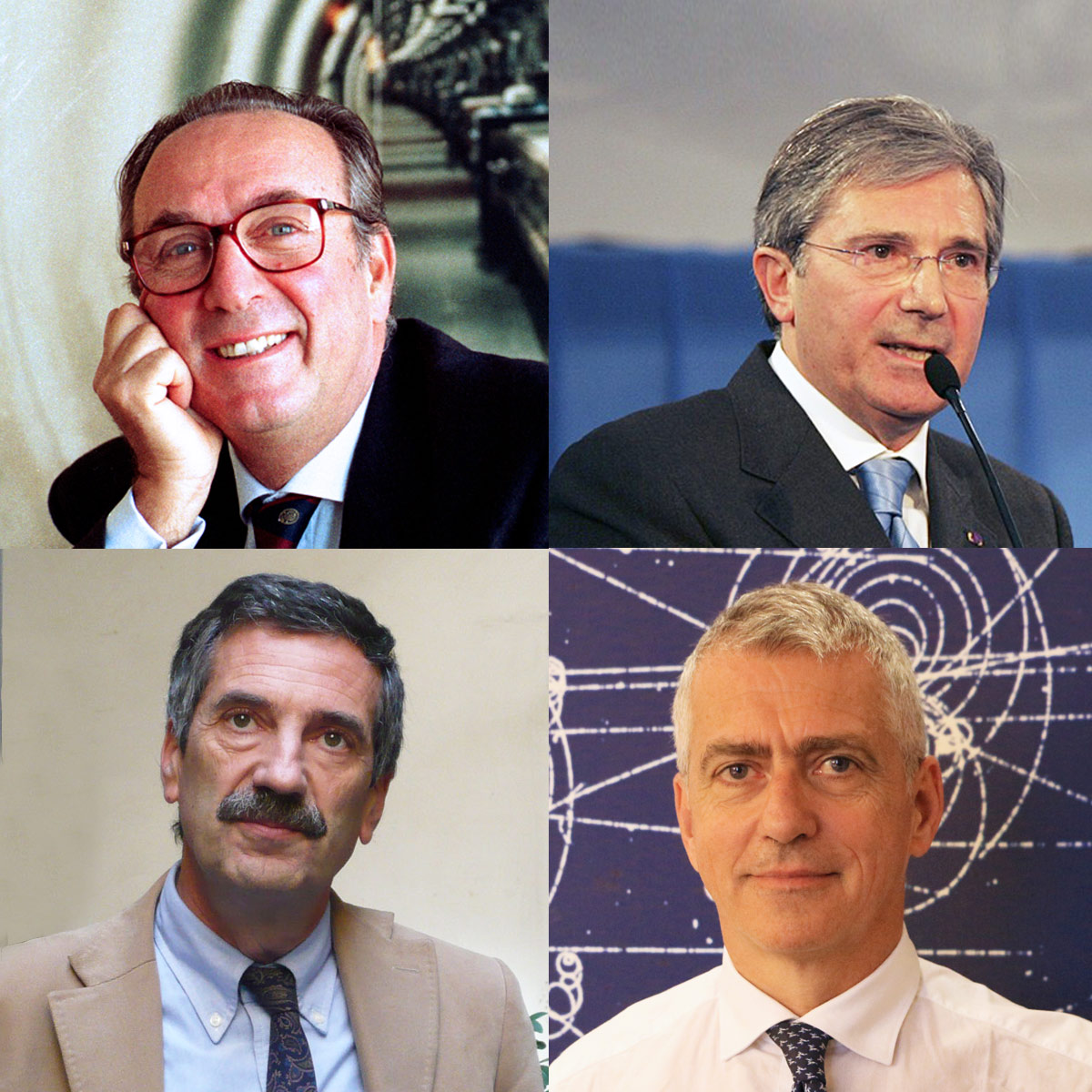
Luciano Maiani was President of INFN from 1993 to 1998, and Director General of CERN from 1999 to 2003, where he led the decisive phase that resulted in the development of the Large Hadron Collider. A theoretical physicist and professor at the University of Rome La Sapienza, he is known for the GIM mechanism, formulated together with Sheldon Glashow and John Iliopoulos, which led to the prediction of the charm quark. From 2008 to 2011 he chaired the National Research Council of Italy.
Enzo Iarocci was President of INFN from 1998 to 2004, and of the CERN Council from 2004 to 2006. Professor of experimental physics at the University of Rome La Sapienza, he directed the INFN Frascati National Laboratories from 1990 to 1996 and was chairman of the Large Hadron Collider Committee at CERN from 1996 to 1998. He made fundamental contributions to particle physics and cosmic radiation physics, developing in the 1970s streamer tubes, detectors used in numerous international experiments.
Fernando Ferroni was President of INFN from 2011 to 2019. Professor of experimental physics at Sapienza University of Rome and at the Gran Sasso Science Institute, he has carried out extensive international research activity, participating in experiments such as CHARM and L3 at CERN and BaBar at SLAC in Stanford. At the INFN Gran Sasso National Laboratories he worked on the CUORE experiment and, thanks to an ERC Advanced Grant, on LUCIFER. He has been a member of numerous scientific committees in the field of high-energy physics and has taken on coordinating roles in international initiatives for the development of Einstein Telescope.
Antonio Zoccoli has been President of INFN since 2019, of CoPER (Council of Presidents of Public Research Organisations) since 2021, and of the ICSC Foundation – National Research Centre in High Performance Computing, Big Data and Quantum Computing since 2022. Professor of experimental physics at the University of Bologna, he has been a member of the INFN Executive Board and Director of the INFN Bologna division. He has taken part in numerous international collaborations, including ATLAS at CERN, which played a leading role in the discovery of the Higgs boson in 2012.
the Presidents of INFN
Interview with INFN Presidents Luciano Maiani (1993-1998), Enzo Iarocci (1998-2004), Fernando Ferroni (2011-2019), Antonio Zoccoli (2019-present)
What message or wish would you like to entrust to INFN, to its community and to the new generations of researchers?
[Luciano Maiani] My opinion is that INFN is a fantastic organisation, one that works and that has a reference community that is motivated and, above all, honest. I have never experienced episodes that called into question the correctness or integrity of INFN, and my wish is that it continues in this way. Difficult times lie ahead, but INFN has broad shoulders, and I believe it can face them successfully.
[Enzo Iarocci] INFN’s structure and organisation are rather diverse. The Institute is made up of large and small structures and scientific programmes are defined through five research lines with a strong bottom-up character, meaning that they are governed from below, to which any special projects activated by management may be added. It is a complex organisation, which in practice gives the Institute an unparalleled capacity for adaptation and evolution, as demonstrated by its history. My wish for the organisation, therefore, is that it preserves this ability to evolve and adapt to the new, in harmony and without shocks for the research community.
[Fernando Ferroni] My wish for INFN and for its community is to succeed in crossing these deserts, one after another, each unfortunately longer and broader than the previous one, while maintaining a high level of interest and the ability to transmit knowledge, and also rethinking the possibility of integrating enormous global-scale projects with smaller-scale projects, at national level or involving only a few countries, in other words, with a dimension that allows people to continue exercising their hands and minds while major projects take shape. There is no point in hiding the transformation under the carpet: we must instead find tools capable of turning an objective problem into an opportunity.
[Antonio Zoccoli] I believe ours is the most beautiful profession in the world. We must be proud to do this work and aware of the importance it has. But above all, we must be able to enjoy ourselves while doing research, to be amazed and to dream of continuously pushing the frontiers of knowledge further forward. This is the wish I make for the organisation, and for the young researchers who will become part of it: to always believe in their own dreams, because only by dreaming can we move forward.
Read the interview Read the interview- September 10-13Miramare Terrace, CamogliINFN at the Camogli Communication Festival 2026INFN at the Camogli Communication Festival 2026
- September 25
Particle Chronicle © 2025 INFN
EDITORIAL BOARD
Coordinator Martina Galli;
Project and contents Martina Bologna, Cecilia Collà Ruvolo, Eleonora Cossi,
Francesca Mazzotta, Antonella Varaschin;
Design and mailing coordinator Francesca Cuicchio; ICT service SSNN INFN