A study carried out through a collaboration between the Institute of Nanoscience of the CNR, the University of Pisa, Sapienza University of Rome, the National Institute for Nuclear Physics and Columbia University has investigated how graphene influences tritium decay, a key process for measuring the neutrino mass. The research, published in Physical Review C, provides valuable guidance for the next generation of experiments dedicated to neutrinos.
Measuring the neutrino mass is one of the most important challenges in contemporary physics. These particles, among the lightest and most elusive in the universe, pass through matter with almost no interaction and hold fundamental information about cosmic evolution.
A new study, resulting from a collaboration between the Institute of Nanoscience of the National Research Council (CNR Nano), the University of Pisa, Sapienza University of Rome, the National Institute for Nuclear Physics (INFN) and Columbia University within the framework of the PTOLEMY project, analyses in detail the role of a graphene substrate during tritium decay, one of the processes underpinning neutrino mass measurements. The work has been published in the journal Physical Review C.
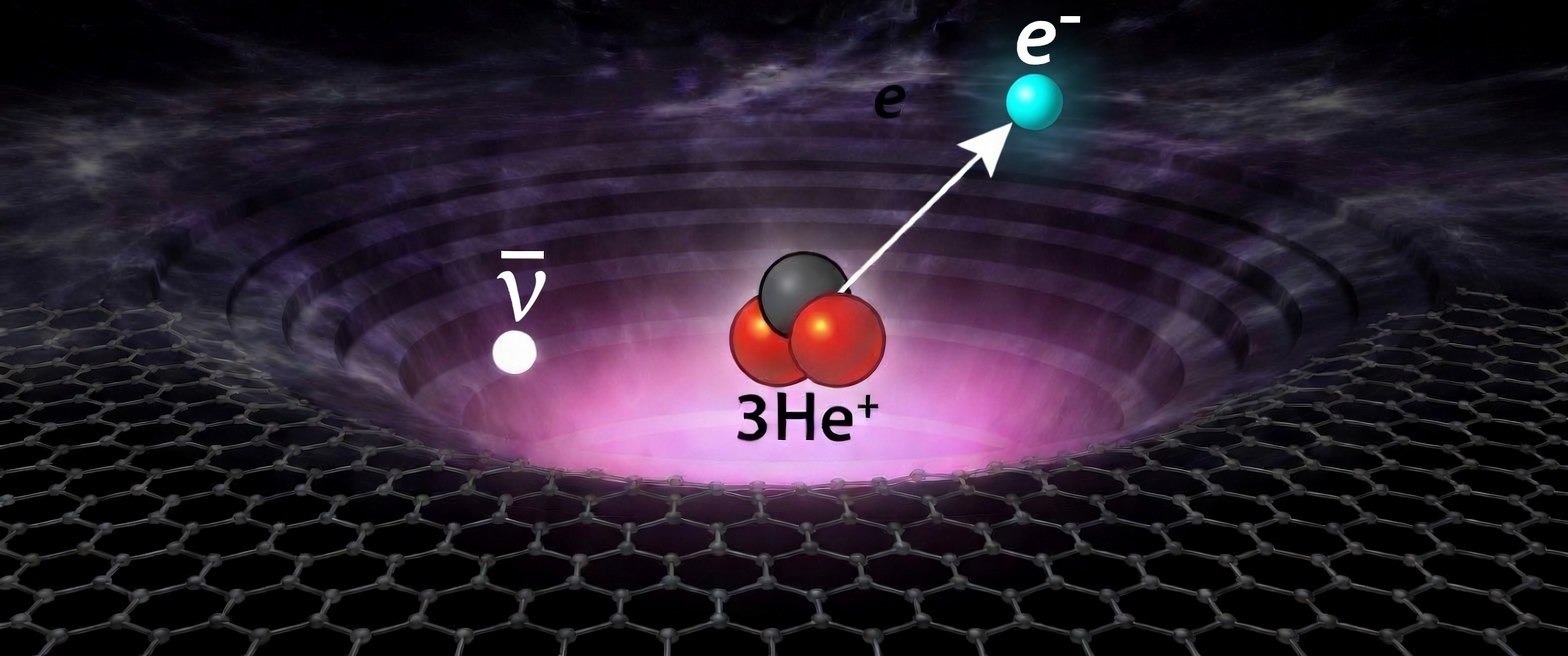
Tritium is a radioactive isotope of hydrogen that decays by emitting an electron and a neutrino. Precise measurement of the energy of the emitted electrons makes it possible to derive indirect information about the neutrino mass, but this approach is now close to its experimental limits.
To improve the sensitivity of these measurements, the PTOLEMY project aims to use tritium adsorbed onto graphene, a two-dimensional material consisting of a single layer of carbon atoms. Under these conditions, interactions between the tritium and the graphene substrate can modify the energy of the emitted electrons, introducing “solid-state effects”.
“Within a material, unlike in a vacuum, electronic and vibrational excitations alter the energy spectrum of the emitted electrons, which is precisely the fundamental signal used to determine the neutrino mass. It is therefore essential to quantify these effects with great precision in order to interpret the experimental data correctly”, explains Valentina Tozzini of CNR Nano, author of the study together with Andrea Casale of Columbia University, Angelo Esposito of Sapienza University of Rome and INFN, and Guido Menichetti of the University of Pisa.
To address this problem, the researchers developed a theoretical approach that combines simulations of the electronic structure of graphene – based on a non-conventional application of a computational method known as Density Functional Theory – with the quantum description of nuclear decay, making it possible to reproduce realistically the conditions in which tritium is found in experimental devices. This new theoretical approach has, for the first time, enabled the calculation of the energy distribution of electrons while including both nuclear and solid-state effects.
“This result perfectly defines the multidisciplinary nature of the PTOLEMY project. It is a project that spans cosmology, particle physics, solid-state physics and theoretical physics. In each of these fields, the project offers major opportunities to achieve results at the frontiers of knowledge”, emphasises Marcello Messina, researcher at the INFN Gran Sasso National Laboratories, technical coordinator and one of the founders of PTOLEMY.
“This type of analysis makes it possible to gain a better understanding of the effect of the material on the decay signal, making it possible to distinguish details that have so far been difficult to isolate in the energy distribution of the electrons”, the researchers explain. “It also provides guidance for the design of the optimal medium for neutrino mass studies and, in the longer term, for the detection of cosmic background neutrinos by exploiting the process of neutrino capture by tritium”.
The study explores a highly interdisciplinary field at the interface between condensed matter physics, nuclear physics and cosmology, and highlights how two-dimensional materials such as graphene are not only advanced technological platforms but also tools for addressing fundamental problems in contemporary physics.