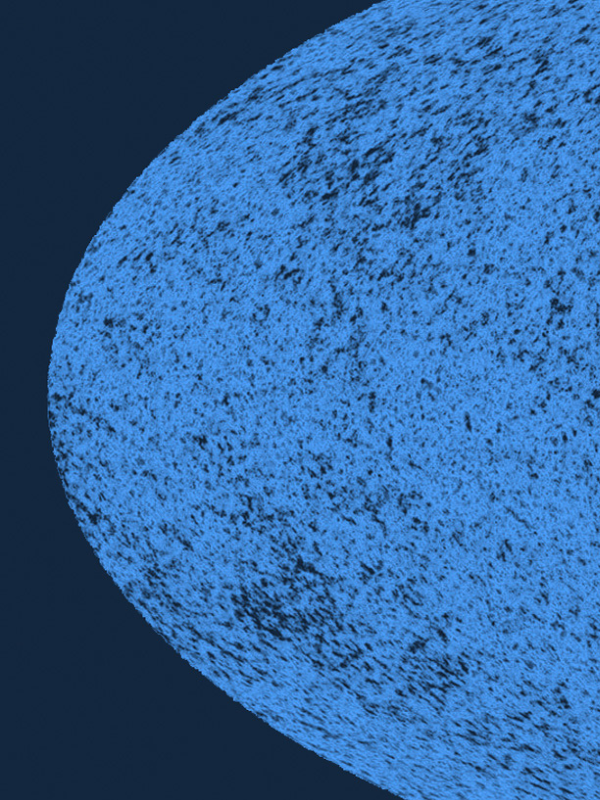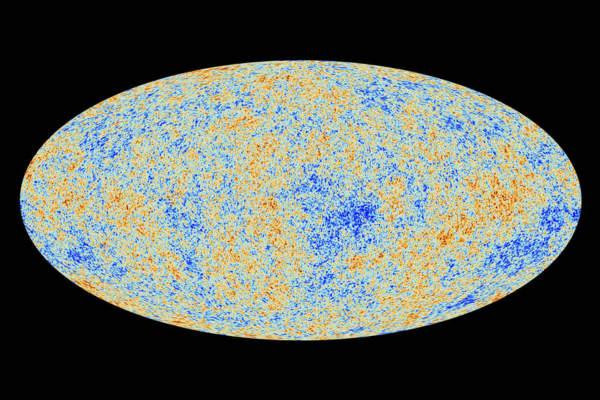
Map of the anisotropies of the cosmic microwave background seen from ESA's Planck satellite. (©ESA and Planck Collaboration)
|
|
|
From quantum vacuum
to cosmic darkness:
history of life of the universe
|
|
|
In the 1920s, the astronomer Edwin Hubble, observing galaxies, realised that they were moving away from us, and that the more distant they were the faster they seemed to move away, as if the entire fabric of space was stretching. His discovery revolutionised the cosmological view of the time (which held that the universe was static and eternal), demonstrating that in reality the universe is in perpetual expansion and must have had an origin in which it was smaller, denser and hotter. Then, in the 1960s, Robert Wilson and Arno Penzias, while experimenting with a radio antenna for satellite communications, accidentally discovered cosmic background radiation, the faint fossil echo emitted when the universe was just 380,000 years old, which provides us an image of the infant universe and allows us to measure its very first inhomogeneities, the seeds from which galaxies and clusters would be born. Several decades later, in 1998, the teams led by Saul Perlmutter, Brian Schmidt and Adam Riess, studying distant supernovae, noticed that their brightness was weaker than expected and deduced that the universe was not only expanding but doing so at an ever-increasing rate. One experimental measurement after another, we have managed to trace the history of the universe, discriminating between different theoretical proposals, without however picturing the complete story. Several experimental clues suggest the need to expand the current theoretical framework, still crowded with questions and hypotheses, and we have tried to navigate it with Antonio Riotto, theoretical physicist awarded the 2018 Buchalter Cosmology Prize for his innovative contributions to cosmology.
|
|
|
|
|
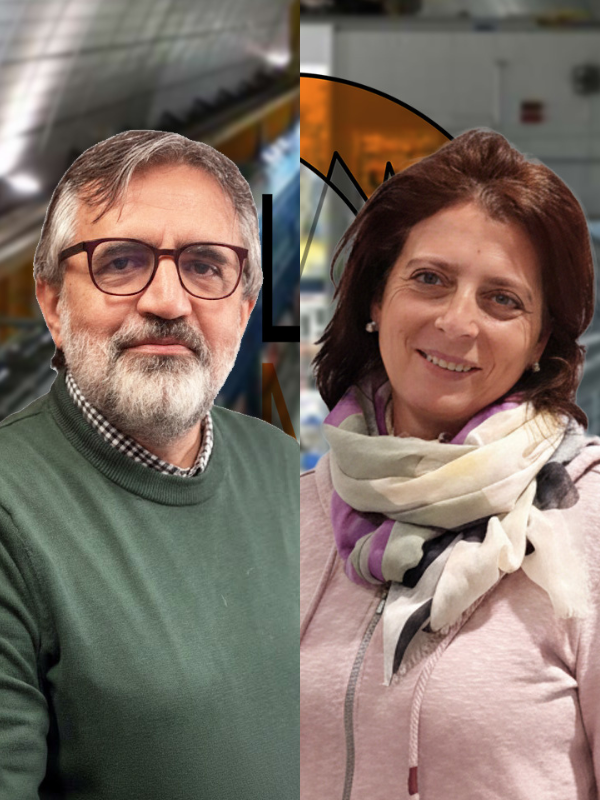
Interview with Antonio Riotto, Professor of Theoretical Physics and President of the Physics Section at the University of Geneva, awarded the 2018 Buchalter Cosmology Prize for his innovative contributions to cosmology
|
|
|
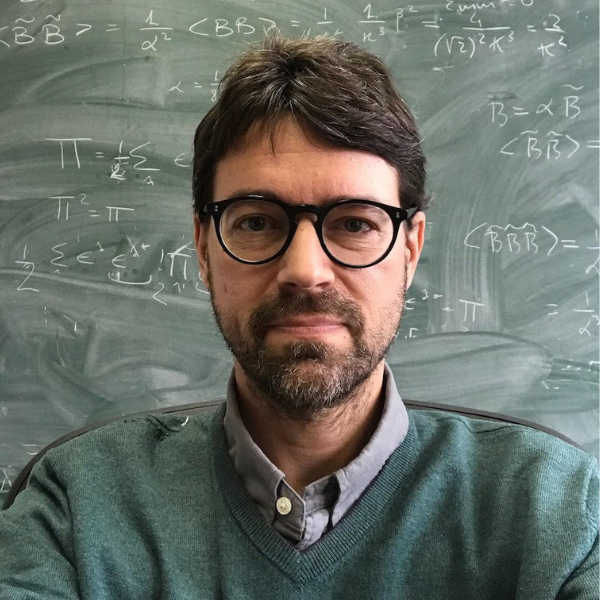
Antonio Riotto is currently Professor of Theoretical Physics and President of the Physics Section at the University of Geneva. He works in the fields of cosmology, black hole physics and gravitational waves. In the past, he was postdoctoral researcher in the cosmology group at Fermilab in Chicago, CERN fellow in Geneva, research director at INFN and staff member in the theoretical division at CERN. In 2018, he was awarded the Buchalter Cosmology Prize for his innovative contributions to cosmology.
|
|
How did the universe originate?
We do not know for certain, but there are several hypotheses. The most widely accepted is that about 14 billion years ago the universe emerged from nothing, as the result of a quantum fluctuation of the vacuum – a concept we will come back to later – which would have produced an energy variation sufficient to trigger cosmic expansion. Alternatively, another possibility is that the universe is eternal, that it has no origin, and that what we perceive as its beginning by tracing events backwards in time, is in fact merely the end of another epoch, of a universe that expanded and then contracted, only to expand again afterwards. Unfortunately, none of these hypotheses is experimentally testable. According to the modern cosmological view, immediately after its initial phase, the universe underwent a period of extremely rapid expansion, known as inflation, which increased its volume exponentially within a fraction of a second, erasing any pre-existing information. We can no longer recover the content of the universe prior to inflation; for this reason, today the term “big bang” is used – somewhat imprecisely – to refer to the transitional phase between inflation and the moment when the universe began to fill with a thermal bath, the so-called primordial soup.
|
|
|
|
|
|
INTERNATIONAL COLLABORATIONS
|
|
|
|
|
|
|
|
INTERNATIONAL COLLABORATIONS
|
|
|
|
|
Palazzo Turchi di Bagno, Ferrara
|
|
Giovanni Poleni Museum, Padua
|
|
|
|
If you can't see the message below correctly, go here
If you receive this newsletter without subscribing, it means that you have been added to a list of recipients who may be interested, or you are an employee or affiliate of INFN.
If you no longer wish to receive this newsletter and are not an employee or affiliate of INFN, you can unsubscribe by sending an email to grafica@lists.infn.it.
Particle Chronicle © 2025 INFN
Newsletter Archive
EDITORIAL BOARD
Coordinator Martina Galli;
Project and contents Martina Bologna, Cecilia Collà Ruvolo, Eleonora Cossi,
Francesca Mazzotta, Antonella Varaschin;
Design and mailing coordinator Francesca Cuicchio; ICT service SSNN INFN
INFN - COMMUNICATIONS OFFICE - Piazza dei Caprettari, 70 - 00186 Roma
www.infn.it - news@lists.infn.it
|
|
|
|