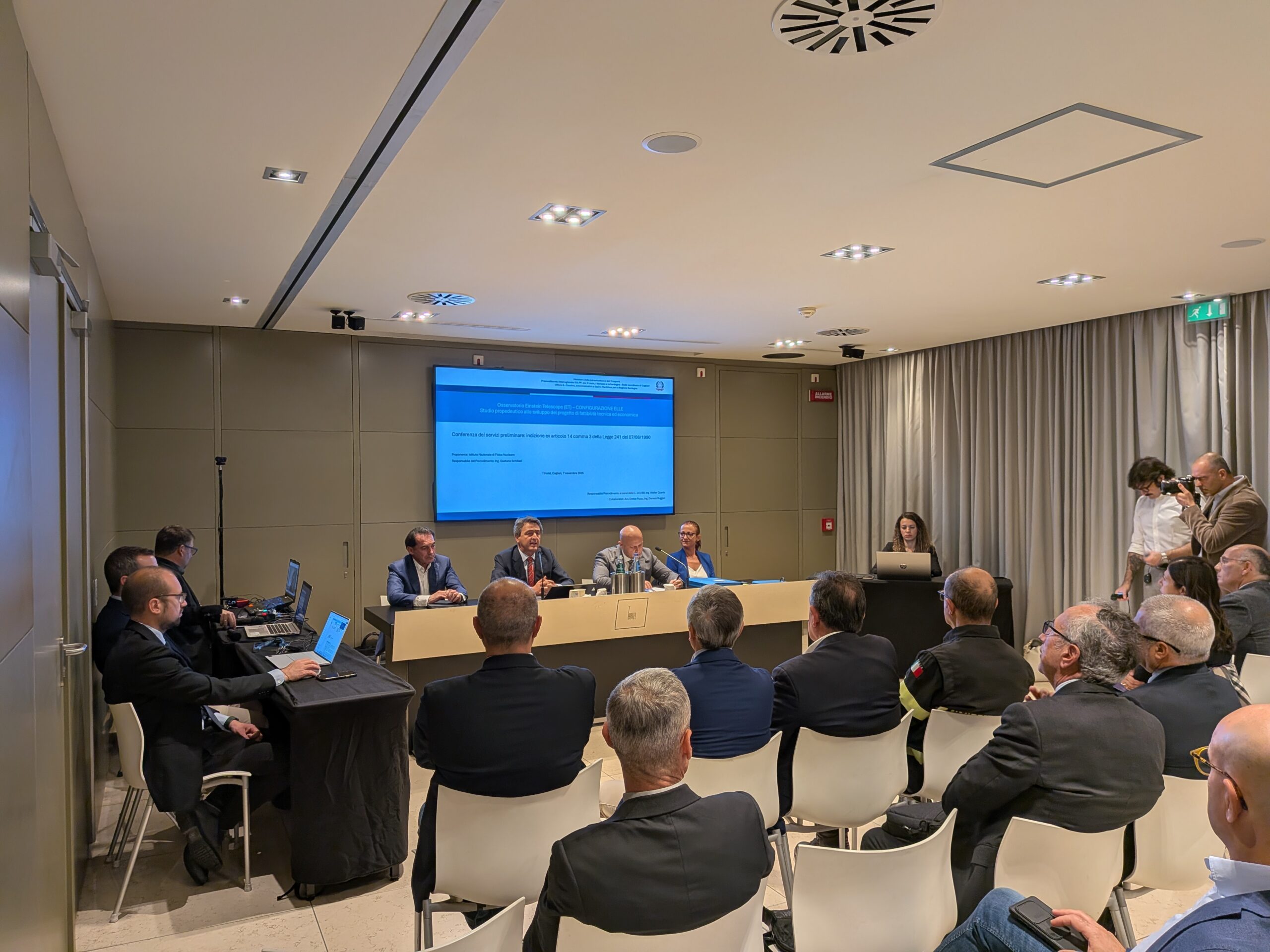
The Multilateral International DONES Agreement (MIDA) was signed today, November 21, in Madrid, at the headquarters of the Spanish Ministry of Science, Innovation and Universities, and was also signed by Italy through INFN. The aim of the agreement is to strengthen the collaboration, establishing a comprehensive framework for decision-making, resource allocation and programme management. Representatives from 17 countries took part in the signing ceremony, together with delegates from the European Commission and international bodies involved in fusion energy (EURATOM/EUROfusion/F4E). In particular, attending were the INFN Vice-President Diego Bettoni, the Directors of IFMIF-DONES España Ángel Ibarra, of F4E Fusion for Energy Marc Lachaise and of the Croatian Ruđer Bošković Institute David M. Smith, and the President of the Japanese institute QST Koyasu Shigeo. The agreement document also formally certifies the participation of the signatory institutions as Parties to the DONES Programme. At the same time as the signing of the MIDA Agreement, the meeting of the DONES Steering Committee, which oversees the development of the programme, was held. During the meeting, the updates to the 2025 Programme Plan were evaluated and approved, further international contributions were discussed, including those from Italy with ENEA and from Germany, and finally information was provided by other potential international contributors, such as Slovenia and France, interested in supporting the DONES programme.
“The signing of the Multilateral International DONES Agreement represents a fundamental milestone for the development of fusion energy. It strengthens collaboration between countries worldwide and highlights the multilateral nature of science and technology. Italy is proud to participate in this project through the INFN and ENEA”, comments Diego Bettoni, INFN Vice-President. “The participation of the INFN, in continuity with other projects such as IFMIF-EVEDA and ESS, enhances our research infrastructures, as well as the Institute’s investments and expertise in the field of particle accelerators, and reaffirms our commitment to applying our technologies in sectors of interest for society”, concludes Bettoni.
The mission of the DONES programme is to develop a database on the effects of neutron irradiation on materials, similar to that produced in fusion reactions, essential for the design and construction of future fusion reactors. One of the main challenges in achieving fusion energy is indeed the development of neutron-resistant materials capable of withstanding a neutron flux of up to 14 MeV while maintaining good physical and structural properties for prolonged periods. Currently, engineering data, properties and standards are based on neutron irradiation campaigns from fission and do not fully cover neutron energies, temperatures and other operating conditions. To test materials and advance this knowledge, it is necessary to develop a neutron source with a spectrum similar to that of fusion: this source, capable of reproducing the irradiation conditions of future reactors, is IFMIF-DONES (International Fusion Materials Irradiation Facility – Demo Oriented NEutron Source).
The IFMIF-DONES scientific infrastructure is the central element of the DONES Programme and consists of a particle accelerator that will produce a beam of deuterons (D+) with a current of 125 mA and an energy of 40 MeV, directed onto a 25 mm thick liquid lithium target flowing at 15 m/s. The reactions in the lithium target, triggered by the impact of the deuteron beam, will generate a high-energy neutron flux with sufficient intensity to simulate, in an accelerated manner, the damage that neutrons would produce in a fusion reactor. This neutron flux will be used to irradiate material samples placed immediately behind the lithium target in the test modules of the irradiation area.
IFMIF-DONES is a scientific infrastructure unique in the world, in which materials destined for future fusion power plants will be tested, validated and qualified for DEMO (an experimental demonstrative reactor). The European Strategy Forum on Research Infrastructures (ESFRI) included IFMIF-DONES in the 2018 Roadmap as a project in the energy area, confirming it also in the 2021 Roadmap. IFMIF-DONES thus becomes one of ESFRI’s key infrastructures, establishing itself as a strategic facility of great relevance for the European scientific community engaged in research and innovation in the energy sector. In addition to its importance for the development of fusion as an energy source, it will also be of great relevance in other fields of research and knowledge that will benefit from its technology, such as medicine, particle physics, fundamental physics studies and industry. All this in a planet increasingly oriented towards sustainable development and the use of clean, safe and efficient energy.