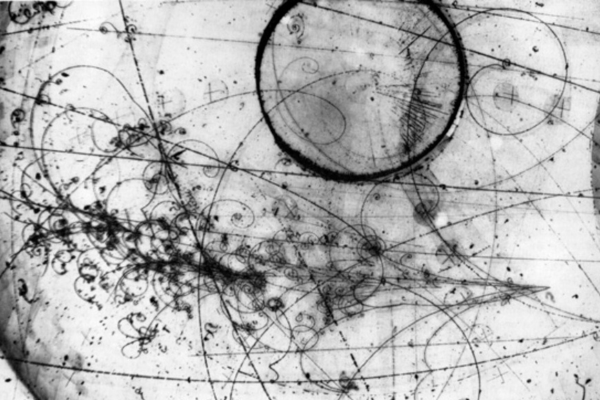
Image of neutrino interaction in the Fermilab bubble chamber taken in April 1976 ©Fermilab
|
|
|
From the secrets
of neutrinos to the mysteries of the universe: in conversation with Nobel laureates Kajita and McDonald
|
|
|
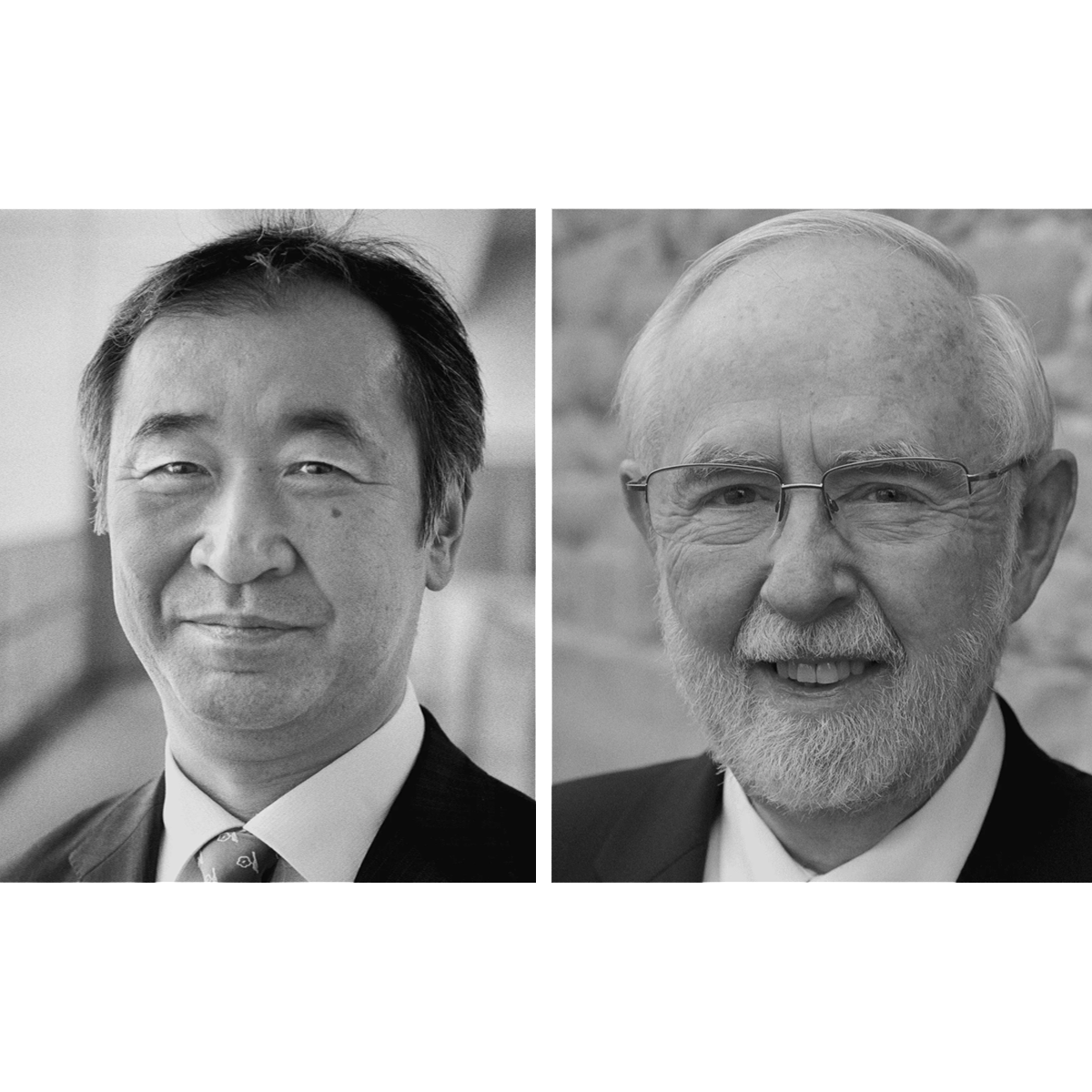
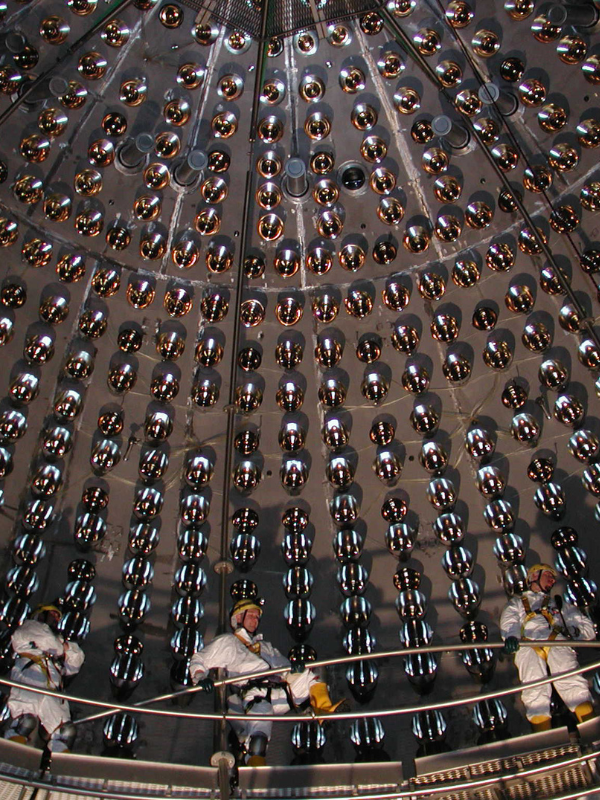
It is five o’clock in the morning and there is a phone ringing in Canada: a man wakes with a start, listens in astonishment, hangs up and, overcome with emotion, hugs his wife. In Japan it is already late afternoon, and another man, busy reading his mail, is about to receive a similar call that will leave him speechless. They are Arthur McDonald and Takaaki Kajita, the year is 2015, and the two have just been informed that the Royal Swedish Academy of Sciences has awarded them the Nobel Prize in Physics “for the discovery of neutrino oscillations, which shows that neutrinos have mass”. Kajita, who was in charge of data analysis of the atmospheric neutrino detector Super-Kamiokande in Japan, had announced in 1998 the discovery that neutrinos coming from the atmosphere change identity during their journey to the detector. While McDonald, head of the heavy-water counterpart of the Japanese detector, the Sudbury Neutrino Observatory in Canada, in 2000 had demonstrated that neutrinos coming from the Sun do not disappear during their journey to the Earth, but arrive with a different identity. In other words, both experiments had proved that neutrinos change identity, or rather change flavour – a metamorphosis known as oscillation possible only if neutrinos possess mass –, and had thus opened up a new question for the Standard Model, which instead held them to be massless. Today, more than ten years later, we interviewed McDonald and Kajita to look back on that sensational discovery, and to look ahead to the next ones through their eyes.
|
|
|
|
|
Takaaki Kajita and Arthur McDonald
|
Interview with Takaaki Kajita and Arthur McDonald, winners of the Nobel Prize in Physics 2015 “for the discovery of neutrino oscillations, which shows that neutrinos have mass”
|
|
|
Takaaki Kajita is Professor at the Institute for Cosmic Ray Research (ICRR) at the University of Tokyo and led the data analysis of the Super-Kamiokande experiment, showing that atmospheric neutrinos change flavour, and thus proving their mass. For this discovery, he received the Nobel Prize in Physics in 2015. Today, he is one of the leaders of the KAGRA experiment for the detection of gravitational waves and contributes to the development of multi-messenger astronomy.
Arthur McDonald is Professor Emeritus at Queen’s University in Kingston, Canada. He led the Sudbury Neutrino Observatory (SNO), demonstrating that solar neutrinos change flavour and have mass. For this discovery, he received the Nobel Prize in Physics in 2015. Today, he is actively involved in the development of large underground experiments for the search for dark matter, particularly in the DarkSide collaboration at the INFN’s Gran Sasso National Laboratories.
|
|
Professor McDonald, you were one of the sixteen members who started the SNO (Sudbury Neutrino Observatory) collaboration: what made you believe in the project?
[AM] At the time we started the project, there was a big puzzle in physics, the so-called solar neutrino deficit: electron neutrinos produced by the nuclear reactions occurring in the Sun had been detected on Earth, but in numbers far lower than those predicted by highly sophisticated theories. To solve this puzzle, we had to determine the total number of neutrinos produced in the Sun that reach the Earth. And to do so, we used heavy water as the target in our experiment – water molecules in which the hydrogen has one extra neutron compared with the ordinary –, and observed that the total number of solar neutrinos reaching Earth – given by the sum of the three types of neutrinos, electron, muon, and tau – corresponds exactly to that predicted by theoretical calculations. However, electron neutrinos were found to be only about one third of the total, indicating that they had changed to one of the other types. In this way we discovered the phenomenon of neutrino oscillation, the process by which neutrinos, during their journey from the core of Sun to the Earth, transform from one type to another or, in technical terms, they change flavour: from electron to muon and tau.
Professor Kajita, where does your interest in neutrinos, and particularly in atmospheric neutrinos, originate?
[TK] I was a member of the Kamiokande experiment in Japan, which searched for proton decay. And the background in the search for proton decay consists of neutrinos produced by the interactions of cosmic rays with the atmosphere, known as atmospheric neutrinos. It was therefore essential to study them: my initial motivation arose in this way, from a necessity. Then Kamiokande, and also the Irvine-Michigan-Brookhaven experiment in the United States provided very promising hints of something new, and we built Super-Kamiokande, the successor to Kamiokande. From the beginning, we knew that we might find something extremely interesting by studying atmospheric neutrinos, and we really concentrated on their analysis. We worked in two teams: one on site, essentially Japanese, and one remotely, essentially US. But soon, by comparing the two separate analyses, we realised that we would work more effectively as a single group, and at that point, by joining forces, we committed ourselves fully to understanding every detail, and we succeeded in obtaining a significant result just two years after the experiment began.
|
|
|
|
|
Fortezza da Basso, Firenze Fiera
|
|
|
|
If you can't see the message below correctly, go here
If you receive this newsletter without subscribing, it means that you have been added to a list of recipients who may be interested, or you are an employee or affiliate of INFN.
If you no longer wish to receive this newsletter and are not an employee or affiliate of INFN, you can unsubscribe by sending an email to grafica@lists.infn.it.
Particle Chronicle © 2025 INFN
Newsletter Archive
EDITORIAL BOARD
Coordinator Martina Galli;
Project and contents Martina Bologna, Cecilia Collà Ruvolo, Eleonora Cossi,
Francesca Mazzotta, Antonella Varaschin;
Design and mailing coordinator Francesca Cuicchio; ICT service SSNN INFN
INFN - COMMUNICATIONS OFFICE - Piazza dei Caprettari, 70 - 00186 Roma
www.infn.it - news@lists.infn.it
|
|
|
|