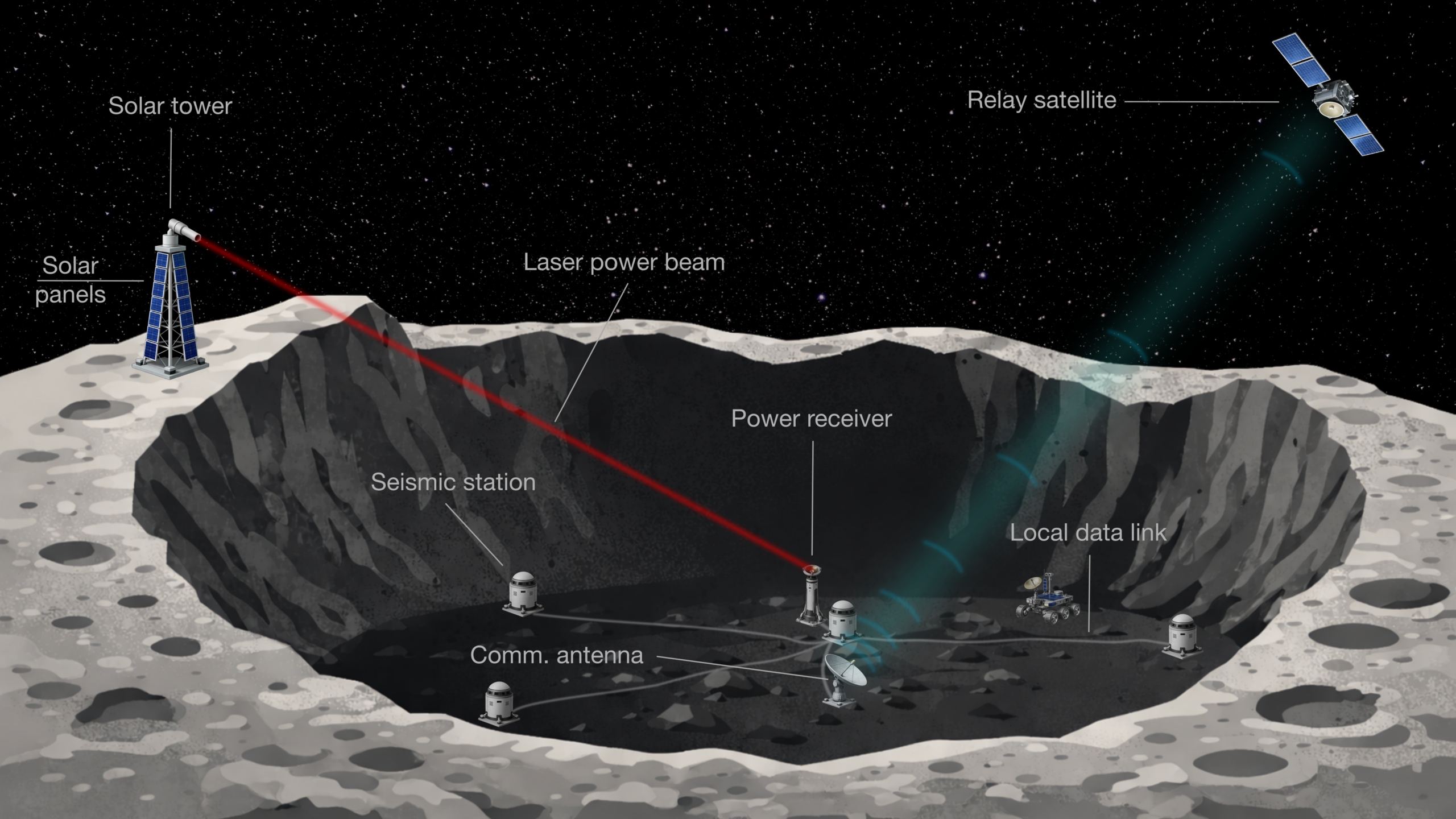
A national consortium, led by the Gran Sasso Science Institute (GSSI), which includes the University of Camerino, the National Institute for Astrophysics (INAF), the National Institute for Geophysics and Volcanology (INGV), and the National Institute for Nuclear Physics (INFN), will carry out the preparatory studies for the Lunar Gravitational-wave Antenna (LGWA). The scientific collaboration agreement, signed by the institutions last 21 January, marks a fundamental step forward for this ambitious project aimed at the search for gravitational waves from the Moon. LGWA had been selected in 2023 by the European Space Agency (ESA) in the Reserve Pool of Science Activities for the Moon, receiving the highest evaluation among all the proposed projects. Following this success, the Italian Space Agency (ASI) chose to fund the preparatory studies for the projects selected by ESA under Italian leadership.
The funded activities are currently focused on the technological development of the lunar payload (GSSI, University of Camerino, INFN and INAF), and subsequently on specific work packages related to studies of lunar soil characterisation with the production of a synthetic model of seismic wave propagation (INGV) and gravitational-wave science (INAF). The current funding will support the first two years of preparatory studies, with the possibility of extending the activities beyond 2027.
The idea of making the Moon itself part of a gravitational detector by exploiting its intrinsic response to gravitational waves was at the basis of the work of the American physicist Joseph Weber in the 1970s. The US scientist contributed to the construction of the Lunar Surface Gravimeter, a gravimeter installed on the lunar surface in 1972 during the Apollo 17 mission. The objective was to observe lunar vibrations caused by gravitational waves, but a design error in the instrument made it impossible to continue the experiment.
More than fifty years later, LGWA, with the creation of a lunar antenna for gravitational waves, could mark a turning point and open up new scenarios for astrophysics and beyond. The instrument would be capable of detecting signals from compact binary systems ranging from galactic white dwarfs to enormous black holes at cosmological distances, and could also gather data on the internal structure of our natural satellite and shed light on the mechanisms of its moonquakes.