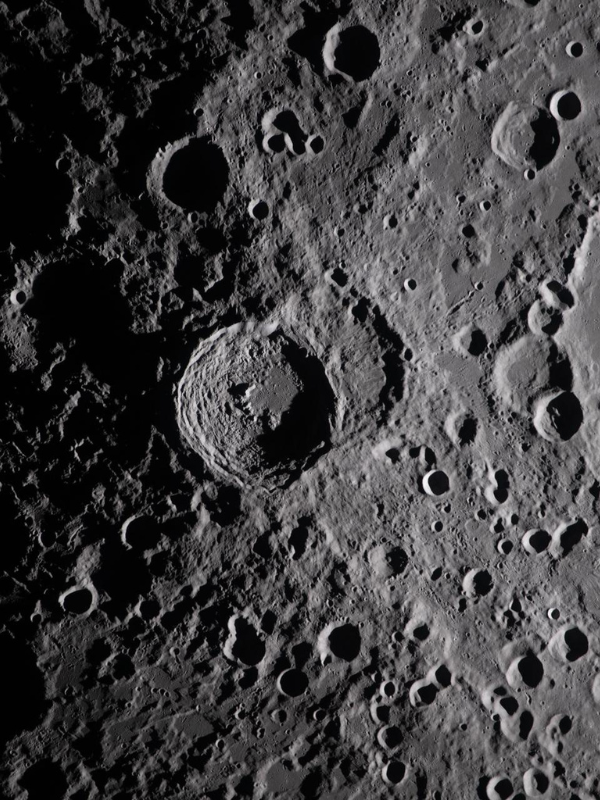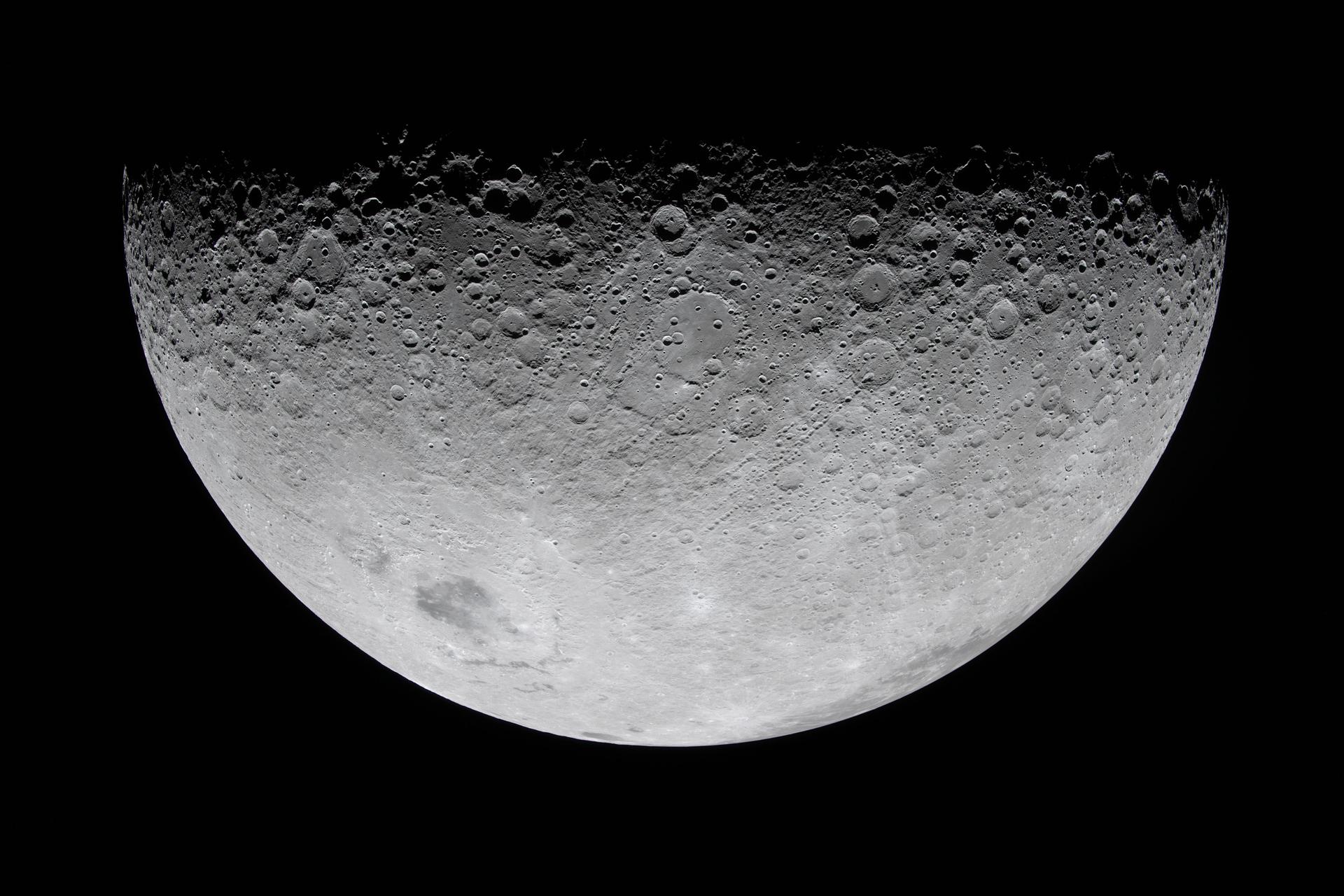
Image taken by the crew of NASA’s Artemis II mission, on 6 April 2026, during the flyby of the Moon. ©NASA
|
|
|
Dear Moon, I know that you can speak and answer questions like a human being, for I have heard so from many of the poets. Besides, our children say you have really a mouth, nose, and eyes like everyone else, and that they see them with their own eyes, which at their time of life ought to be very sharp. […] Is it true that the Arcadians came into the world before you? Are your women, or whatever I should call them, oviparous, and did one of their eggs fall down to us, once upon a time? Are you perforated like a bead, as a modern philosopher believes? Are you made of green cheese, as some English say? Is it true that Mahomet one fine night cut you in two like a watermelon, and that a good piece of your body fell into his cloak? [1]
In 1827, Giacomo Leopardi published his Essays and Dialogues and, in the Dialogue between the Earth and the Moon, entrusted the Earth with the arduous task of investigating the true nature of the celestial body closest to us. The Earth, however, did not have highly advanced instruments at its disposal, but rather popular beliefs and outlandish theories, myths portraying the Moon as anthropomorphic, Arabic legends, scientific speculations, and even proverbs, with the result that the investigation ends with the same aura of mystery with which it had begun. That mystery, in a different form, still endures today, nearly two hundred years after the publication of Leopardi’s text. Despite sophisticated technologies and refined instruments, numerous questions continue to crowd the minds of scientists about the nature of our natural satellite, and it seems that it has begun again the race to reach the lunar surface that had already kept the world glued to television screens in the 1960s. April, in fact, opened with the launch of NASA’s Space Launch System rocket, which carried four astronauts beyond Earth orbit, on a flyby of the Moon, and into the Pacific Ocean off San Diego, California, for the final splashdown. This was the second stage of the Artemis mission, a five-phase programme aimed at returning humans to the lunar surface, with the goal of studying, understanding, but also living and working there, in preparation for long-duration missions into deep space. A new chapter of space exploration has just begun, and we asked James Carpenter, Lead for Moon and Mars Science and Moon Utilisation Manager for the European Space Agency’s Directorate of Human and Robotic Exploration, to tell us about its challenges, opportunities and prospects.
[1] Giacomo Leopardi, Essays and Dialogues, translated by Charles Edwardes, London, Trübner & Co. Ludgate Hill, 1882.
|
|
|
|
|
Interview with James Carpenter, Lead for Moon and Mars Science and Moon Utilisation Manager for the European Space Agency’s Directorate of Human and Robotic Exploration
|
|
|
James Carpenter is Lead for Moon and Mars Science and Moon Utilisation Manager for the European Space Agency (ESA)’s Directorate of Human and Robotic Exploration. He is a physicist with a background in instrumentation for space astrophysics and planetary science. While at ESA, he has worked on lunar and Martian mission activities and has led the development for the scientific strategy for the Moon and space resources. In his current role, he leads the establishment of new research activities for the Moon and Mars for the decade to come and beyond.
|
|
Why are we returning to the Moon?
Well, there’s a lot of different answers to that. From a scientific perspective, we are witnessing a renewed interest in the Moon. Despite the period of low activity that followed the Apollo missions, the samples collected during those missions have provided an extremely rich body of information, still under examination today, which has left us with more questions than answers. At the same time, the orbital missions around the Moon in recent years have given us a global view that we didn’t have before. And the combination of this evidence (the global view and the returned samples) has shown us that the Moon is much more diverse than we had understood. It is, in fact, a “recorder” of the whole history of the Solar System, including the era of the great impacts. When we look at it, we see very large craters that formed at the same time as the Earth and the whole inner Solar System were taking shape, which is also around the time to which the first observed traces of potential life on our planet date back. On Earth, however, the geological record of that era is pretty much lost, and the only place where it can be read is the Moon. In its volcanic materials and on its surface, we have captured chemical traces of everything that has happened since its formation, over billions of years, so it also serves as a model for understanding how all the planets formed and evolved; it is an extremely valuable archive. But the interest in the Moon today is also due to its potential as a source of resources.
|
|
|
INTERNATIONAL COLLABORATIONS
|
|
|
|
|
|
|
Mostra d’Oltremare, Naples
|
|
|
|
|
If you can't see the message below correctly, go here
If you receive this newsletter without subscribing, it means that you have been added to a list of recipients who may be interested, or you are an employee or affiliate of INFN.
If you no longer wish to receive this newsletter and are not an employee or affiliate of INFN, you can unsubscribe by sending an email to grafica@lists.infn.it.
Particle Chronicle © 2025 INFN
Newsletter Archive
EDITORIAL BOARD
Coordinator Martina Galli;
Project and contents Martina Bologna, Cecilia Collà Ruvolo, Eleonora Cossi,
Francesca Mazzotta, Antonella Varaschin;
Design and mailing coordinator Francesca Cuicchio; ICT service SSNN INFN
INFN - COMMUNICATIONS OFFICE - Piazza dei Caprettari, 70 - 00186 Roma
www.infn.it - news@lists.infn.it
|
|
|
|