Artistic representation of a quantum
|
|
|
Entangled: from mathematical space to physical intuition
|
|
|
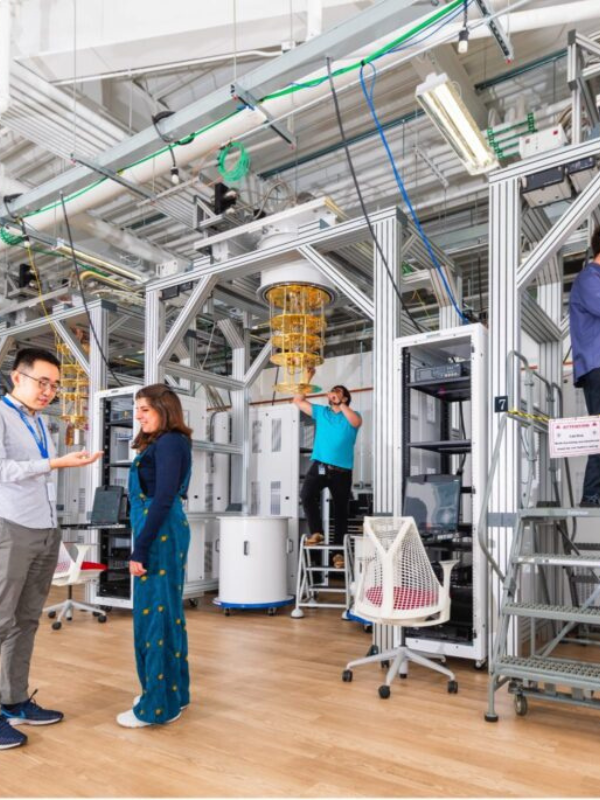
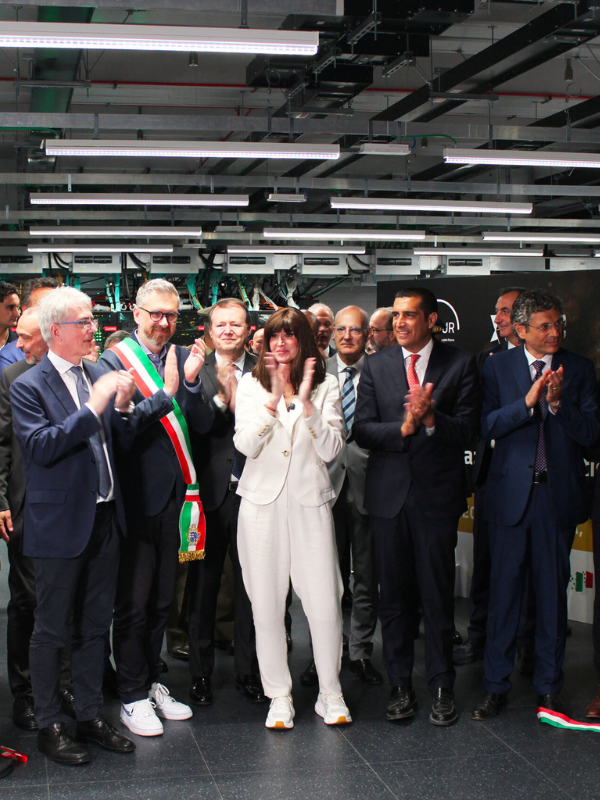
The cold, dark night and the bright sun: NOX and SOL, the two quantum computers inaugurated in Bologna on 11 June, occupy the same room at the National Research Centre for High Performance Computing, Big Data and Quantum Computing (ICSC) at the DAMA Technopole, embodying two profoundly different approaches to quantum computing. NOX, produced by the Finnish company IQM Quantum Computers and equipped with 54 qubits, uses superconducting circuits cooled to extremely low temperatures; SOL, developed by the French company Pasqal as part of the European EuroHPC programme, uses neutral-atom technology, with atoms trapped inside a large ultra-high-vacuum chamber by means of laser systems (hence the reference to light). Together, NOX and SOL make the Bologna hub one of the most advanced quantum infrastructures in Europe, while enriching a technological landscape that remains highly heterogeneous and is evolving rapidly, in which it is difficult to predict which approach will ultimately prevail over the others. We therefore asked Alain Aspect, recipient of the Nobel Prize in Physics 2022 for his experiments on entanglement and co-founder of Pasqal, what kind of scenario we can expect for the future of quantum computing and what role it may play in our understanding of physical reality.
|
|
|
|
|
Interview with Alain Aspect, recipient of the Nobel Prize in Physics 2022 for his experiments with entangled photons, that confirmed that quantum mechanics gives a correct description of entanglement, and paved the way for quantum computers, quantum networks and quantum encrypted communication
|
|
|
Alain Aspect is Professor at the Institut d’Optique Graduate School, the University Paris-Saclay, the Ecole Polytechnique (Institut Polytechnique de Paris), and is Emeritus senior scientist at CNRS. He earned the Nobel Prize in Physics 2022 for his experiments with entangled photons conducted in 1981–1982, that confirmed that quantum mechanics gives a correct description of entanglement and paved the way for quantum computers, quantum networks and quantum encrypted communication. In addition to the Nobel Prize, he has received many awards, among them the CNRS Gold Medal (2005), the Wolf Prize in Physics (2010), the Balzan Prize for Quantum Information (2013), the Niels Bohr Gold Medal (2013), the Albert Einstein Medal (2013) and the Ives Medal of the Optical Society of America (2013).
|
|
“If Einstein had known”[1] about your experiments on entanglement, would he have accepted quantum mechanics as a theory capable of describing the world?
Oh, yes, there is no doubt, because our experiments show that quantum mechanics describes the world even in the most surprising situations. Had he known, Einstein would have had to admit that, within his epistemological vision of the world, that we call “local realism”, there is something that must be abandoned. Following our experimental tests, it is no longer possible to uphold both locality and realism at the same time, one must give up at least one of these two assumptions. In the final chapter of my book, I try to answer precisely the question of which of the two it is more reasonable to abandon, but I cannot reveal it here, otherwise I would deprive you of the pleasure of reading it!
[1] If Einstein had known is Aspect’s third popular science book, published in 2025 by Editions Odile Jacob.
|
|
|
INFN National Laboratories of Gran Sasso
|
|
San Bernardino Staircase, L’Aquila
|
|
|
|
If you can't see the message below correctly, go here
If you receive this newsletter without subscribing, it means that you have been added to a list of recipients who may be interested, or you are an employee or affiliate of INFN.
If you no longer wish to receive this newsletter and are not an employee or affiliate of INFN, you can unsubscribe by sending an email to grafica@lists.infn.it.
Particle Chronicle © 2025 INFN
Newsletter Archive
EDITORIAL BOARD
Coordinator Martina Galli;
Project and contents Martina Bologna, Cecilia Collà Ruvolo, Eleonora Cossi,
Francesca Mazzotta, Antonella Varaschin;
Design and mailing coordinator Francesca Cuicchio; ICT service SSNN INFN
INFN - COMMUNICATIONS OFFICE - Piazza dei Caprettari, 70 - 00186 Roma
www.infn.it - news@lists.infn.it
|
|
|
|