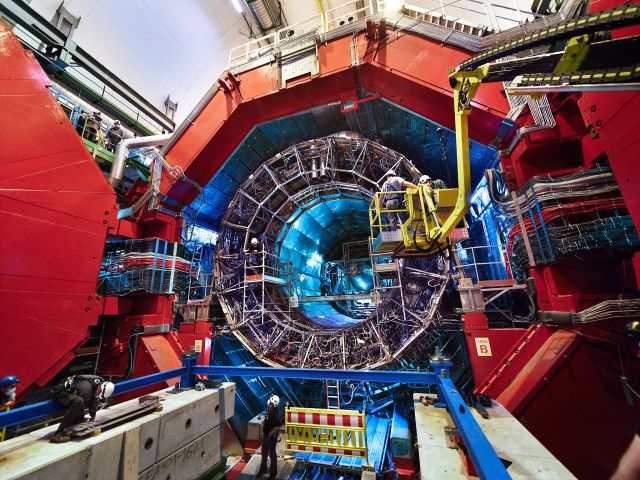
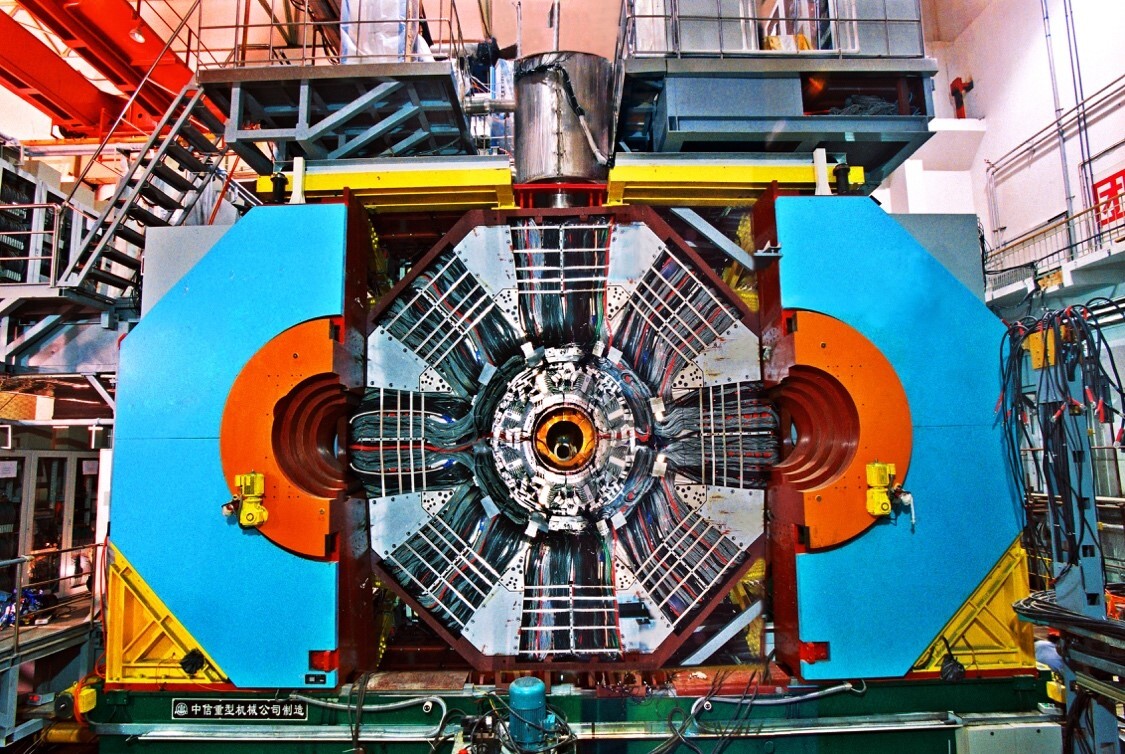
In a recent paper, the ALICE collaboration has published a new measurement of the production of neutral beauty mesons, particles made up of a beauty quark and a down quark at CERN. For the first time at the current LHC energies, researchers have managed to measure how often these mesons are produced at very low momentum values (1 GeV, i.e. five times lower than their mass), namely particles that emerge from collisions with low velocity compared to others produced in the same interactions. It is precisely in this region, so far little explored, that most of the beauty quarks generated in the collisions are found. This region is not accessible to other LHC experiments and is essential for obtaining a measurement of how many of these particles are produced.
“This measurement also demonstrates the effectiveness and, with a play on words, the beauty of the ALICE upgrade, which was designed and implemented over more than a decade with strong contribution from INFN groups” comments Federico Antinori, national coordinator of ALICE.
The measurement is based on data collected in proton–proton collisions at an energy of 13.6 TeV during the third data-taking period of the LHC (Run 3). A result made possible thanks to the significant improvements made to the ALICE detector during the second long shutdown of the accelerator. Among these, the installation of the new Inner Tracking System 2 detector has allowed a substantial improvement in the precision with which particle tracks are reconstructed, a decisive element for reconstructing the decays of low-momentum beauty mesons that occur a few tenths of a millimetre from the collision point.
Further upgrades to the Time Projection Chamber and to the Time-of-Flight detector have made it possible to greatly increase the data acquisition rate: by up to a factor of 500 compared to previous runs. The INFN ALICE groups play a central role in many of the ALICE detectors, including the Inner Tracking System 2 and the Time-of-Flight. In order to efficiently manage and analyse the enormous volume of data produced, ALICE now also uses a software-based filtering system capable of selecting specific events, such as those leading to the production of beauty mesons. This approach is part of the new Online–Offline (O2) computing framework, designed to meet the performance requirements of Run 3 and future phases of the LHC.
The probability of producing particles containing beauty quarks can be predicted through calculations based on quantum chromodynamics (QCD), the theory describing the strong interaction responsible for the cohesion of protons. In the new region explored by ALICE, the calculations have larger uncertainties and dependencies on the assumptions made: this makes the impact of the measurements particularly significant.
Finally, this new measurement represents an important reference for the analysis of large data samples from heavy-ion collisions collected during Run 3 of the LHC. “The measurement of beauty production in these events, which reproduce conditions similar to those present in the first microseconds after the Big Bang, is essential for studying the behaviour of beauty quarks in the quark–gluon plasma, a primordial phase of matter.” comments Grazia Luparello (INFN Trieste) – coordinator of the working group that produced the measurement.