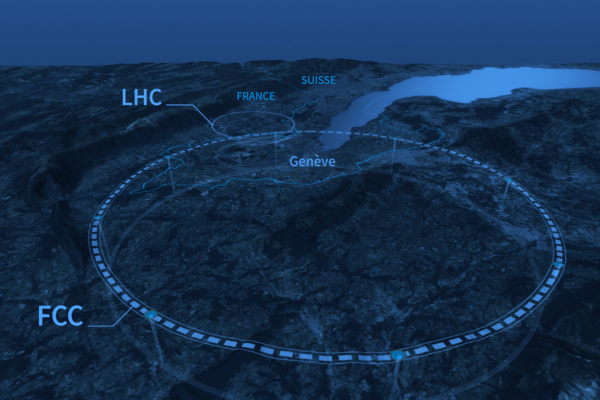
Map showing the proposed location of the Future Circular Collider in the CERN area ©CERN
|
|
|
Beyond LHC: the accelerators in the future of CERN
|
|
|
90 km is the distance between Basel and Zurich, the route covered by participants in the South African Comrades Marathon (the oldest ultramarathon in the world), and about five hours of cycling in an average cycle touring stage. And 90 km, or rather 91, could also be the length of the circular tunnel that will host Europe’s next particle accelerator, the Future Circular Collider (FCC). At a depth of 200 metres underground, extending between France, Switzerland, the CERN laboratory and office complex, and a section of Lake Geneva, the FCC could provide answers to the most profound mysteries of the universe, colliding electrons and their antiparticles, and producing data with an unprecedented level of detail. On May 22, the CERN Council updated the European Strategy for Particle Physics and identified FCC-ee as CERN’s future flagship project. And a decision on its actual construction is expected by 2028. In the meantime, however, the European physics community will focus on an equally crucial goal: fully exploiting the scientific potential of the Large Hadron Collider (LHC) through its High-Luminosity upgrade (HiLumi LHC). The LHC is still the world’s most powerful particle accelerator, and it will remain in operation in its upgraded version until the 2040s. At the end of June the upgrade phase of the accelerator machine and the experiments will begin, and we asked Oliver Brüning, CERN Director for Accelerators and Technology, to guide us through the challenges, expectations and technologies that will shape the history of Europe’s next accelerators.
|
|
|
|
|
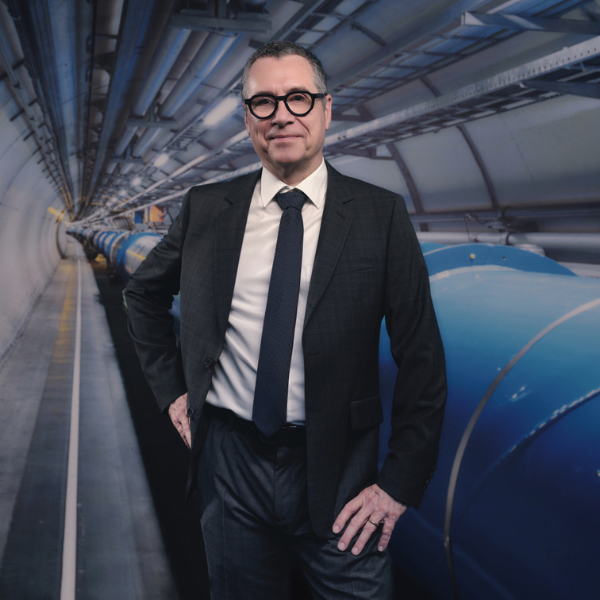
Interview with Oliver Brüning, CERN Director for Accelerators and Technology
|
|
|
Oliver Brüning took up the role of CERN Director for Accelerators and Technology in January 2026. Following his work at DESY on the stability of the HERA proton beam, he arrived at CERN in 1995, and since 1997 he has contributed to the LHC optics, commissioning and upgrades. From 2008, he served as LHeC Study Leader and held several leadership positions in beam physics. From 2015 to 2019, he led the LHC Full Energy Exploitation Study, and from 2020 to 2025, he headed the High-Luminosity LHC Upgrade project. He has served on several international committees, and was Chair of the DESY Machine Advisory Committee (2017–2020) and of the EPS Accelerator Group (2008–2011).
|
|
June 29, 6.00 am: the LHC will be shut down for a four-year upgrade. What will this consist of? Which limitations of the current accelerator will it allow us to overcome?
It is a complex question, because over these four years we will be upgrading quite a number of elements, and there is a risk of oversimplifying things by merely saying that we are making LHC more performant. We are planning a profound renewal of CERN’s entire accelerator complex, and during Long Shutdown 2 (from 2018 to 2022) we already upgraded the injector complex in preparation for the major Long Shutdown 3 upgrade (2026-2030). The objective is to increase beam intensities in LHC and the luminosity, which is the measure of how many events we can produce per second per unit of space. At present, LHC has two fundamental intensity limitations: the overall intensity the machine can digest before beam instabilities develop, and the power of the radiofrequency system. As regards the first limitation, we are upgrading the collimation system, namely the sections dedicated to beam cleaning. Specifically, we will position absorbers as close as possible to the beam in order to remove stray particles, which generate unwanted electromagnetic fields and cause instabilities – an effect described by the so-called beam impedances. We will therefore replace the current collimators with “low-impedance collimators”, thereby paving the way for an increase in intensity. As for the power limitation of the radiofrequency system, this too will be upgraded and improved, so that it can sustain higher beam intensities once we emerge from Long Shutdown 3.
|
|
|
|
|
Franco Parenti Theatre, Milan
|
|
|
|
|
Espacio Fundación Telefónica, Madrid
|
|
|
|
If you can't see the message below correctly, go here
If you receive this newsletter without subscribing, it means that you have been added to a list of recipients who may be interested, or you are an employee or affiliate of INFN.
If you no longer wish to receive this newsletter and are not an employee or affiliate of INFN, you can unsubscribe by sending an email to grafica@lists.infn.it.
Particle Chronicle © 2025 INFN
Newsletter Archive
EDITORIAL BOARD
Coordinator Martina Galli;
Project and contents Martina Bologna, Cecilia Collà Ruvolo, Eleonora Cossi,
Francesca Mazzotta, Antonella Varaschin;
Design and mailing coordinator Francesca Cuicchio; ICT service SSNN INFN
INFN - COMMUNICATIONS OFFICE - Piazza dei Caprettari, 70 - 00186 Roma
www.infn.it - news@lists.infn.it
|
|
|
|