

From bit to qubit. The quantum future of computing
The CERN Council approves the update of the European Strategy, giving priority to the upgrade of LHC with HiLumi LHC, and identifies FCC as the flagship project for the future.
On 22 May, the CERN Council, meeting in Budapest, updated the European Strategy for Particle Physics, presenting in a press conference attended by journalists from all over the world the results of this intense work, which engaged the European particle physics community for two years.
The Strategy recommendations focus on medium- and long-term objectives, confirming that the highest priority remains the full exploitation of the scientific potential of LHC and its upgrade through the High-Luminosity LHC (HiLumi LHC) project, which from 2030 to 2040 will increase the integrated luminosity by approximately a factor of ten, decisively increasing the volume of data available to researchers. This leap forward will enable physicists to explore the behaviour of the Higgs boson and other elementary particles with unprecedented precision and to identify rare phenomena that have so far been inaccessible.
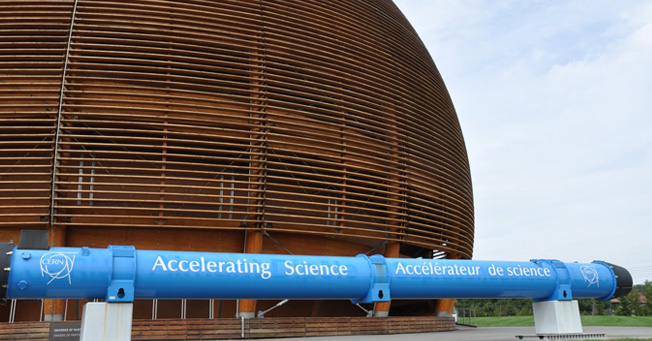 Cern, the Globe. Credit CERN

Looking to the long term, the Strategy identifies the electron-positron Future Circular Collider (FCC e+e-) as the flagship project, proposed with almost unanimous consensus. The infrastructure, with a 91-kilometre underground ring between Switzerland and France and an estimated investment of around 16 billion euros, represents a scientific and technological challenge on a global scale. FCC will offer the broadest exploration programme in fundamental physics, with a high discovery potential. The project will make it possible to address some of the main open questions, in particular those linked to the Higgs boson and the validity of the Standard Model, opening the way to the search for new physics. At the same time, it will promote technological innovation and advanced training for thousands of young researchers, engineers and technicians.
The CERN Council has also invited the Management to begin discussions with Member States, Associate Countries and the European Union in order to define a sustainable funding plan. The process foresees annual reports on the state of progress and will lead to a final decision on the project by 2028, on the basis of scientific, technical and economic feasibility. In addition to the European Future Circular Collider project, there is also the Chinese Circular Electron Positron Collider (CEPC) project for the construction of an electron-positron accelerator with a circumference of 100 km. CEPC was proposed in 2012 by the Chinese Academy of Sciences and in December 2023 the technical design report was published. The project is not included in the Chinese government’s 2026–2030 funding plan, which foresees other priorities. Its future is also linked to the choices that will be made in Europe regarding FCC.
The INFN scientific community contributed decisively to defining the scientific vision and to the studies that led to the recommendations underlying the resolution adopted by the Council, and will continue to be fully engaged, in close collaboration with CERN and international partners, in the development of the next technical project report, which will provide the Council with all the elements necessary for the final decision expected in 2028.
As Antonio Zoccoli, President of INFN, underlined: “This decision represents a fundamental step in the process of shaping the European future of particle physics and accelerators, a sector operating at the frontiers of science and technology.” For the INFN scientific community, FCC ee represents a strategic infrastructure, capable of opening new frontiers in the understanding of the fundamental structure of matter and the Universe, with an extraordinary impact not only on the advancement of scientific knowledge, but also on technological innovation, the training of new generations of researchers, and European industrial development. FCC ee is therefore a truly strategic project for Europe, because it would allow CERN not only to maintain, but also to strengthen its scientific leadership in big science.
Interested in the process of the European Strategy for Particle Physics? read more here
