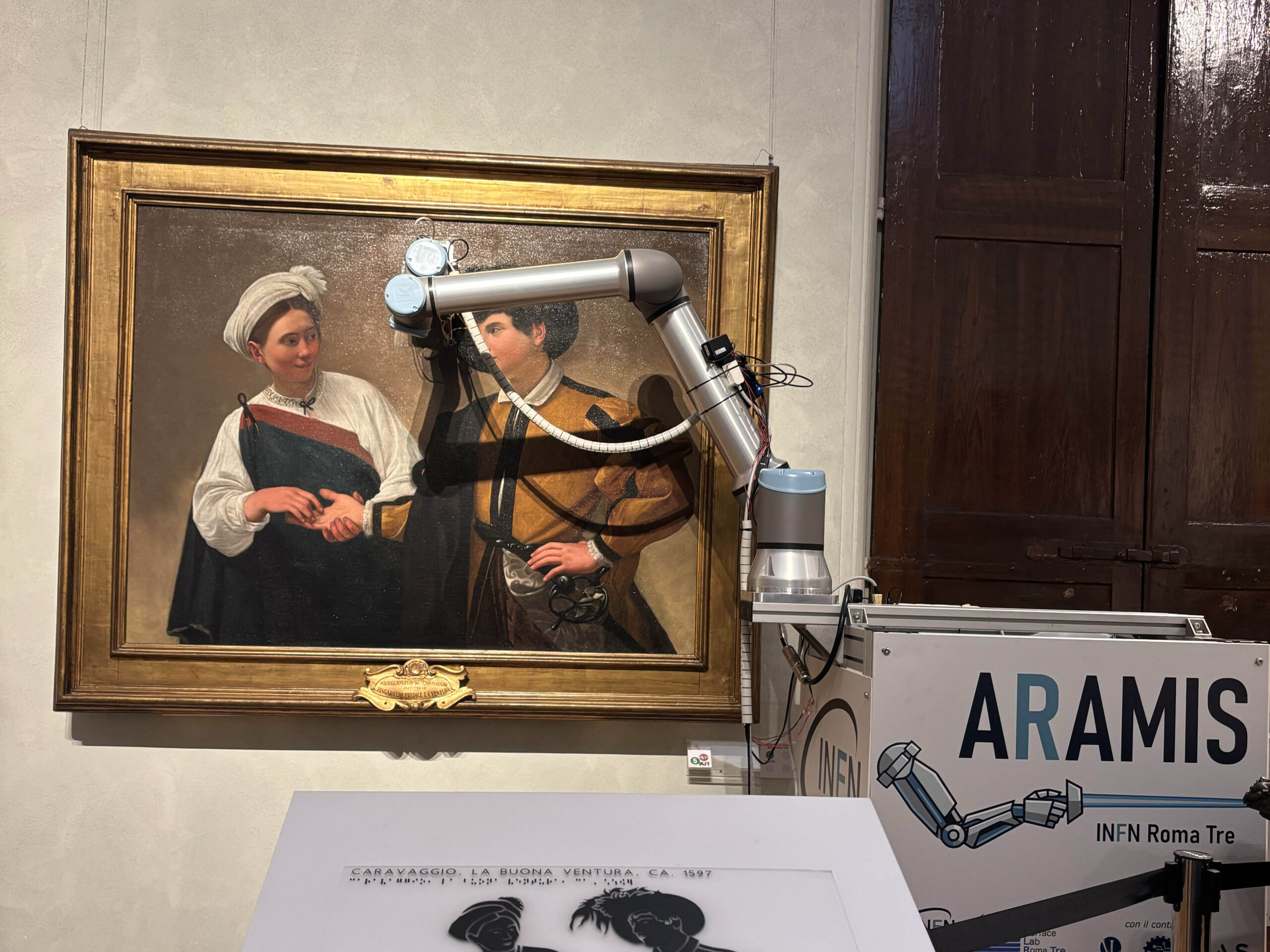
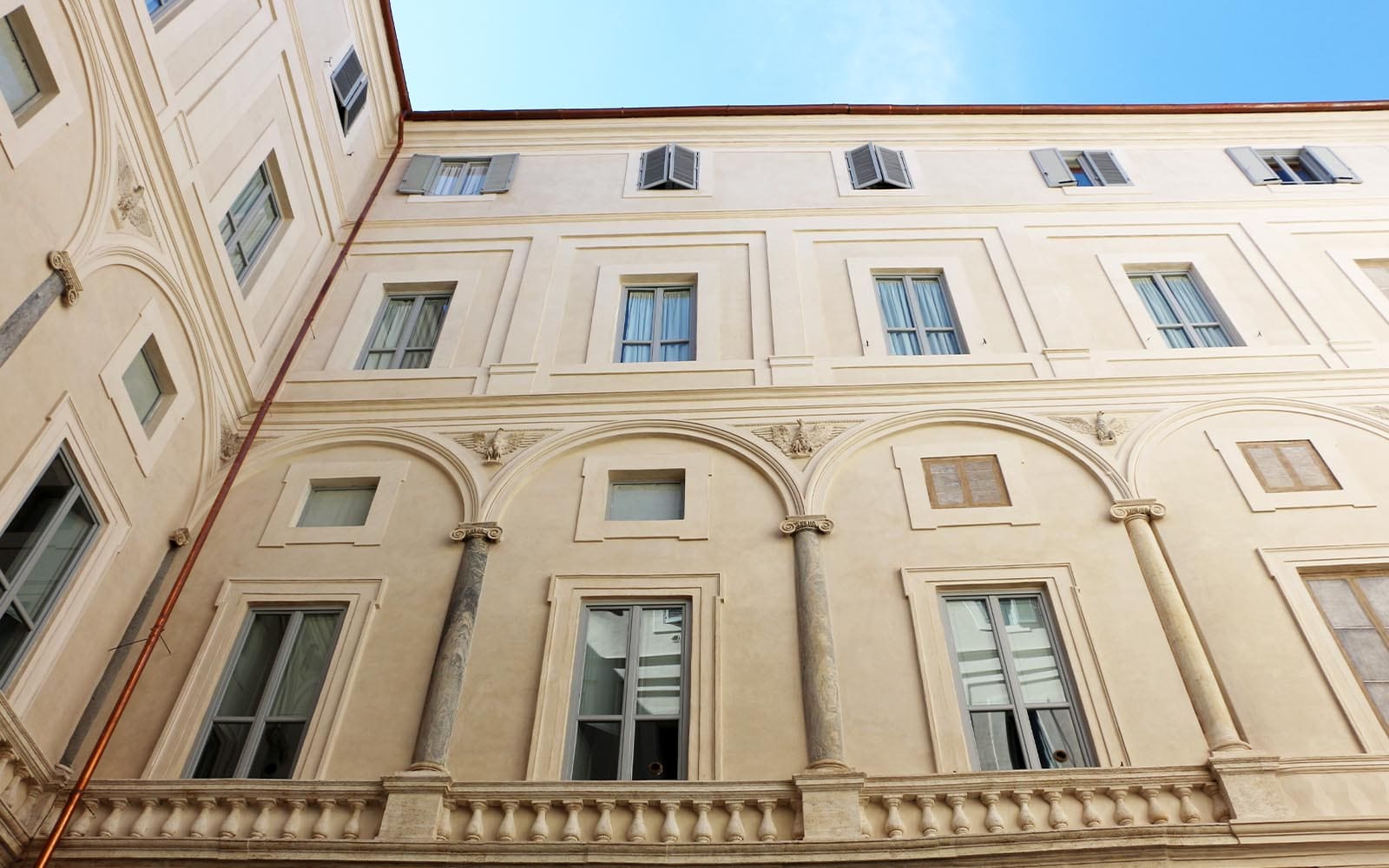
A campaign of non-invasive diagnostic investigations is currently underway at the Pinacoteca of the Capitoline Museums in Rome on the painting The Fortune Teller by Michelangelo Merisi da Caravaggio, carried out thanks to an innovative system that combines a macro X-ray fluorescence scanner (MA-XRF) with the accuracy of a very high-precision robotic arm, designed for remote surgical operations and adapted to the context of fine arts. This is the first time that this technology, named Aramis, has been employed.
The painting, an oil on canvas made by Caravaggio at the end of the 16th century, depicts a scene of everyday life, but it is what cannot be seen with the naked eye that captures the interest of scholars. In the specific case of The Fortune Teller, the presence of an underlying painted version, already highlighted by radiographic investigations in the 1970s and by subsequent analyses promoted by the Capitoline Superintendency, makes the work a particularly significant case study. The analysis with the Macro XRF Scanner mapping system integrated with the robotic arm could in fact provide new data useful for the attribution of the underlying Madonna and Child, an enigma still open in the critical debate on Caravaggio.
The analyses will be carried out by researchers from the Istituto Nazionale di Fisica Nucleare (INFN), Rome Tre section, in collaboration with the Department of Science of Roma Tre University, within the activities of the INFN cultural heritage network CHNet. Specifically, this project is part of the PNRR project EAR – Enacting Artistic Research, coordinated by the Accademia di Belle Arti di Roma and carried out in collaboration with the Capitoline Superintendency, with which, since 2015, an agreement has been active aimed at the joint promotion of cultural, artistic and research projects.
“The system used is based on a robotic arm with micrometric precision employed to guide an X-ray source, capable of adapting in real time to the surface of the work”, explains Luca Tortora, INFN researcher and professor at Roma Tre University. “This technology, used here for the first time, will also make it possible to study complex surfaces, such as frescoes on curved vaults or three-dimensional objects, and to reach areas that are difficult to access with traditional two-dimensional scanners”, Tortora concludes.
“It is thus possible to obtain high-resolution chemical maps even on non-planar surfaces, allowing the characterisation of pictorial materials, a deeper understanding of execution techniques and the investigation of the presence of the underlying painting”, concludes Valerio Graziani, researcher of the INFN Roma Tre division who worked on the development of the robotic arm.
The analysis with Macro XRF mapping integrated with a robotic arm
The analyses are carried out through macro X-ray fluorescence scans (MA-XRF), a completely non-destructive technique that makes it possible to obtain actual images of the distribution of chemical elements present in the pigments. The robotic arm integrated into the system is a medical-grade device designed for remote surgical operations with micrometric precision and integrated for the first time into this technique of non-invasive analysis of cultural heritage.
The introduction of the robotic arm represents a significant advancement: the system is in fact capable of adapting to the morphology of the pictorial surface, maintaining a constant distance thanks to advanced sensors and ensuring micrometric precision. Thanks to these characteristics, this technology makes it possible to study complex surfaces, such as frescoes on curved vaults or three-dimensional objects, and to reach areas that are difficult to access with traditional two-dimensional scanners. This innovative diagnostic methodology allows the mapping of pictorial layers in relation to pigments, making it possible to distinguish surface applications from underlying ones and to identify any hidden elements.
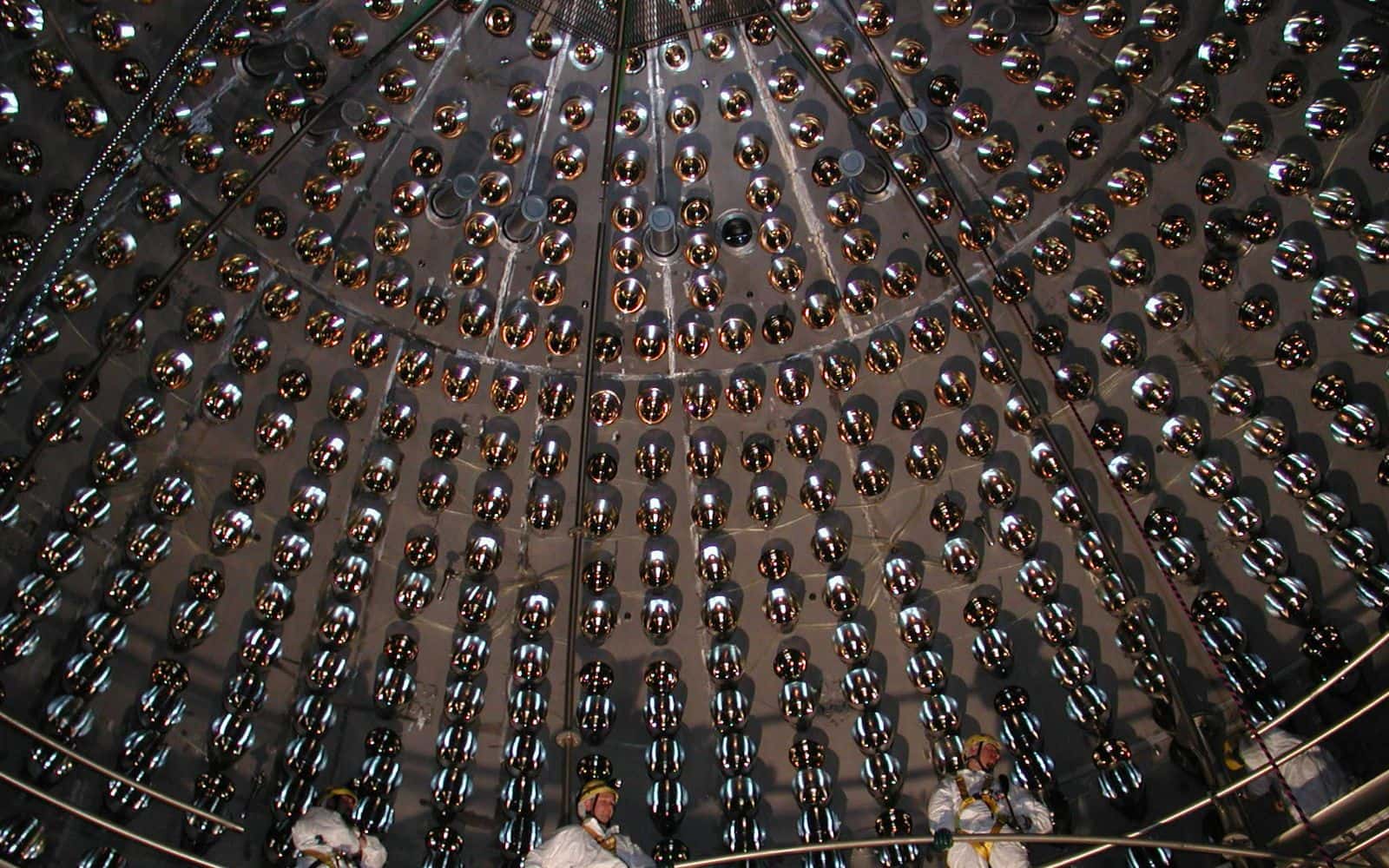
The INFN has a network dedicated to the development of instrumentation for applications in cultural heritage, called INFN CHNet. This analysis campaign is carried out by a multidisciplinary group that integrates scientific and art-historical expertise, with contributions from researchers of the INFN division, the department of Roma Tre University and the Pinacoteca. The investigations are part of a broader study project that has also involved works of great historical and artistic importance, including Christ and the Adulteress by Jacopo Palma il Vecchio.
The work The Fortune Teller by Caravaggio is exhibited within the exhibition The Unfinished: between poetics and execution technique, held at the Pinacoteca Capitolina from 15 January to 12 April 2026 and extended until 14 June. The exhibition project represents one of the main outcomes of the EAR – ENACTING ARTISTIC RESEARCH project (Work Package 2, led by Costanza Barbieri), funded by the Ministry of University and Research through PNRR funds allocated to strategic partnerships and the promotion of the internationalisation of research within the Ministry’s system of Higher Education in Art and Music. The EAR project brings together the Academies of Fine Arts of Rome (lead partner), Florence and Brera, and the Conservatoires of L’Aquila and Rome, in partnership with the INFN division of Roma Tre University and the Polytechnic University of the Marche, with the aim of promoting interaction between artistic and scientific research.