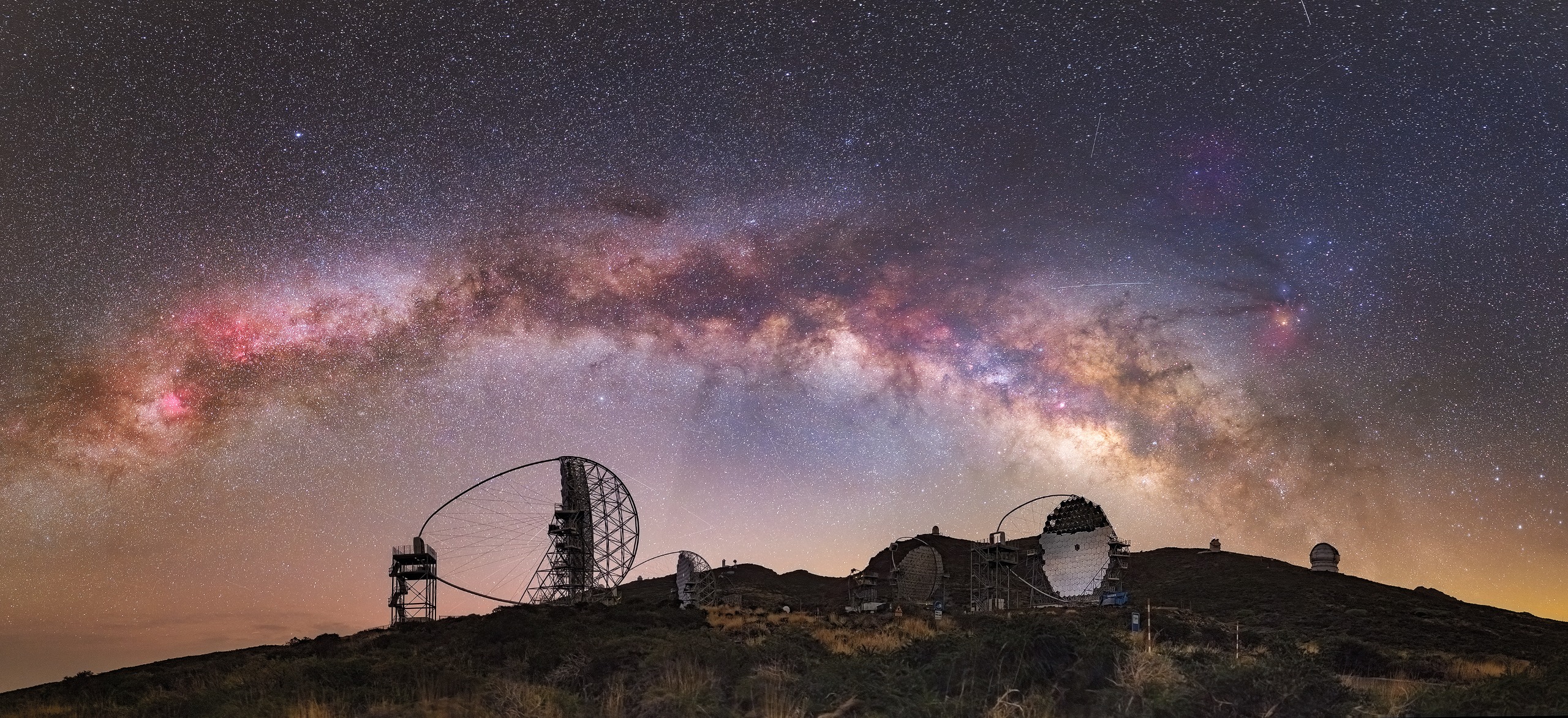
Two hundred and fifty scientists and representatives of leading research institutions from around the world gathered to celebrate the inauguration of the Large-Sized Telescope (LST) sub-array at the northern site of the Cherenkov Telescope Array Observatory (CTAO-North), located at the Roque de los Muchachos Observatory on La Palma, in the Canary Islands (Spain). The completion of the four LST telescopes marks a major milestone for the global astrophysics and astroparticle physics communities and represents a crucial step towards the full scientific operation of CTAO, to which the National Institute for Astrophysics (INAF) and the National Institute for Nuclear Physics (INFN) have also made significant contributions.
Each telescope is equipped with a 23-metre-diameter mirror and state-of-the-art, ultra-fast cameras. Designed to detect the faint flashes of Cherenkov light produced when very-high-energy gamma rays interact with the Earth’s atmosphere, the LST telescopes are the world’s most sensitive instruments for observing gamma rays at energies ranging from approximately 20 gigaelectronvolts (GeV) to several teraelectronvolts (TeV).
This extraordinary sensitivity is essential for identifying distant and transient gamma-ray sources. Since very-high-energy gamma rays are gradually absorbed as they travel through the Universe, the ability of the LST telescopes to detect gamma rays down to the lowest energies allows scientists to explore sources at cosmological distances, look further back into cosmic history and observe the extremely rapid variability of dynamically evolving gamma-ray sources with greater statistical accuracy.
The pioneering LST-1 As early as 2020, even before the entire sub-array had been completed, the LST-1 prototype produced remarkable results during its commissioning phase. These included observations of pulsars, studies of active galactic nuclei at cosmological distances and rapid monitoring of transient phenomena such as novae and gamma-ray bursts (GRBs). With the addition of the three new LSTs (LST-2, LST-3 and LST-4) to the existing LST-1, the four telescopes now form a fully fledged network (sub-array). By simultaneously observing the same gamma-ray shower from multiple directions, the LST telescopes will deliver significantly greater sensitivity, improved angular resolution and more precise energy reconstruction, opening up a new level of accuracy in the study of the gamma-ray Universe.
“The completion of the LST sub-array is the culmination of more than fifteen years of international collaboration and technological innovation”, said Masahiro Teshima, Principal Investigator of the LST Collaboration and Spokesperson for the CTAO Consortium. “These telescopes will allow us to explore some of the most extreme environments in the Universe, including supermassive black holes and neutron stars, investigate the possible origins of cosmic rays and contribute to research into the nature of dark matter”.
The LSTs form the low-energy core of CTAO-North and will provide a unique opportunity to probe the Universe, looking back in time as far as approximately 12 billion years, when it was less than two billion years old. Their sensitivity to lower-energy gamma rays will make it possible to detect and study bright, high-redshift very-high-energy (VHE) gamma-ray bursts, potentially extending gamma-ray observations to sources with redshifts of up to z~4 and providing new insights into the early Universe.
“Today marks an extremely important step forward towards the completion of CTAO, to which Italy contributes a wealth of scientific, design and industrial expertise. Italy hosts the headquarters of the international Observatory in Bologna, at INAF, and is contributing to the construction of a large part of its instruments. Today, attention is focused on the northern site, but our vision encompasses the entire Observatory: Italy’s contribution is also particularly significant at the southern site in Chile, through the construction of two additional Large-Sized Telescopes and as many as 37 Small-Sized Telescopes, all being built in Italy for CTAO-South”, said Lucio Angelo Antonelli, an INAF researcher and Co-Principal Investigator of the international LST Collaboration. “The next commissioning phases and integration into CTAO operations will enable these instruments to reach their full potential. This is a decisive step towards the discoveries we are looking forward to, but above all towards those we cannot yet imagine”.
“INFN has been involved in the development of these new telescopes since the earliest design stages. It has built the carbon-fibre structure supporting the camera arch and contributed to the construction of the camera itself, as well as developing other high-precision mechanical and electronic components required to calibrate the pointing system. So far, our contribution has focused mainly on the instruments at CTAO’s northern site, but now, thanks to funding from the Ministry of University and Research’s National Recovery and Resilience Plan (PNRR), we are making a major contribution, together with INAF, to the construction of the cameras for the telescopes at the southern site”, explains Mosè Mariotti, an INFN researcher and national coordinator of the INFN group within CTAO. “Over the next two years, when the new telescopes become fully operational, sensitivity will increase considerably, by up to an order of magnitude compared with current instruments. This means that we will be able to achieve the same scientific results in one hundredth of the time, opening up extraordinary new opportunities for discovery”, Mariotti concludes.
Over the coming years, the LSTs will undergo commissioning and be integrated into CTAO operations. Together with the other telescopes planned for both Observatory sites, they will address fundamental questions in astrophysics, particle physics and cosmology, such as the nature of dark matter, the origin of cosmic rays and the physics of extreme cosmic accelerators.
CTAO (Cherenkov Telescope Array Observatory) will be the largest and most powerful gamma-ray astronomy observatory in the world. CTAO’s unprecedented precision and broad energy range (20 GeV–300 TeV) will help answer some of the most challenging questions in astrophysics and particle physics, organised around three main themes: understanding the origin and role of relativistic cosmic particles; probing extreme environments such as black holes and neutron stars; and exploring the frontiers of physics in the search for dark matter or deviations from Einstein’s theory of relativity. To cover its broad energy range, CTAO will use three types of telescopes: Large-Sized Telescopes (LSTs), Medium-Sized Telescopes (MSTs) and Small-Sized Telescopes (SSTs). More than 60 telescopes will be distributed across two observing sites: CTAO-North, in the Northern Hemisphere, at the Roque de los Muchachos Observatory on La Palma (Spain), and CTAO-South, in the Southern Hemisphere, at the ESO Observatory at Paranal in the Atacama Desert (Chile).