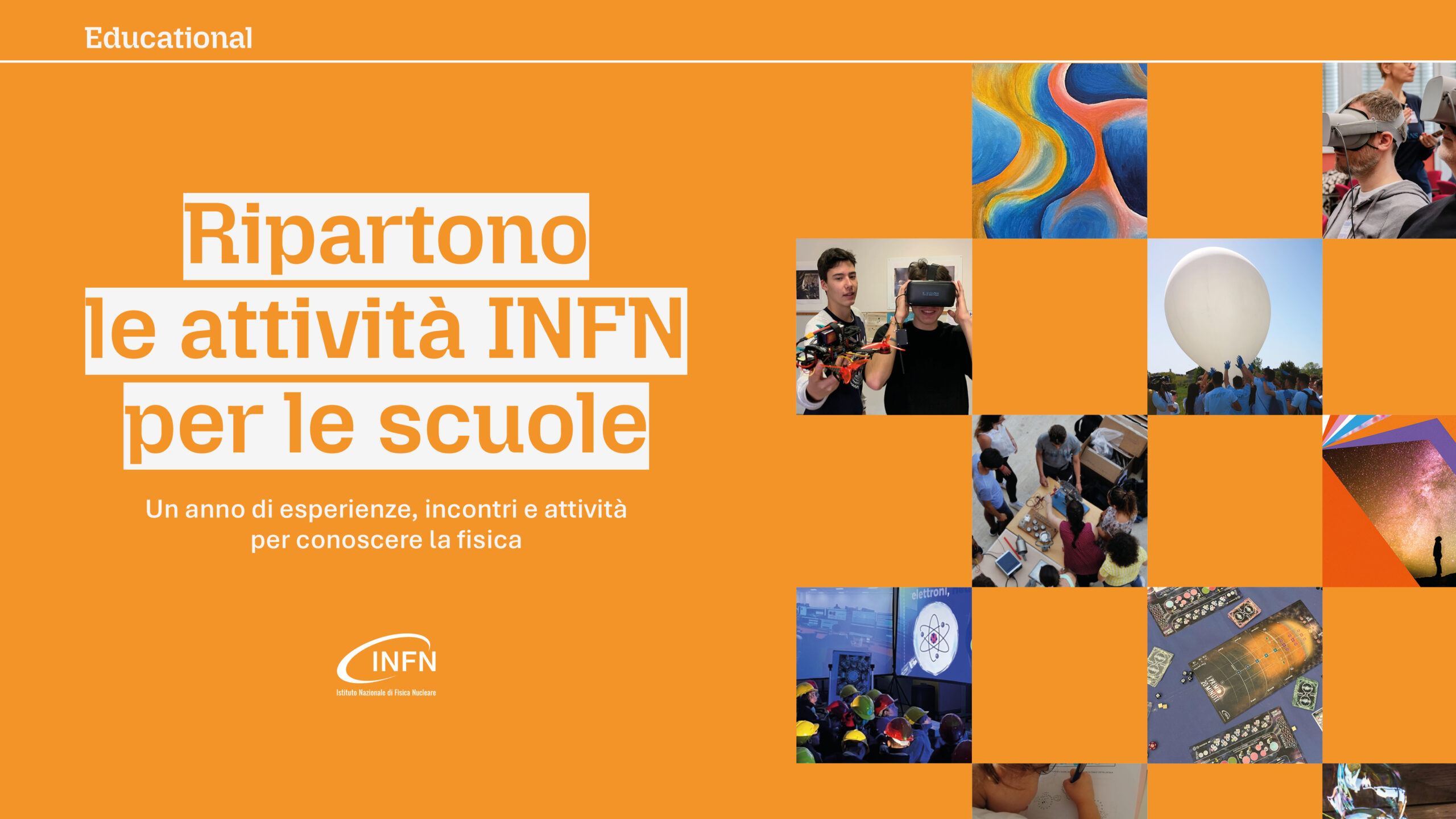
As the new 2026–2027 school year gets underway, the National Institute for Nuclear Physics (INFN) is once again renewing its commitment to schools, offering a wide-ranging programme of activities for students, teachers and schools across Italy.
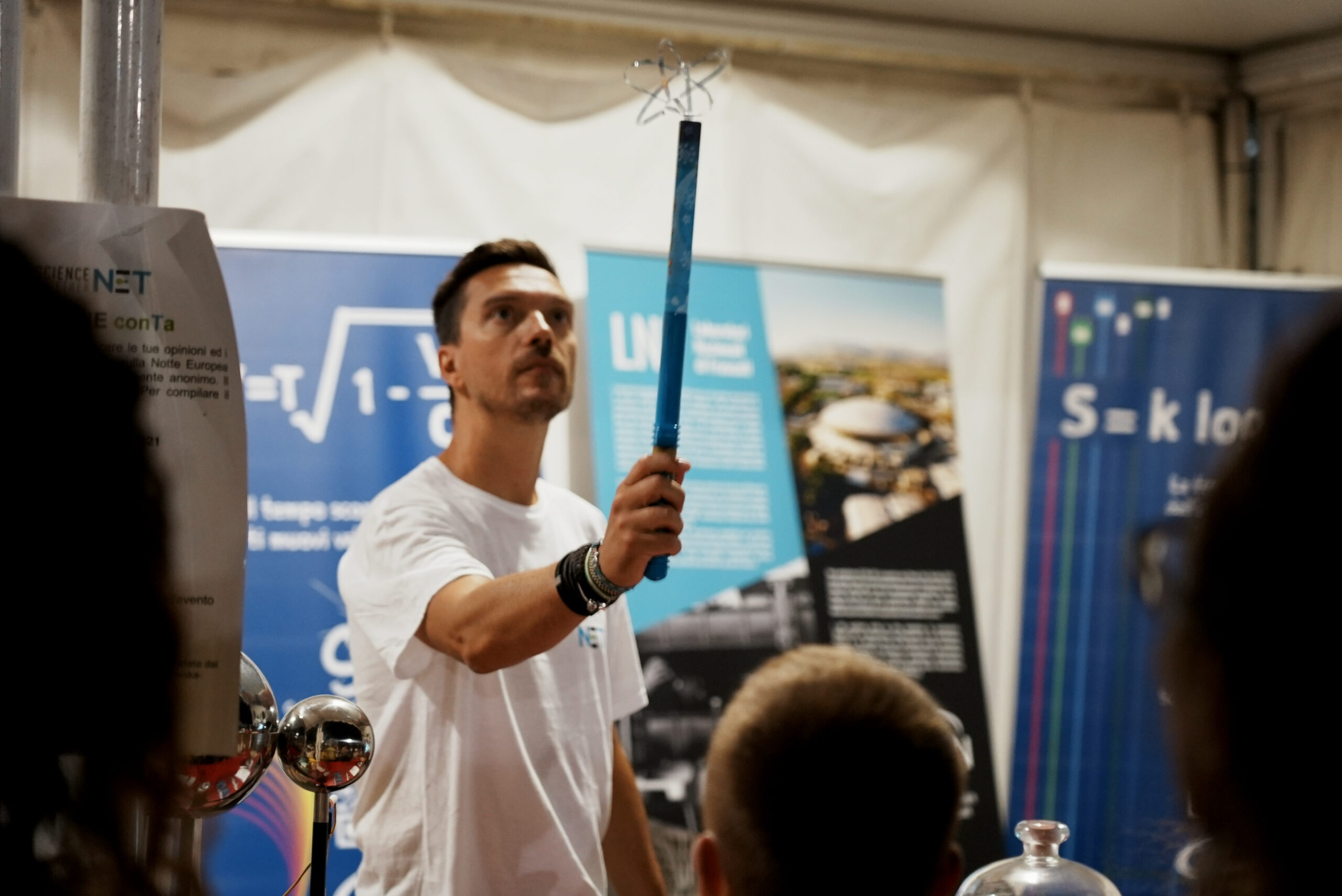
The INFN programme comprises 17 projects and initiatives that will run throughout the school year, offering opportunities for engagement, training and hands-on exploration of physics and scientific research. Laboratories, meetings with researchers, visits to INFN laboratories, competitions and science communication activities: there are many ways for teachers and students to discover scientific research and gain a closer insight into the work of researchers working at the frontiers of physics, studying the structure of matter and the phenomena of the universe.
The programme is designed to engage different age groups and levels of education, from primary through to upper secondary school, while providing teachers with useful tools and opportunities for professional development to bring science into and beyond the classroom.
The new school year will feature the return of several well-established INFN projects, alongside new editions and activities, with the programme getting underway in the coming weeks.
A year of science, research and training with INFN
The INFN programme for schools offers a range of different pathways designed to introduce students to scientific research through ever-changing forms of engagement: from reading and creative activities to laboratory experimentation and data analysis, games and making, as well as direct interaction with the Institute’s researchers.
CREATIVITY, UPPER SECONDARY SCHOOLS
Students at upper secondary schools can once again take part in some of the projects that have involved thousands of young people across Italy over the years. The new school year begins with the 6th edition of Art&Science Across Italy, which from October 2026 will engage students in a two-year programme bringing the worlds of scientific research and art into dialogue. Scientific literature is the focus of the Asimov Prize, which invites young readers to read and review one of the books shortlisted for the competition. The five finalists will be selected in autumn 2026, and the winner will be announced in May 2027 at the Salone Internazionale del Libro in Turin. DialogAI, meanwhile, will explore the relationship between science and new technologies, involving classes in early 2027 in writing a theatrical dialogue created with the support of artificial intelligence.
RESEARCH AT SCHOOL, UPPER SECONDARY SCHOOLS
Among the programmes that offer students a more direct introduction to scientific research are Lab2Go, International Masterclasses, OCRA and RadioLab. These four programmes differ in their subject matter and methods, but all give students the opportunity to experience aspects of scientific research first-hand: collecting and analysing data, interpreting results, working in groups and discussing their findings with other students. With Lab2Go, students take part in laboratory activities and data analysis, which will subsequently enable them to contribute to the improvement and redevelopment of the science laboratories in their schools. The International Masterclasses, held between February and March 2027 at INFN sites and universities, allow students to work with data and exercises related to particle physics experiments, before sharing and discussing their results with students from around the world. Similarly, the OCRA project introduces students to cosmic rays, particularly through the International Cosmic Day on 19 November 2026, an international event bringing together students, teachers, scientists and researchers from different countries. Finally, RadioLab focuses on environmental radioactivity and radon through activities involving measurement, data analysis and interpretation. These experiences introduce students not only to the content of research, but also to the practical ways in which science is developed, discussed and shared. Also aimed at students is HoPE, a project that introduces them to STEM subjects by challenging them to design and build small experimental prototypes in these fields.
TEACHER TRAINING, SECONDARY SCHOOLS
Alongside activities for students, INFN also offers programmes dedicated to teacher training through AggiornaMenti, HOP and PID. These initiatives are designed to bring tools, methods and knowledge related to contemporary research into the classroom.
SCIENCE GAMES, PRIMARY AND SECONDARY SCHOOLS
Particular attention is devoted to younger students. Through INFN Kids, children can explore fundamental concepts in physics, from matter and energy to electrostatics and the structure of the atom. The project also offers the opportunity to visit INFN laboratories and encounter scientific research beyond scientific facilities: in 2026, INFN Kids will also be present at Lucca Comics&Games, bringing physics to one of Italy’s leading events dedicated to popular culture.
The discovery of science can also take place through play. INFN Game, through the creation of board games, offers an engaging way to explore particle physics and scientific research, turning scientific concepts and collaborative challenges into a playful experience for students and the general public. Alongside INFN Game, HEPscape! turns high-energy physics into an interactive experience through escape rooms that allow participants to explore research concepts and topics in an engaging way. HEPscape! will feature at numerous events across Italy, from the European Researchers’ Night in Avezzano, Terni, Pisa and Bari, to Lucania Is Comics, Lucca Comics&Games and GALA 2026 in L’Aquila.
LIFE IN THE LABORATORY, UPPER SECONDARY SCHOOLS
There are also programmes that allow students to experience research first-hand, entering INFN facilities and interacting directly with researchers who work there on a daily basis. STAGE, the STEAM SUMMER CAMP and the international school INSPYRE – INternational School on modern PhYsics and REsearch will all return. INSPYRE is aimed at students from Italian and international upper secondary schools and will hold two editions in 2027: at INFN’s Frascati National Laboratories from 12 to 16 April and, in autumn, at the INFN Lecce Section. All three programmes offer three or more days devoted entirely to modern physics and scientific research, with lectures, discussions and interactive experiments.
COMPETITIONS AND ONLINE ACTIVITIES, SECONDARY SCHOOLS
Rounding out the programme is ScienzaPerTutti, which invites students to tell the story of science through a video exploring the scientific aspects hidden behind an element of everyday life. It is a way of turning curiosity into a story while giving students the opportunity to explore the tools of science communication alongside scientific research.
This broad and varied programme brings together research, training, experimentation, games and communication. Throughout the school year, it will engage schools and students across Italy through the network of INFN Sections and National Laboratories, as well as through numerous collaborations with universities, organisations and institutions across the country.
With this programme, INFN is once again renewing its strong commitment to promoting and disseminating physics and science, with particular attention to schools and future generations.
All the projects listed above are carried out through INFN’s Third Mission Coordination Committee (CC3M), which supports Public Engagement projects promoted by the research community through an internal peer-review process.
Stay up to date
The INFN programme for the 2026/2027 school year is continuously being updated. Teachers interested in taking part in one of the projects presented here can consult the INFN portal dedicated to schools, where information on activities, participation procedures and any deadlines is available at the following web address: https://progettiscuola.infn.it/
To stay up to date with the various initiatives and new opportunities offered by INFN, you can also subscribe to the INFN Scuola mailing list of Collisioni, the portal dedicated to the Institute’s cultural activities, using the following link: https://collisioni.infn.it/registrazione-alla-mailing-list-infn-scuola/