From the reason why stars and the Sun shine to pioneering technologies: in 32 years at INFN Gran Sasso National Laboratories, the Borexino experiment has achieved fundamental scientific as well as technological achievements that represent an important legacy for experiments studying rare events or very low energy neutrinos. The main results of the experiment are included in a review article recently published in the journal Annual Review of Nuclear and Particle Science by Gianpaolo Bellini, an INFN researcher and professor emeritus at the University of Milan, who was the founder and long-standing sole spokesperson of Borexino. At the heart of the Borexino project is an experiment of unparalleled sensitivity for the study of low-energy neutrinos, and in 32 years of operation (14 years of data acquisition, preceded by extensive research, design, development and construction work) it has succeeded in measuring all of the Sun’s main nuclear reactions. The experiment has thus succeeded in finding an answer to one of the questions that has always interested humanity, “why do the Sun and stars shine?” and has done so by measuring, in 2014, neutrinos produced in the proton-proton nuclear chain that produces 99% of the Sun’s energy, and by observing, in 2020, solar neutrinos from the CNO (carbon-nitrogen-oxygen) cycle, which plays a very significant role in large-mass stars. Borexino did not stop there: it also succeeded in detecting geo-neutrinos, or antineutrinos from the Earth’s interior, and thanks to these observations, it was possible to derive an estimate of the radioactivity of the Earth’s mantle and to learn about that of the Earth’s crust.
“The legacy of Borexino experiment is both scientific and technical and technological, and it will have an important influence on all experiments studying rare events or neutrinos of very low energy”, explains Gianpaolo Bellini. “For example, in order to succeed in their scientific goals, experiments searching for dark matter or very rare phenomena, which are being conducted or even already in data acquisition, are heavily involved in trying to achieve ever-increasing levels of radiopurity: to do this they use techniques derived largely from the Borexino experience. And nothing standard has been used in the implementation of Borexino: all components, from the smallest and most sophisticated to the largest, have been studied in the smallest detail and developed ad hoc”, concludes Bellini.
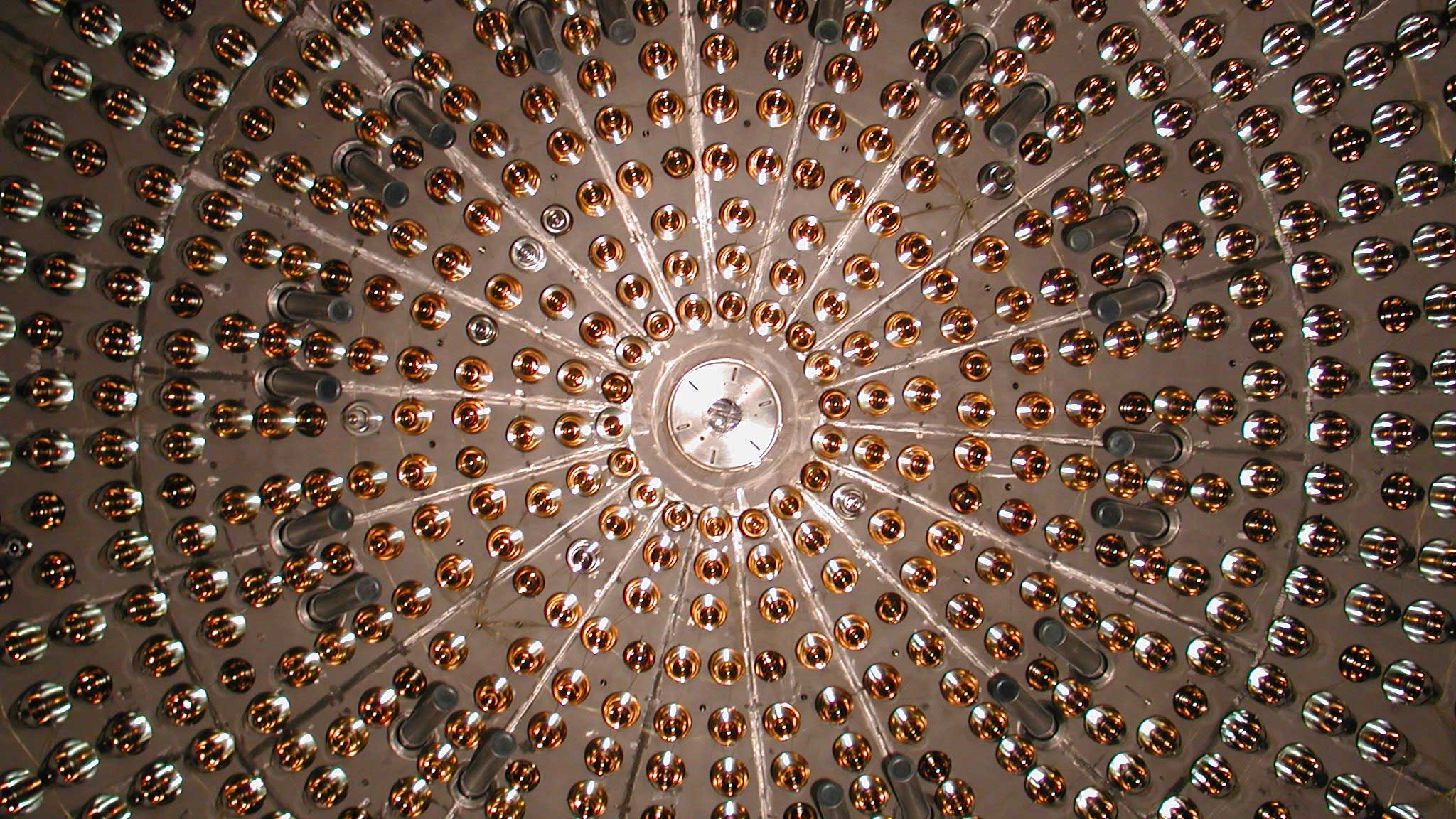
Indeed, Borexino was able to achieve its extraordinary results thanks to techniques and methods that allowed it to reach unprecedented levels of radiopurity. Suffice it to say that the active part of the detector, which made it possible to observe neutrino interactions, the so-called scintillator, achieved a radiopurity in Borexino equal to one radioactive nucleus for every ten trillion non-radioactive nuclei. Moreover, the experiment consisted of highly sensitive electronic eyes and shields that protected it from natural radiation from the laboratory rocks and the underground environment. Finally, installation in the underground environment of the Gran Sasso National Laboratories allowed the experiment to be protected from cosmic rays, radiation from the universe, thanks to the 2,000 metres of rock above.