The international experiment KATRIN (KArlsruhe TRItium Neutrino Experiment) at the Karlsruhe Institute of Technology (KIT) has set a new record in measuring the mass of neutrinos, once again improving upon its previous results. The latest data, published today, April 10, 2025, in Science, establish an upper limit of 8·10⁻³⁷ kg (equivalent to 0.45 eV/c²) for the mass of neutrinos—less than a millionth the mass of an electron.
Neutrinos are among the most enigmatic particles in the universe. They are ubiquitous, yet interact extremely rarely with matter. In cosmology, they influence large-scale galaxy formation, while in particle physics, their tiny mass explains the phenomenon of neutrino oscillations. Precisely measuring their mass is essential for a complete understanding of the fundamental laws of nature—and so far, no experiment has succeeded in determining it exactly.
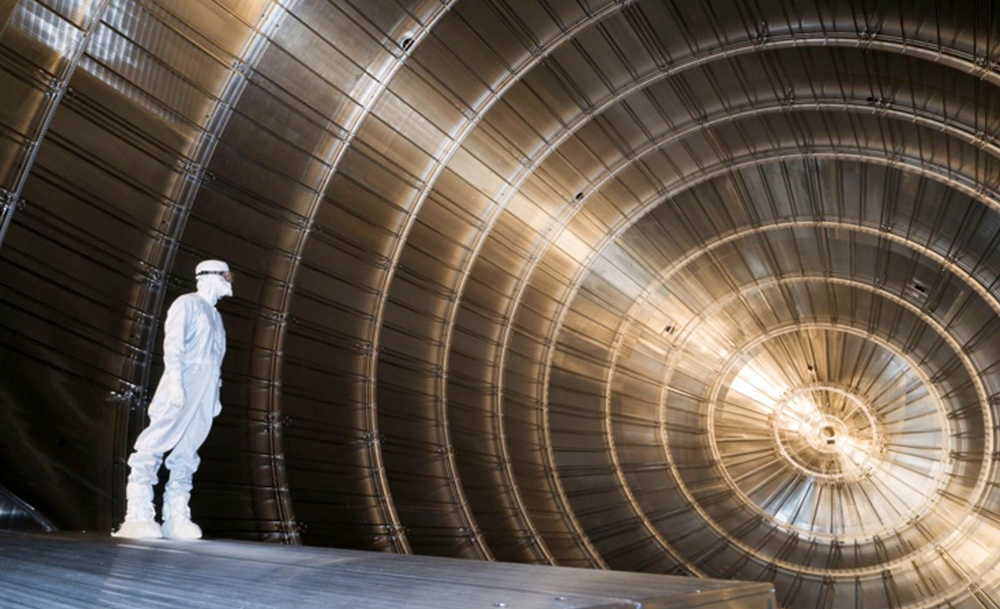
That’s where the KATRIN experiment comes in. With a scientific collaboration involving 20 institutions from 7 countries, including Italy and INFN (National Institute for Nuclear Physics), KATRIN aims to measure the neutrino mass in a laboratory setting using a method independent of any specific theoretical model. It does this by analyzing the beta decay of tritium, an unstable isotope of hydrogen: the energy distribution of the resulting electrons allows for a direct kinematic determination of the neutrino mass. Achieving this requires highly advanced technology: KATRIN’s 70-meter-long beamline hosts a powerful tritium source and a high-resolution spectrometer 10 meters in diameter. This cutting-edge setup allows for unprecedented precision in direct neutrino mass measurements.
The quality of KATRIN’s initial datasets has steadily improved since measurements began in 2019. “For this result, we analyzed five measurement campaigns, covering about 250 days of data collection from 2019 to 2021—roughly a quarter of the total data KATRIN is expected to collect,” explains Kathrin Valerius (KIT), one of the experiment’s two scientific coordinators. Susanne Mertens (Max Planck Institute for Nuclear Physics MPIK and Technical University of Munich TUM), the other KATRIN coordinator, adds: “With each campaign, we gained new insights and further optimised the experimental conditions.”
“Our neutrino mass measurements will continue through the end of 2025. Thanks to ongoing improvements in the experiment and data analysis, as well as a larger dataset, we expect even greater sensitivity, and hopefully groundbreaking discoveries,” comments Marco Carminati, professor at Politecnico di Milano and INFN researcher, and national coordinator of the experiment.
KATRIN is already a world leader in direct neutrino mass measurements and its initial data improved the limits set by previous experiments by a factor of four. The latest findings indicate that neutrinos are at least a million times lighter than electrons, the lightest charged elementary particles. Explaining this vast mass difference remains a fundamental challenge for theoretical particle physics.
Beyond precision mass measurements, KATRIN is already preparing for its next phase. Beginning in 2026, a new detector called TRISTAN will be installed. INFN is contributing to TRISTAN’s development in the areas of electronics, detector modeling, and data analysis. This upgrade will enable the search for the sterile neutrino, a hypothetical particle that interacts even more weakly than known neutrinos. With an expected mass on the order of keV/c², sterile neutrinos are strong candidates for explaining dark matter.