Eighteen new detection units and an advanced long-range acoustic positioning system: the most recent offshore campaign by the KM3NeT collaboration, conducted over the past two weeks off the coast of Capo Passero, in Sicily, has concluded successfully, setting a new operational record for the project.
KM3NeT is a large-scale telescope that explores the universe from the depths of the Mediterranean Sea and which, in February 2023, detected the most energetic cosmic neutrino ever observed, with an energy of about 220 PeV. Its gigantic infrastructure consists of two detectors – ARCA, in Sicily, dedicated to the study of high-energy neutrinos and their cosmic sources; and ORCA, off the coast of Toulon in France, optimised for investigating the fundamental properties of neutrinos – and, once completed, it will span a volume exceeding one cubic kilometre, hence the name, KM3NeT.
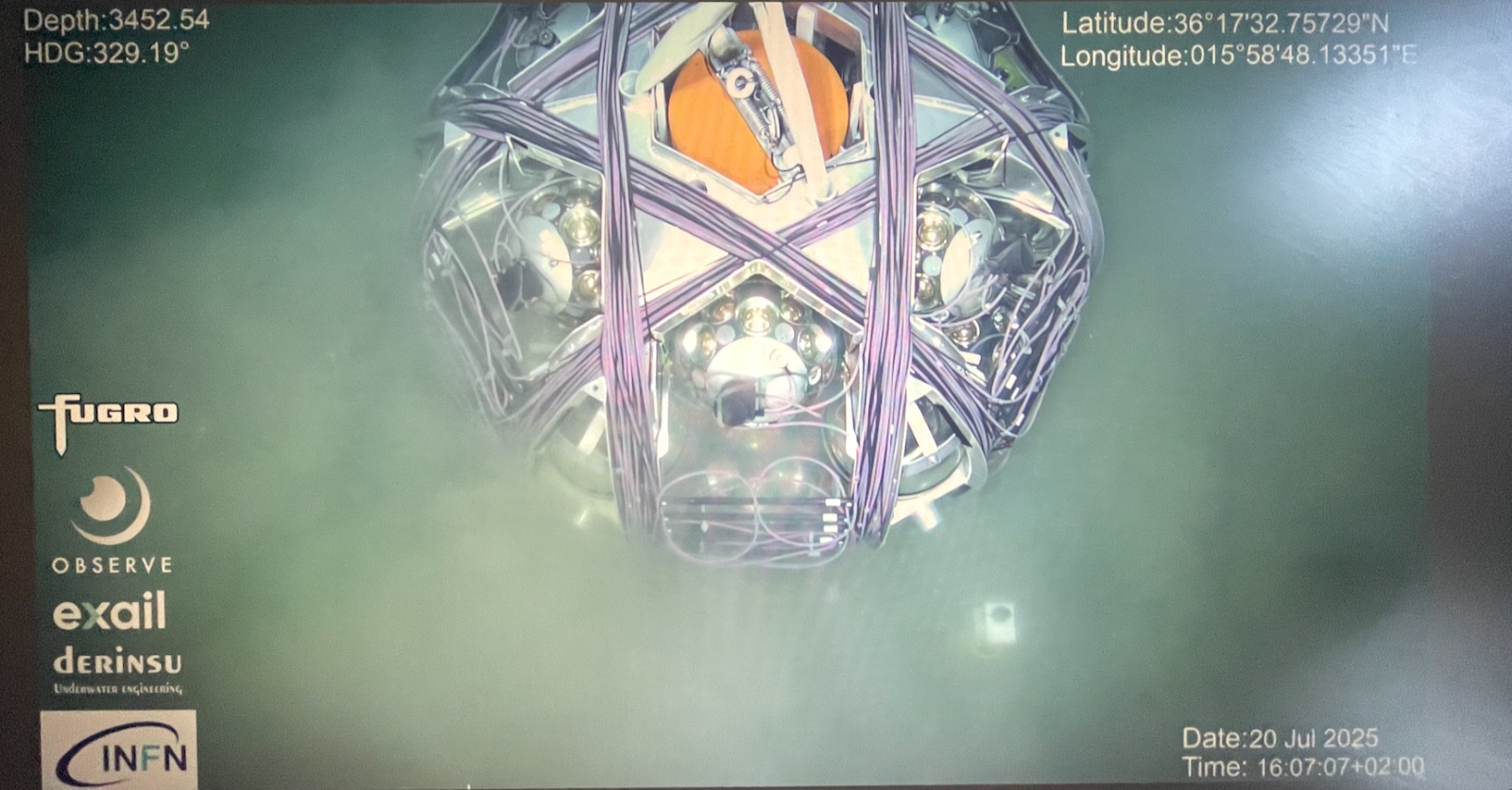
Thanks to the installation of 18 new detection units (DUs), ARCA now has 51 units deployed, almost a quarter of the total planned. Each unit, 700 metres tall and approximately 100 metres apart from the others, houses 560 photomultipliers arranged in 18 optical modules distributed vertically along each string: light detectors that are the ultra-sensitive “eyes” of KM3NeT. These “eyes” record signals from the cosmos and send them to the mainland via a system of long-distance electro-optical cables and underwater junction boxes.
“The Sicilian network currently includes two 100-kilometre-long electro-optical cables and five junction boxes built with advanced technologies, requiring particularly complex integration work”, said Nunzio Randazzo, technologist at INFN Catania division.
“So far, installation across the entire underwater infrastructure has been carried out with a success rate above 99%, with only a very small number of optical modules experiencing issues after deployment”, added Emanuele Leonora, technologist at INFN Catania division and coordinator of optical module integration for KM3NeT. “This result is due to the outstanding teamwork across eight different integration sites”.
“Italy has played a fundamental role in every stage of this international effort, thanks to a wide network of laboratories working in close synergy”, emphasised Marco Circella, researcher at INFN Bari division and former technical project manager of the collaboration.
The offshore operation, completed earlier this week, involved a large team of scientists, engineers, and operators, and it was carried out on board the Optimus Prime vessel, which sailed from Malta and was managed by Fugro-Derinsu. The underwater activities were performed with the support of a ROV (Remotely Operated Vehicle) operated by Observe, which helped positioning of the detection units on the seafloor, connecting the units to the junction boxes, inspecting and measuring the location of the deployed structures, and triggering the release mechanism that allows the detection unit to unfold from its launcher. Meanwhile, the installation of the new acoustic positioning system was handled by EXAIL, using state-of-the-art autonomous acoustic beacons.
Rosa Coniglione, researcher at INFN National Laboratories of the South and KM3NeT physics coordinator, explained: “The system composed of the three newly installed acoustic beacons together with a fourth previously deployed one will enable, in combination with the already operational triangulation system, sub-metre precision in the absolute positioning of the telescope, further improving its pointing capabilities”.
“This campaign enabled the completion of an extraordinary number of activities with unprecedented efficiency, setting a new performance record for KM3NeT’s open-sea operations”, stated Pasquale Migliozzi, researcher at INFN Naples division and national coordinator of the experiment. “The increase in the telescope volume also opens new scenarios for exploring the universe through cosmic neutrinos, boosting KM3NeT’s scientific potential”.
Giacomo Cuttone, scientific coordinator of the project for INFN National Laboratories of the South, highlighted the strategic national significance of the campaign: “The success of this operation marks a decisive step toward completing the KM3NeT4RR project, aimed at enhancing the ARCA detector and funded with 67 million euros by the Italian Ministry of University and Research (MUR) under the National Recovery and Resilience Plan (PNRR)”.
The milestone just reached is only the first step towards the next one, which will consist in starting data acquisition with the telescope in its new configuration. As stated by Francesco Benfenati, technologist at INFN Bologna division, the collaboration is already conducting the necessary tests with the goal of bringing the upgraded apparatus into full operation as soon as possible.
The KM3NeT collaboration brings together over 360 scientists, engineers, technicians and students from 68 institutions across 21 countries worldwide. Italy’s contribution is coordinated by the INFN Istituto Nazionale di Fisica Nucleare, which participates through research groups based at National Laboratories of the South and the divisions of Bari, Bologna, Catania, Florence, Genoa, Naples, Padua and Rome, as well as the affiliated group of Salerno, in collaboration with the respective universities: Politecnico di Bari, Alma Mater Studiorum University of Bologna, University of Catania, University of Genoa, University of Naples Federico II, University of Florence, University of Campania Luigi Vanvitelli, University of Padua, Sapienza University of Rome and University of Salerno.