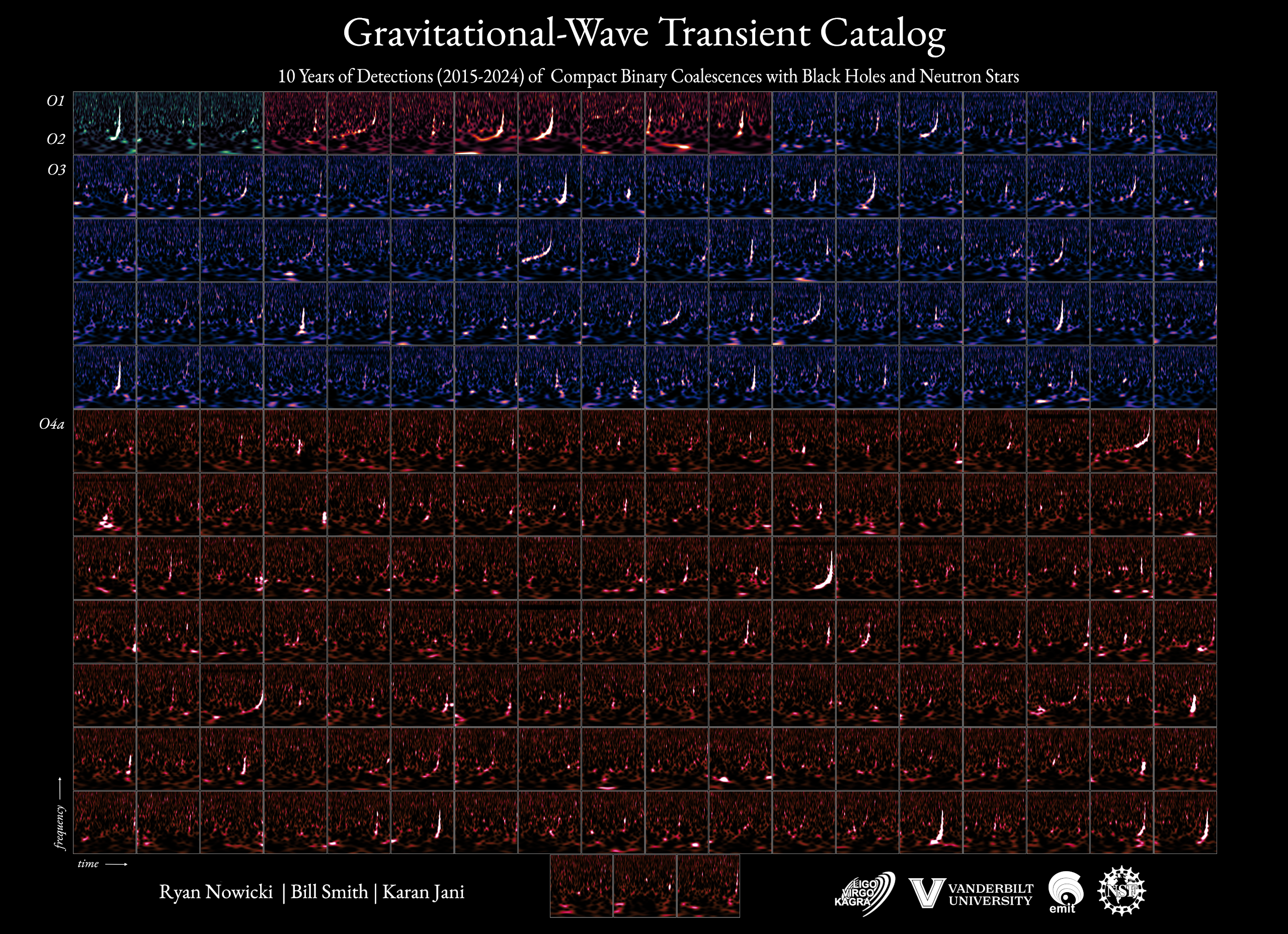
The catalogue of all 128 new events observed by LIGO, Virgo and KAGRA between May 2023 and January 2024 was published today, 5 March 2026. The catalogue reveals an even greater variety of binary systems producing gravitational waves than previously known. The new observations allow us to better understand the formation of black holes, to investigate the cosmological evolution of the universe and to provide increasingly stringent confirmations of the theory of general relativity.
The international network of gravitational-wave detectors LIGO in the United States, Virgo in Italy and KAGRA in Japan (LVK) announced today the publication of an updated catalogue of all gravitational events observed so far, called Gravitational-Wave Transient Catalogue-4.0 (GWTC-4).
The results are the outcome of in-depth analyses, carried out over more than two years by the scientists of the LVK collaboration, to verify their validity and to study their most important astrophysical and cosmological implications.
The catalogue, accompanied by a series of articles published in Astrophysical Journal Letters, collects 128 new events, more than doubling the number of events in the previous catalogue, which contained the 90 signals detected during the three previous observing runs. The data, now made available for further analysis by research groups outside the LVK collaboration, reveal an even greater variety of binary systems that are sources of gravitational waves than previously known. Among these are the most massive binary black hole system ever detected via gravitational waves, a system with the greatest mass asymmetry ever observed and one in which both black holes exhibit exceptionally high spins, as well as two systems composed of a black hole and a neutron star.
“Over the past decade, gravitational-wave astronomy has progressed from the first detection to the observation of hundreds of black hole mergers”, comments Stephen Fairhurst, professor at Cardiff University and coordinator of the LIGO Scientific Collaboration. “These observations allow us to better understand how black holes form from the collapse of massive stars, to probe the cosmological evolution of the universe and to provide increasingly stringent confirmations of the theory of general relativity”.
“The publication of the GWTC-4 catalogue represents a decisive step forward, adding 128 new signals to our archive in less than one year of observations”, emphasises Gianluca Gemme, researcher at the Istituto Nazionale di Fisica Nucleare and coordinator of the Virgo collaboration. “This wealth of data reveals a true kaleidoscope of cosmic collisions: from the heaviest binary black holes ever detected, to pairs that rotate at almost half the speed of light. These are no longer exceptional cases, and they constitute the statistical basis necessary to test Albert Einstein’s general relativity with unprecedented precision, and to provide a new independent measurement of the expansion rate of the universe. For Virgo and the LVK network, these results demonstrate that we are mapping the complex evolution of the cosmos with a clarity never achieved before”.
Unusual signals Among the most unusual signals detected in the first phase of the O4 observing run is GW231123 (the name refers to the day on which the signal was observed, according to the US convention): this signal was generated by the most massive binary black hole system ever detected so far, each with a mass of about 130 times that of the Sun. Most of the black holes in binary systems observed so far have a mass of about 30 solar masses. The much more massive black holes that generated GW231123 suggest that each of them may be the result of a previous collision between lighter “progenitor” black holes, probably in extremely crowded and chaotic cosmic environments. Another case of extraordinary interest is GW231028, generated by a pair of black holes with the highest spin ever observed: both rotate at about 40% of the speed of light. Also in this case, the black holes may be the product of previous collisions, from which they would have inherited their enormous rotational energy. Among the events in the catalogue there is also GW231118, generated by an unusually unbalanced pair, with one black hole twice as massive as the other.
Thanks to the most recent gravitational-wave detections and the significant growth in data on black hole mergers, scientists have begun to study their properties also in terms of populations.
“Unexpected signals such as GW231123 and GW231028 remind us that the universe can surprise us. To truly understand it, our scientific models must be able to explain, and even anticipate, the full range of signals that nature produces”, explains Filippo Santoliquido, researcher at the Gran Sasso Science Institute.
The new data also allow research groups to refine tests and measurements previously carried out with a more limited data set, continuing to explore some of the major questions in contemporary physics that remain unresolved.
Was Einstein right? The new discoveries make it possible, for example, to further test Einstein’s theory of general relativity with greater precision: the theory that a century ago revolutionised our view of the universe, describing gravity as a geometrical property of space and time. Since then, Einstein’s theory has been confirmed by numerous experimental tests and observations, proving to be the best theoretical description of gravity available to us.
However, the fact that collisions between black holes shake space and time more intensely than almost any other conceivable phenomenon makes them ideal candidates for putting the theory itself to the test.
“When we test our physical theories, it is good to consider the most extreme situations possible, because it is precisely there that theories are most likely to fail and where we have the greatest chances of making new discoveries”, adds Aaron Zimmerman, associate professor of physics at the University of Texas at Austin.
Researchers tested Einstein’s theory using GW230814, one of the “strongest” gravitational-wave signals in this latest catalogue. The remarkable clarity of the signal made it possible to analyse it in detail to check for any deviations from Einstein’s theory. So far, however, the theory has passed all tests.
“I am excited to see how the growing number and improving quality of gravitational-wave detections are enabling increasingly sensitive tests of general relativity in the dynamical and strong-field regime of gravity”, comments Soumen Roy, researcher at the Centre for Cosmology, Particle Physics and Phenomenology (CP3) at the University of Louvain in Belgium. “With future observations covering a wider range of black hole masses, spins and orbital eccentricities, we will be able to place tighter constraints on alternative theories of gravity and, potentially, also discover signals of new physics”.
How fast is the universe expanding? Another major mystery in cosmology concerns the rate at which our universe is expanding today. To answer this question, it is essential to estimate the Hubble constant, which indicates the current expansion rate of the universe. There are several estimates of this constant which, using different methods and astrophysical sources, have produced conflicting results.
Gravitational waves offer an additional way to measure the Hubble constant, because by studying the signal it is possible to calculate, in a relatively straightforward way, the distance travelled by the source.
By analysing all the gravitational-wave detections in the entire LVK catalogue, scientists have developed a new independent estimate of the Hubble constant, which suggests that the universe is expanding at a rate of 76 kilometres per second per megaparsec, meaning that a galaxy located one megaparsec from Earth would be receding from us at a speed of 76 km/s.
“There is growing excitement around gravitational-wave cosmology”, comments Ulyana Dupletsa, researcher at the Marietta Blau Institute (Austrian Academy of Sciences). “In addition to representing a new and independent approach, it is very interesting because it avoids the complex calibration required by established methods. Although we do not yet have a sufficient number of observations to match the precision of traditional measurements, each new gravitational-wave detection helps to shed more and more light on how fast our universe is expanding”.
Link to other images