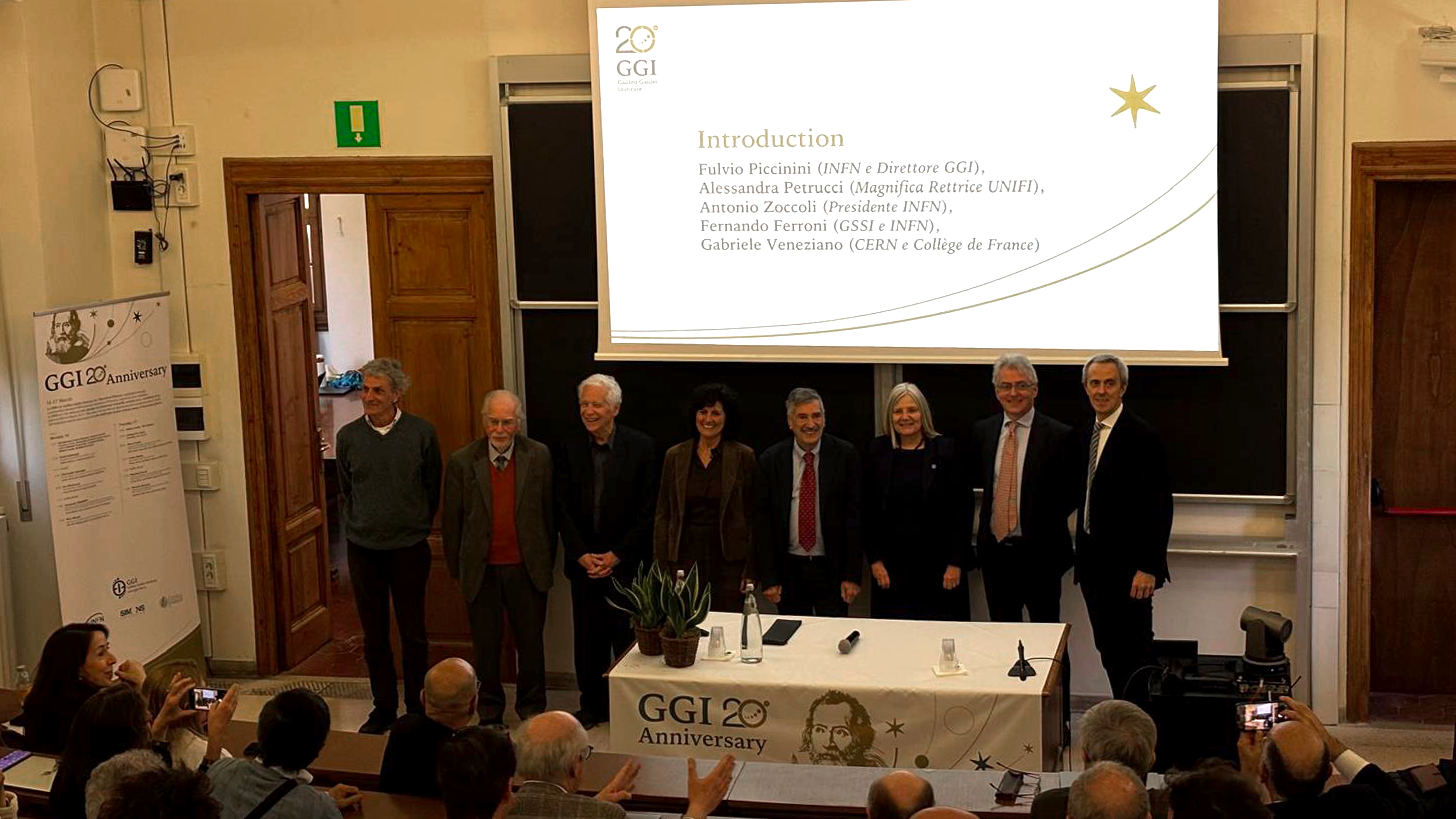
The first European institute dedicated to research in theoretical physics of the fundamental interactions: the Galileo Galilei Institute (GGI), National Centre for Advanced Studies of INFN in partnership with the University of Florence, celebrates twenty years of activity with an event aimed at the scientific community, which is gathering at the centre’s headquarters in Arcetri between today and tomorrow, 16 and 17 March, to discuss the most recent developments and new challenges in several leading areas of theoretical physics.
Twenty years ago, in 2006, GGI hosted its first workshop dedicated to physics beyond the Standard Model in field and string theory. This event marked the beginning of the centre’s activities, which originated from a 2003 proposal by the theoretical physicist Giuseppe Marchesini. Over two decades of activity, GGI has established itself as one of the main international reference centres for theoretical physics, through the organisation of long-duration scientific workshops devoted to frontier topics.
A central role in the activities of GGI is also played by the numerous thematic schools aimed at PhD students and dedicated to field and string theory, theoretical physics of the fundamental interactions, nuclear and hadronic theoretical physics, statistical field theory and astroparticle physics, cosmology and gravitation. The first school, dedicated to field and string theory, was hosted between November and December 2008 and since then GGI has hosted 67 of them, welcoming thousands of PhD students from all over the world.
In 2018, the centre acquired organisational and administrative autonomy, becoming a National Centre for Advanced Studies of INFN, and, on the occasion of this change, INFN, together with GGI, established the Galileo Galilei Medal, a prestigious international award granted every two years to scientists who have made an exceptional contribution to the progress of research in theoretical physics. Since then, the Medal has been awarded to nine internationally renowned scientists: Juan Martin Maldacena, Alessandra Buonanno, Thibault Damour and Frans Pretorius, Zvi Bern, Lance Dixon and David Kosower, Pierre Sikivie and Leonard Susskind.
To promote and encourage the presence of young women researchers in theoretical physics, the INFN “Women in Theoretical Physics” prize ceremony is held every year at GGI, established in 2020 and dedicated to Milla Baldo Ceolin, a charismatic figure and internationally renowned scientist, the first woman to hold a professorship at the University of Padua. In these years, the award has been granted annually to recent graduates for the best master’s thesis work in the field of theoretical physics on topics of interest to INFN, namely field and string theory, phenomenology of elementary particles, nuclear and hadronic physics, mathematical methods, astroparticle physics and cosmology, statistical physics and applied field theory.
Over the years, GGI has strengthened its international dimension, also thanks to the support of the Simons Foundation, which has funded programmes dedicated to long-term research visits, to the participation of internationally renowned scientists in the centre’s workshops and to the involvement of young researchers and PhD students from institutions with limited resources. The collaboration with the Simons Foundation also contributes to the development of the Pollica Physics Centre, a new centre dedicated to the organisation of workshops in theoretical physics and mathematics in the municipality of Pollica, in the Cilento area, further strengthening the network of scientific initiatives devoted to the study of the frontiers of theoretical physics.
“In two decades GGI has established itself as a reference point for the international scientific community, both for its research activity through extended workshops and for its advanced training with schools aimed at PhD students”, says Fulvio Piccinini, director of GGI. “Three simple indicators of this are: the high number of scientists who participate each year in GGI scientific programmes; the two prestigious Simons Foundation grants awarded to INFN for GGI in less than ten years; more than 1,600 scientific publications that have been conceived or developed during the stays of scientists involved at GGI. In the future it will be important to maintain the excellence of GGI’s scientific level in the continuously evolving landscape of theoretical physics and to further develop fruitful synergies with research in experimental physics, in particular those in which INFN is directly involved. At the same time, it will be important to develop forms of collaboration with other research centres in theoretical physics to foster the exchange of knowledge and the consequent emergence of new ideas”.