Entanglement, i.e. the correlation, the “intertwining” that exists at the quantum level among the properties of physical systems after these have interacted with each other, has been verified in atomic physics by measuring the violation of the “Bell inequality”, named after the physicist J. S. Bell. It was actually Bell who first understood that for systems in which the properties are locally determined and that, thus, can be divided into their parts without any intertwining, there is a mathematical relation – an inequality – among the values of the measurement of these properties that can never be violated. However, in quantum mechanics, where these values are entangled probabilities, inequality is violated.
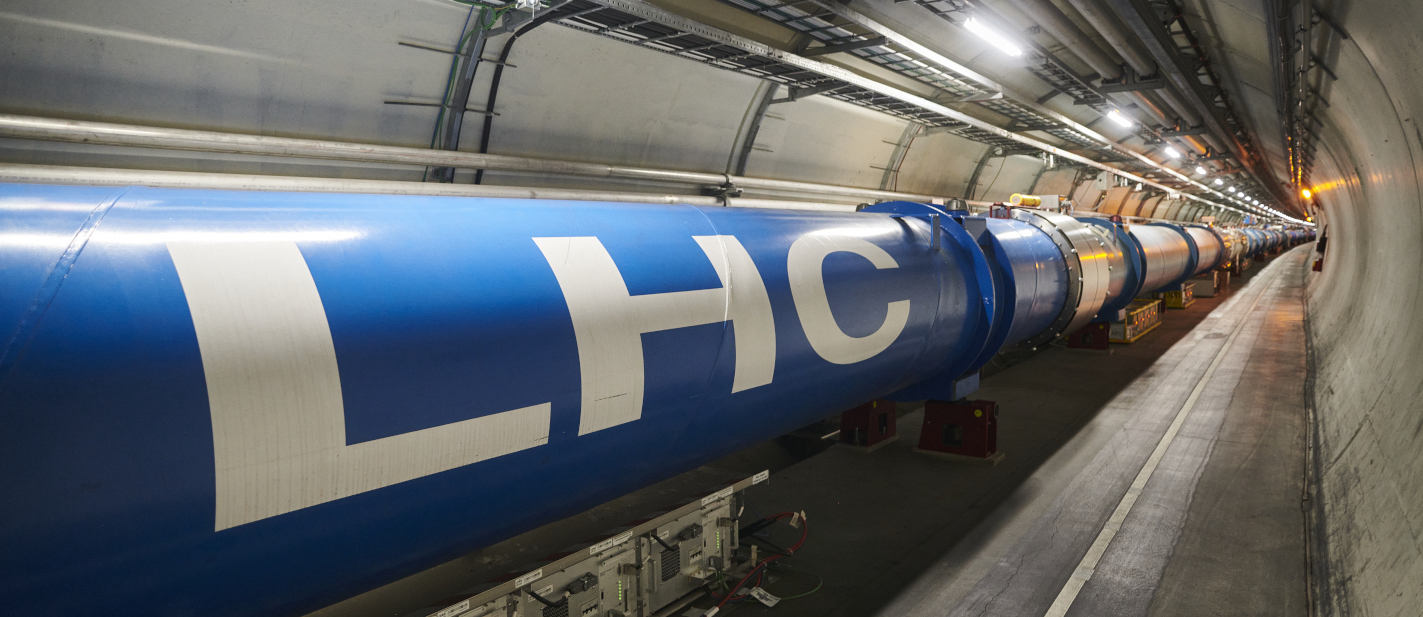
A study recently published in Physical Review D, and selected as one of the editor’s suggestions, shows that it is possible to study quantum entanglement and the violation of Bell inequality through particle accelerator experiments. The theoretical group that authored the study, which INFN researchers are also part of, used the analyses of the LHCb experiment at CERN’s Large Hadron Collider on the polarisation of particles involved in some decays to calculate the entanglement between the final products of these events. The results confirm that Bell inequality is violated, in accordance with the general principles of quantum mechanics. “This research helps us to understand not so much what the physical world is made of (electrons, quarks, or dark matter) but how these components behave, whatever their nature is”, comments Roberto Floreanini, researcher at the Trieste INFN Division and one of the authors of the study just published.
The extension of the study of quantum entanglement in the field of particle physics is not just a reformulation, at higher energies, of what was studied in atomic physics. It is of wider interest, because it also involves new aspects, like the experimentation of quantum mechanics with weak and strong interactions and in the presence of more complicated states of photons. This result confirms that studies of quantum mechanics in accelerators are not just possible but constitute a new research thread. This research is at the start, but already quickly developing, with the introduction of new and sophisticated observables for comparing experimental data and predictions of the Standard Model, the theory that describes elementary particles and their fundamental interactions.