Confirmations of the Standard Model and hints of new physics emerge from the recent study “The Standard Model tested with neutrinos”, published in Physical Review Letters and carried out by researchers from the INFN divisions of Cagliari, Tor Vergata and Turin, from the Gran Sasso National Laboratories, and from the Gran Sasso Science Institute (GSSI). The study brings together decades of data from various low-energy neutrino experiments to produce a unified and highly precise test of the Standard Model, the theory that describes elementary particles and their interactions.
“Until now these experimental data have been considered as separate pieces of a mosaic. By connecting them for the first time, we have transformed the study of low-energy neutrinos into a test of extremely high precision for the Standard Model”, commented Matteo Cadeddu, researcher at the INFN Cagliari division. “The results show that the key to new physics may also be hidden in the subtlest details and in the interactions of the most elusive particles, if investigated with the right methodology”.
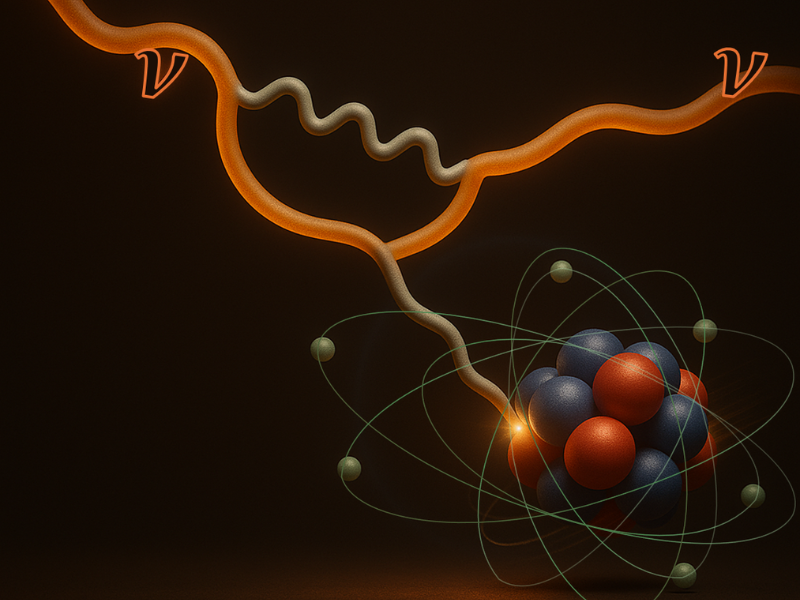
Theorised in 1930 by Wolfgang Pauli, incorporated in 1934 into Enrico Fermi’s theory of beta decay, and experimentally confirmed in 1956 by Reines, Cowan and their collaborators, neutrinos are often called “ghost particles” precisely because of their elusiveness: they interact extremely rarely with matter and pass through us continuously almost without leaving a trace. However, over time the development of increasingly sensitive experiments based on different approaches has made it possible to observe these particles, produced by nuclear reactors or particle accelerators, or originating from the Sun. All these experiments have obtained independent results, which the authors of this study have now organised into a single coherent framework, obtaining original results such as the determination of the neutrino charge radius – that is, how “large” the neutrino appears to the electromagnetic force – and updated measurements of the parameters that describe the interaction of the neutrino with the electron.
“Attributing a charge radius or a size to a neutral and point-like particle such as the neutrino appears counterintuitive. In reality, in quantum field theory even an electrically neutral particle can possess an effective and measurable charge radius, which reflects the way it responds to the electromagnetic interaction”, explains Nicola Cargioli, researcher at the INFN Cagliari division. “Having isolated this property within decades of measurements represents a significant milestone: it confirms that, in order to find new physics, we can also look at the most imperceptible properties of particles”.
Alongside this solid confirmation of the Standard Model, the analysis also revealed another interesting element. The data, while being compatible with the current theory, leave open the possibility of an alternative scenario: a “mirror” solution of the weak interactions emerges, namely a different possible configuration of the parameters that describe these interactions, which is currently favoured from a statistical point of view.
“We are not yet faced with definitive proof”, says Mattia Atzori Corona, researcher at the INFN Rome Tor Vergata division. “It will be up to future experiments to clarify whether we are observing a statistical fluctuation or a real deviation from the predictions of the Standard Model”.
The overall result is therefore twofold. On the one hand, the Standard Model passes a particularly stringent test, significantly narrowing the space for new exotic interactions. On the other hand, the analysis reveals a small but intriguing deviation from the textbook prediction, a hint that is not conclusive but will be important to examine with future measurements. In this sense, the work tightens the net around the possibility of new physics and also provides an indication of where the next clues might emerge.
In addition, the study lays the foundations for a new research programme: the use of increasingly sensitive low-energy neutrino and dark matter detectors as precision instruments, capable of carrying out tests that once seemed to require only ultra-high-energy colliders. The work thus offers a new reference point for ongoing and future experiments, and for how “tabletop” neutrino measurements can continue to challenge our best theory of fundamental particles.