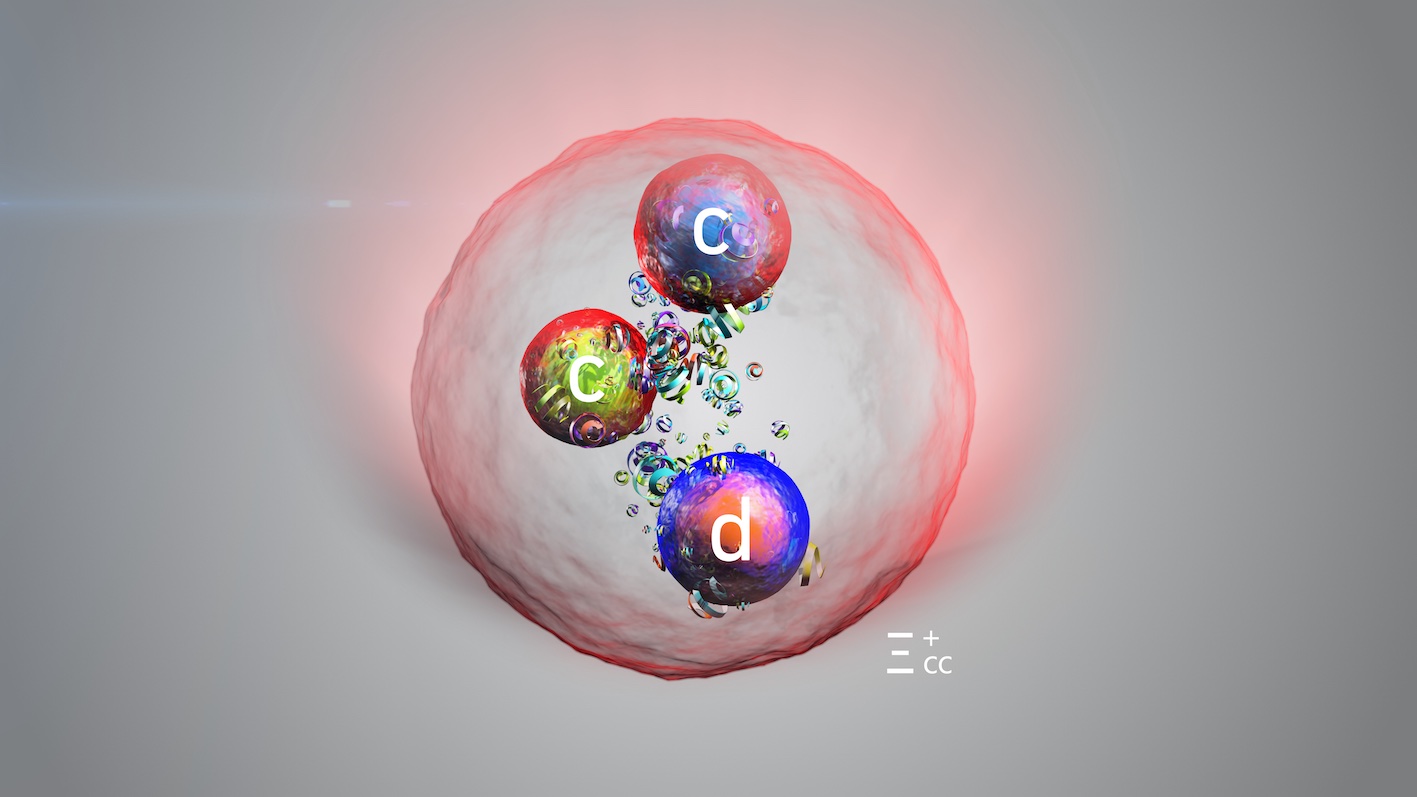
The LHCb experiment at the CERN LHC accelerator has observed for the first time, with a statistical significance of 7 sigma, a new particle composed of two charm quarks and one down quark: a structure similar to that of the familiar proton, but in which the two up quarks of the proton are replaced by two charm quarks which, being heavier, quadruple its mass. The discovery was presented yesterday, 16 March, at the annual Rencontres de Moriond conference, which this year celebrates its sixtieth edition.
The observation of the new hadronic particle, whose scientific name is Xi_cc+, is very difficult because it is produced very rarely in proton collisions at the LHC due to the presence of the two charm quarks, and because it is unstable, unlike the ordinary proton which is instead a stable hadron. However, even though unstable hadrons decay rapidly, the stable particles resulting from their decay can be detected and, from them, the properties of the original particle can be inferred.
Researchers use this approach to discover new hadrons, and the new particle presented today by the LHCb experiment collaboration is the eightieth new hadron discovered in LHC experiments. In 2017, the LHCb experiment had already presented the first observation of a particle belonging to the same “family” of hadrons, composed of two charm quarks and one up quark, the only difference compared to the new particle, which instead contains a down quark. Despite the similarity, the new particle, due to complex quantum effects, has a lifetime up to six times shorter than that of the 2017 particle: if it were at rest, it would last only about 45 femtoseconds, that is 45 millionths of a billionth of a second.
“This is the first new particle identified after the upgrade interventions on the LHCb detector completed in 2023”, explains Vincenzo Vagnoni, INFN researcher who leads the LHCb scientific collaboration. “This observation may contribute to testing theoretical models of quantum chromodynamics, the theory that describes the strong force that binds quarks not only in ordinary hadrons, but also in more exotic hadrons such as tetraquarks and pentaquarks”.
“What makes this result so exciting is that we are opening a new window onto a very unusual form of matter. With the upgraded LHCb detector, whose improved performance has significantly increased our sensitivity to hadronic decays, this truly marks the beginning of a new era for these studies”, comments Ao Xu, a Chinese researcher from the Scuola Normale Superiore associated with INFN, who came to Italy thanks to the INFN postdoctoral fellowship programme reserved for foreign researchers, and who in the data analysis handled the real-time selection of the new particle. “Efforts are already under way to search for a further and even heavier baryon with double charm quarks that contains an additional strange quark, which will allow us to further deepen our understanding of the complexities of quantum chromodynamics”.
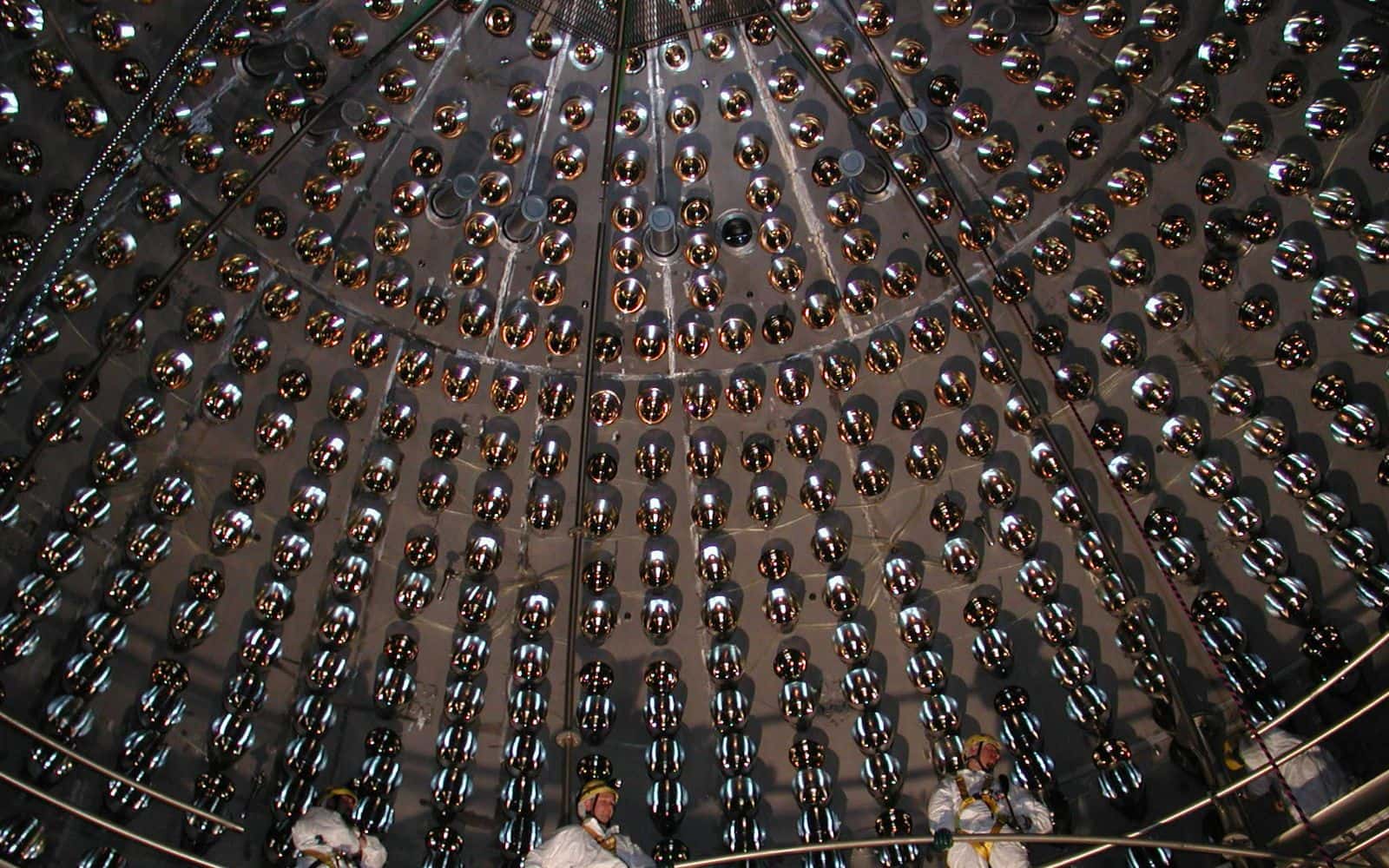
“The INFN groups, which represent almost one fifth of the entire LHCb collaboration, played a decisive role in upgrading the detector, in particular the Upstream Tracker (UT), the Ring Imaging Cherenkov (RICH) detector and the muon detector, as well as in the collection and analysis of the data that led to this new result”, comments Giovanni Punzi, INFN national coordinator in LHCb. “This is the second result obtained with the new detector and confirms LHCb’s ability to operate successfully with a beam intensity a factor of 5 higher than in the past, motivating us to continue with the new LHCb upgrade currently under design, which will lead to a further increase in intensity by another factor of 5, and which will also be carried out with crucial participation from INFN”, concludes Punzi.