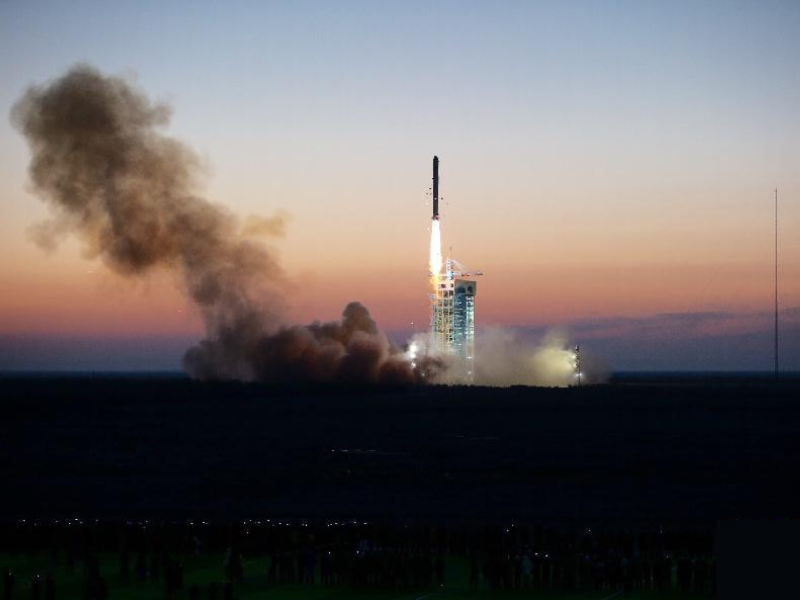
In December 2015, aboard the Long March 2D vehicle, DAMPE (DArk Matter Particle Explorer) experiment entered orbit with the aim of searching for clues about dark matter through the direct study of cosmic radiation. The mission, promoted by the Chinese Space Agency, is the result of a broad international collaboration involving the Italian National Institute for Nuclear Physics (INFN) – with its Perugia, Bari and Lecce divisions and the Gran Sasso National Laboratories –, the Chinese Academy of Sciences, the Gran Sasso Science Institute, the Universities of Perugia, Bari and Salento, and the University of Geneva. It includes more than 150 scientists, technicians and PhD students who, on the Chinese side, are affiliated with various institutions led by the Purple Mountain Observatory in Nanjing.
It is precisely in Nanjing that today, 17 December 2025, the mission’s ten years of data taking are being celebrated, as part of the International Workshop on Cosmic Ray Direct Detection and Physics, a valuable opportunity to look at the state of the art of physics in this field, through the testimony of those who have conducted experiments in space or on the ground to study cosmic rays (highly energetic particles of astrophysical origin that incessantly bombard our planet). The DAMPE Collaboration will also take this opportunity to review the ongoing analyses and discuss the most recent results of the experiment, to which the Italian component has made a significant contribution.
“We are truly proud of the milestone achieved”, commented Giovanni Ambrosi, Italian initiator of the experiment and researcher at the INFN Perugia division. “Over these ten years we have obtained several important results, thanks to the excellent performance of the detector, the valuable work of all members of the collaboration, and the outstanding quality of the data analysis”.
Among the most significant results of DAMPE experiment we can list: the discovery of the sudden decrease in the flux of cosmic electrons and positrons at around 1 TeV (Nature 552, 63, 2017); the direct measurement of the flux of protons (Sci. Adv. 5, 2019) and of cosmic helium nuclei (Phys. Rev. Lett. 126, 2021) up to extremely high energies, of the order of 100 TeV, as well as of cosmic nuclei of heavier elements – from helium up to nickel –, thanks to the detector’s ability to identify with great accuracy the nature of the particles (see for example Phys. Rev. Lett. 134, 2025 on the measurement of the boron nuclei flux); and the measurement of the combined flux of protons and helium nuclei up to 500 TeV – an energy never reached before with direct measurements – which enabled a connection with ground-based measurements, typically affected by large uncertainties, and bridged the energy gap between direct and indirect observations (Phys. Rev. D 109, 2024).
Of particular importance are also the measurements, characterised by unprecedented accuracy and energy range, of the ratios between the fluxes of nuclei of different species as a function of energy (for example the relative abundance of boron with respect to carbon and oxygen, in Science Bulletin 67, 2022), which provide fundamental information on the mechanisms of production and propagation of cosmic rays in the Galaxy. In this context are the most recent results on the energy spectra of cosmic nuclei: the DAMPE Collaboration has in fact observed a marked attenuation, known as softening, of the flux with increasing energies (already known for protons and helium) to manifest itself systematically also for heavier nuclei (carbon, oxygen, iron), as shown in a recent work submitted to Nature and currently available on arXiv. The energy scale at which the softening appears seems to depend on the atomic number Z rather than on the mass of the nucleus, suggesting the existence of a universal feature of the energy spectra of cosmic-ray nuclei, from hydrogen (Z=1) to iron (Z=26), with important implications for the identification of galactic sources and acceleration mechanisms.
“DAMPE measurements are adding fundamental pieces to the complex and still incomplete picture of cosmic radiation”, state the leaders of the Italian data analysis groups. “The implementation of machine learning techniques in the data analysis has significantly improved the quality of event selection and reconstruction, allowing us to extract valuable indications on the origin and on the mechanisms of acceleration and propagation of cosmic radiation within the Galaxy”.
Thanks to its ability to measure with great precision the arrival direction of cosmic particles and photons and to distinguish the latter from charged particles, DAMPE is also able to operate as a gamma-ray telescope – it has observed and studied to date almost 400 galactic and extragalactic gamma-ray sources –, and its photon identification capability has proved fundamental in the search for particles originating from dark matter (Science Bulletin 67, 2022).
DAMPE experiment consists of three main subsystems: a bismuth germanate crystal calorimeter, which makes it possible to measure the energy of cosmic rays with excellent resolution; a charge detector, located at the top of the apparatus and made of two layers of plastic scintillators that emit light when particles pass through them; and a tracker composed of silicon strips and tungsten foils, capable of precisely reconstructing the arrival direction of cosmic rays. The latter was built in Italy under the coordination of the INFN Perugia division, and more generally the Italian component has played a leading role both in the construction and in the operation of the experiment. The Italian groups took part in the design, construction and commissioning phases of the apparatus, coordinated the testing of the detectors on proton, electron and ion beams at the CERN accelerators in Geneva, and continue to contribute significantly to the development of data analysis and simulation software.
Although the mission was planned to last “at least five years”, the detector is still in excellent condition and promises to provide interesting data well beyond the ten years of activity just completed.
For further information
DAMPE experiment website
DAMPE mission video