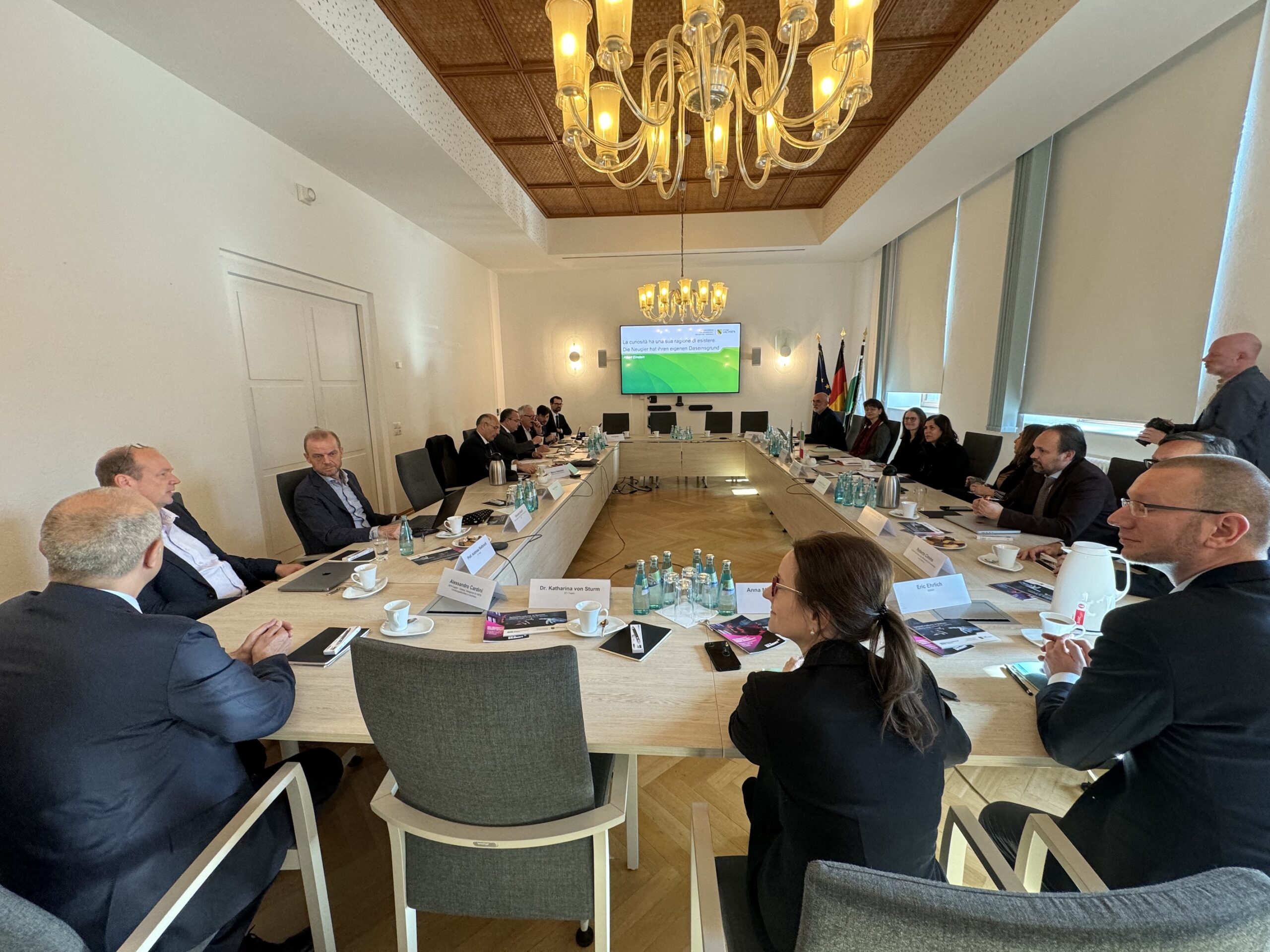
On Friday, March 6, an official meeting was held in Dresden at the Saxon Ministry of Science between an Italian and a Saxon delegation to further examine the operational aspects related to implementing the declaration of intent between the Region of Sardinia and the Free State of Saxony. The declaration had been signed last January 12 in Rome at the headquarters of the Ministry for Universities and Research (MUR). The document, signed by the President of the Region of Sardinia, Alessandra Todde, and the Saxon Minister of Science, Sebastian Gemkow, laid the foundations for scientific collaboration between the two regions, both candidates to host the future gravitational-wave observatory Einstein Telescope (ET). The Italian delegation, led by President Todde, included representatives of the Region of Sardinia, the MUR, the INFN, and the Embassy of Italy in Berlin. The Saxon delegation included members of the Ministry of Science, the Deutsche Zentrum für Astrophysik (DZA), the Technical University of Dresden, and the University of Freiburg.
“The meeting in Dresden allowed us to take an important step forward in the dialogue with Saxony, toward the concrete goal of producing a joint bid book for the Einstein Telescope”, said Marco Pallavicini, member of the INFN executive board with responsibility for the Einstein Telescope project. “Scientific collaboration between the Italian and Saxon communities, now also formalised at the political level through the recent declaration of intent, is strong and has been underway for some time, as demonstrated by the letter of intent signed at the end of 2024 between INFN and DZA and by the joint scientific activities currently ongoing at the two candidate sites”.
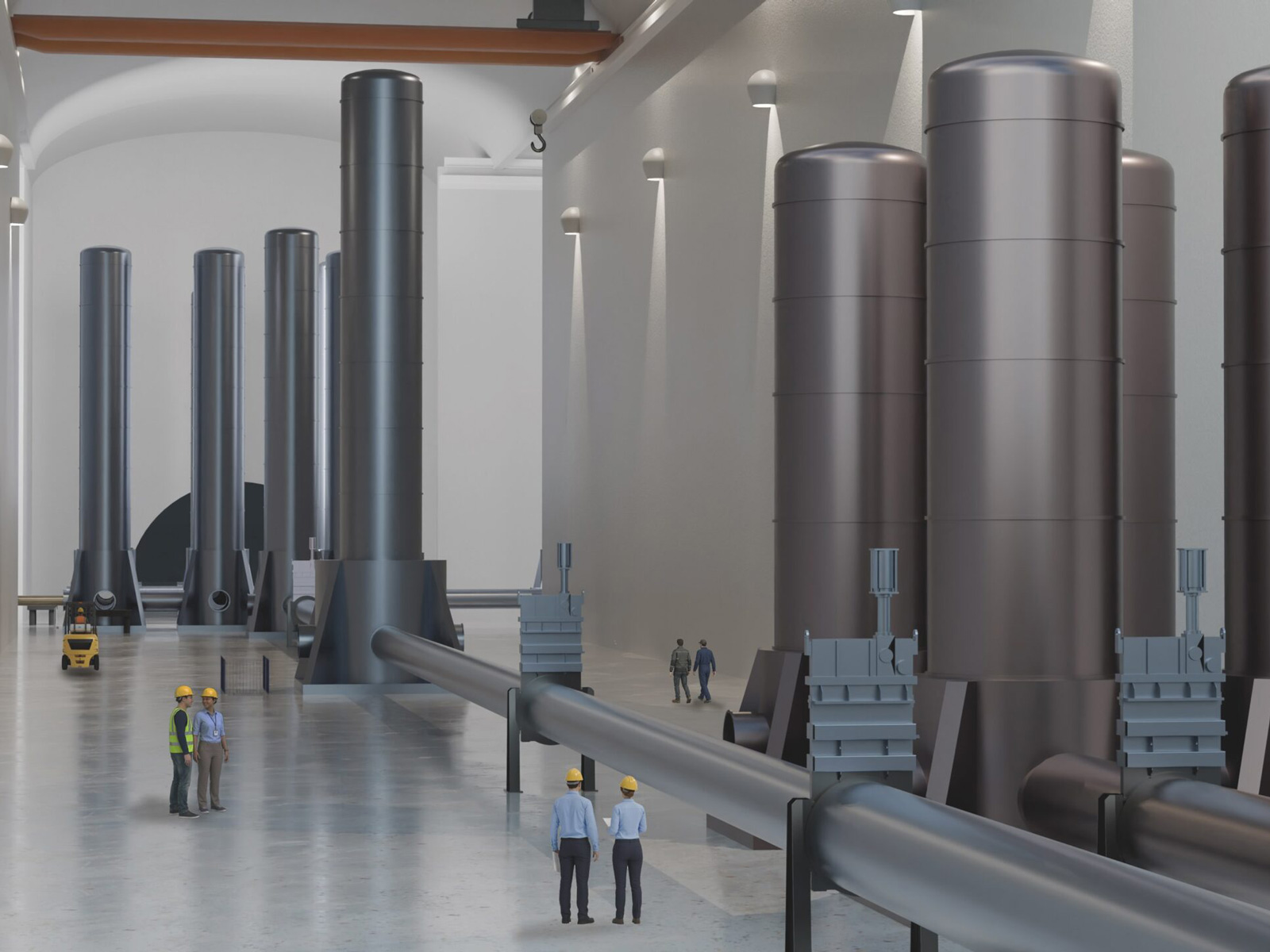
One of the central elements of the agreement between Sardinia and Saxony is actually support for the “double-L” configuration for the future gravitational wave detector, which provides two interferometers, each with two perpendicular arms of about 15 kilometers, to be constructed at two separate and geographically distant sites. This configuration is considered particularly effective in terms of scientific impact, technical feasibility, cost efficiency, and risk mitigation. This aspect was therefore one of the central topics of the Dresden meeting, where the delegations examined the operational implementation of the declaration of intent and began discussing the possibility of preparing a joint bid to host ET, involving the construction of the two “L” interferometers respectively at the candidate sites of Sos Enattos and Lusatia.
“The Einstein Telescope is a symbol of research on a global scale, a unique opportunity for Europe and for Saxony. This project will bring internationally renowned scientists to Lusatia and will place the region firmly on the European research map”, added Christian Stegmann. “Together with the local population, we want to build the observatory in the coming years. In this way we will create new economic value, strengthen the region in its process of structural transformation, and open up new long-term prospects, especially for young people”.
The Dresden meeting took place the day after an event presenting Lusatia’s candidacy for ET, hosted at the representation office of the Free State of Saxony in Berlin. Among the speakers at the event were the Minister-President of Saxony, Michael Kretschmer; President Alessandra Todde; the deputy spokesperson of the Einstein Telescope scientific collaboration, Harald Lueck; and one of the scientific coordinators of the feasibility study for the Lusatia site, Christian Stegmann.
“Last night, at the Representation of the Free State of Saxony, we had the opportunity to present our candidacy in front of parliamentarians, diplomats and scientists, – said President Alessandra Todde – while today we focused in greater depth on the Sardinia-Saxony agreement and on the common steps we will need to take in the coming months”. The president also outlined the approach adopted by the Region to support the candidacy, both financially and politically, and “in full alignment with the scientific community and the national government”. Addressing local authorities, she confirmed her full willingness to support them “in strengthening the Saxon candidacy, with the aim of increasing the chances of realising ET in the double-L configuration”.