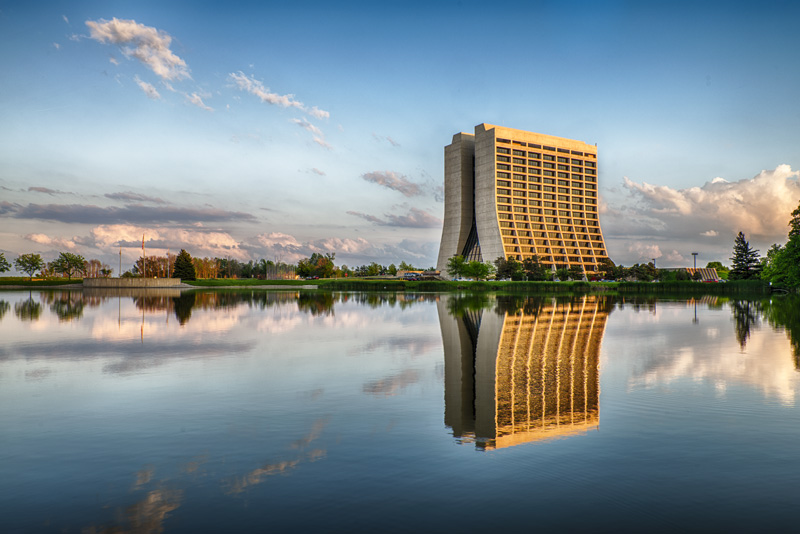
 Ten international institutions – including INFN, on behalf of Italy, and CERN – signed an agreement to build the gigantic underground neutrino detector, DUNE (Deep Underground Neutrino Experiment), in the US. DUNE is an international scientific experiment that will use enormous particle detectors to study the behaviour of neutrinos and, in particular, neutrino oscillation. DUNE will consist of two underground detectors placed 1,300 kilometres apart. They will have the task of identifying the features of neutrinos and their transformations ‘en route’ from Fermilab (FNAL) – 40 km from Chicago, where high-energy beams of these particles will be produced using the new superconductor accelerator – to the Sanford Underground Research Facilities (SURF) in South Dakota. Both the detectors, the Near Detector at Fermilab (ND) and the Far Detector in Sanford (FD), involve a decisive contribution from INFN. With this agreement, the DUNE collaboration, which includes scientists from dozens of countries and more than 200 research institutes from around the world, will contribute to building detectors in both sites in the United States