NOBEL PHYSICS. From X-rays to Gravitational Waves: More Than a Century of Nobel-Winning Discoveries

1 October 2026

Every year for more than a century, since 10 December 1901, when the first award ceremony took place, the Nobel Prizes have been conferred on scientists of any nationality who have made contributions of outstanding importance in the fields of chemistry, physics, and physiology or medicine, as well as on intellectuals for their contributions to literature and peace. As significant from a scientific perspective as from a media one, the Nobel Prize is at the centre of a fascinating and complex history in which science and journalism have been intertwined from the very beginning. And it began with a bang.

Alfred Nobel, chemist, inventor and philanthropist

The Prize was created by Alfred Bernhard Nobel, a Swedish chemist (1833-1896), an extraordinarily successful entrepreneur, passionate about science and literature, cultured and cosmopolitan. He was a man who amassed a fortune through his inventions: he held no fewer than 355 patents, including those for blasting gelatine and dynamite, and during his lifetime established around 90 factories in some twenty countries. Although reserved by nature, Nobel was well known in political and business circles thanks to the success of his inventions. He was also known to the press, which famously made a spectacular mistake.

In 1888, a French newspaper published an obituary announcing the death of Alfred Nobel and remembering him with the caustic words: “The merchant of death is dead. Alfred Nobel, who became rich by finding ways to kill more people faster than ever before, died yesterday.” Not only was he very much alive, it was in fact his brother Ludvig who had died, but many of Nobel’s inventions had largely been used for civilian purposes (for example, dynamite played a crucial role in major engineering projects such as the construction of the Gotthard Tunnel).

Deeply affected by the incident, Nobel spent the following years imagining something that would permanently change his public image and ensure that the profits generated by his inventions would benefit science and human progress.
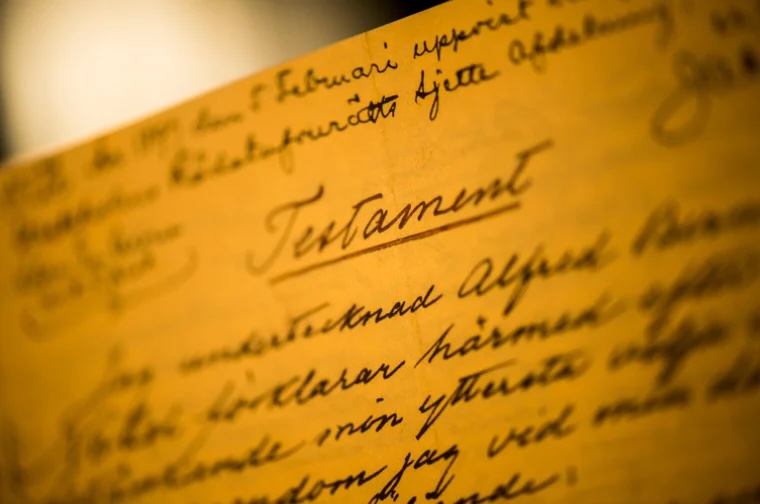
 

This was how the idea of the Prize took shape. In 1895, he set it down in writing, detailing its structure, financial endowment and governance in the lengthy will he drafted just one year before his death.

Once made public, Nobel’s wishes encountered opposition on several fronts: from family members who stood to lose a significant portion of the inheritance, from institutions reluctant to embark on such an ambitious and visionary project, and from some members of the scientific community who viewed the proposal with scepticism. Nevertheless, thanks to the determination of the executors appointed by Nobel, the engineer Ragnar Sohlman and the industrialist Rudolf Lilljequist, who defended the project, as well as Nobel’s nephew Emmanuel Nobel, who worked to ensure that his uncle’s final wishes were respected, Alfred Nobel’s vision became a reality.

In June 1900, the Nobel Foundation was established. It decreed that the prizes would be awarded at a ceremony held on the anniversary of Nobel’s death, 10 December.

testament_nobel
The will of Alfred Nobel. © Nobel Media. Photo: Alexander Mahmoud
rontgen_x-ray_room
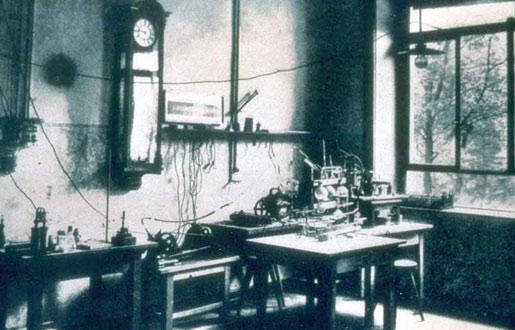
Wilhelm Röntgen's laboratory at the University of Würzburg, where he made his discovery of x-rays. Public domain via Wikimedia Commons Photographer unknown

The first Nobel Prizes

The following year, in 1901, the first Nobel Prizes were announced at the Royal Swedish Academy of Music. The first Nobel Prize in Physics was awarded to the German physicist Wilhelm Conrad Röntgen “in recognition of the extraordinary services he has rendered by the discovery of the remarkable rays subsequently named after him”: X-rays. The Nobel Prize in Chemistry was awarded to the Dutch scientist Jacobus Henricus van ‘t Hoff “in recognition of the extraordinary services he has rendered by the discovery of the laws of chemical dynamics and osmotic pressure in solutions”. The Nobel Prize in Physiology or Medicine was awarded to the German physician Emil von Behring “for his work on serum therapy, especially its application against diphtheria”, at that time the second leading cause of death. The Nobel Prize in Literature went to the French poet and philosopher Sully Prudhomme, while the first Nobel Peace Prize was shared between the Swiss humanitarian Henri Dunant, founder of the Red Cross and promoter of the Geneva Convention, and the French economist Frédéric Passy, founder of the first French society for arbitration between nations. In 1968, the Sveriges Riksbank established an additional award, the Prize in Economic Sciences in Memory of Alfred Nobel.

The Nobel Today: How It Has Changed Over Time

Over more than 120 years of history, the Nobel Prize has been awarded to 990 individuals and 28 organisations. Among the scientific disciplines, 119 Nobel Prizes have been awarded in Physics, 117 in Chemistry, and 116 in Physiology or Medicine. The 119 Nobel Prizes in Physics awarded so far have recognised 230 individuals, since many prizes have been shared by two or three scientists, but never by more than three, as stipulated by the rules of the award.
If one considers the nationality of the laureates or, more broadly, the country where they carried out the research for which they received the Nobel Prize, a marked geographical concentration becomes apparent. Throughout the history of the prize, the United States has established itself as the world’s leading research hub, collecting far more Nobel Prizes than any other nation. Considering the total number of Nobel laureates associated with a country, the United States leads the ranking with more than 400 laureates, followed by the United Kingdom with around 145 and Germany with more than 100. At some distance come France, Sweden and Japan, while Italy counts just over twenty Nobel laureates across the various disciplines. The most recent Italian to receive a Nobel Prize is the physicist Giorgio Parisi, awarded the Nobel Prize in Physics in 2021 for his contributions to the understanding of complex physical systems.
The distribution of Nobel Prizes partly reflects the geography of science, which has changed profoundly over time, showing the gradual shift of the world’s scientific centre of gravity from Europe to the United States in the decades following the Second World War and, more recently, the emergence of new scientific hubs in Asia, from Japan to China.

The behind-the-scenes story of the Nobel Prize in Physics is the subject of an interview published in the latest issue of the INFN newsletter, Particle Chronicle. The newsletter spoke with Mats Larsson, who served as a member of the Nobel Committee for Physics from 2013 and from 2016 to 2023.

Reading the History of Modern Physics Through the Nobel Prize
Throughout its history, the Nobel Prize has recognised many different areas of physics, but certain themes have occupied a particularly central role: quantum mechanics and its applications, condensed matter physics, nuclear and particle physics, and, more recently, cosmology, astrophysics and quantum technologies.
The prizes awarded to Max Planck, Niels Bohr, Albert Einstein, Erwin Schrödinger and Werner Heisenberg mark the milestones of the quantum revolution. Those devoted to the structure of the atomic nucleus, elementary particles and the fundamental forces accompany the construction of the Standard Model. More recent awards testify to physics entering new research frontiers, from astrophysics and gravitational waves to quantum information science.

From the Individual to Large Collaborations
The history of the Nobel Prize also reflects the transformation of the way science is conducted. At the beginning of the twentieth century, awards were often granted to individual scientists working in small laboratories, sometimes using instruments they had built themselves. Wilhelm Conrad Röntgen’s discovery of X-rays, or Henri Becquerel’s and the Curies’ discovery of radioactivity, belong to an era in which a single insight, or the work of a small number of researchers, could still open entirely new chapters in human knowledge.

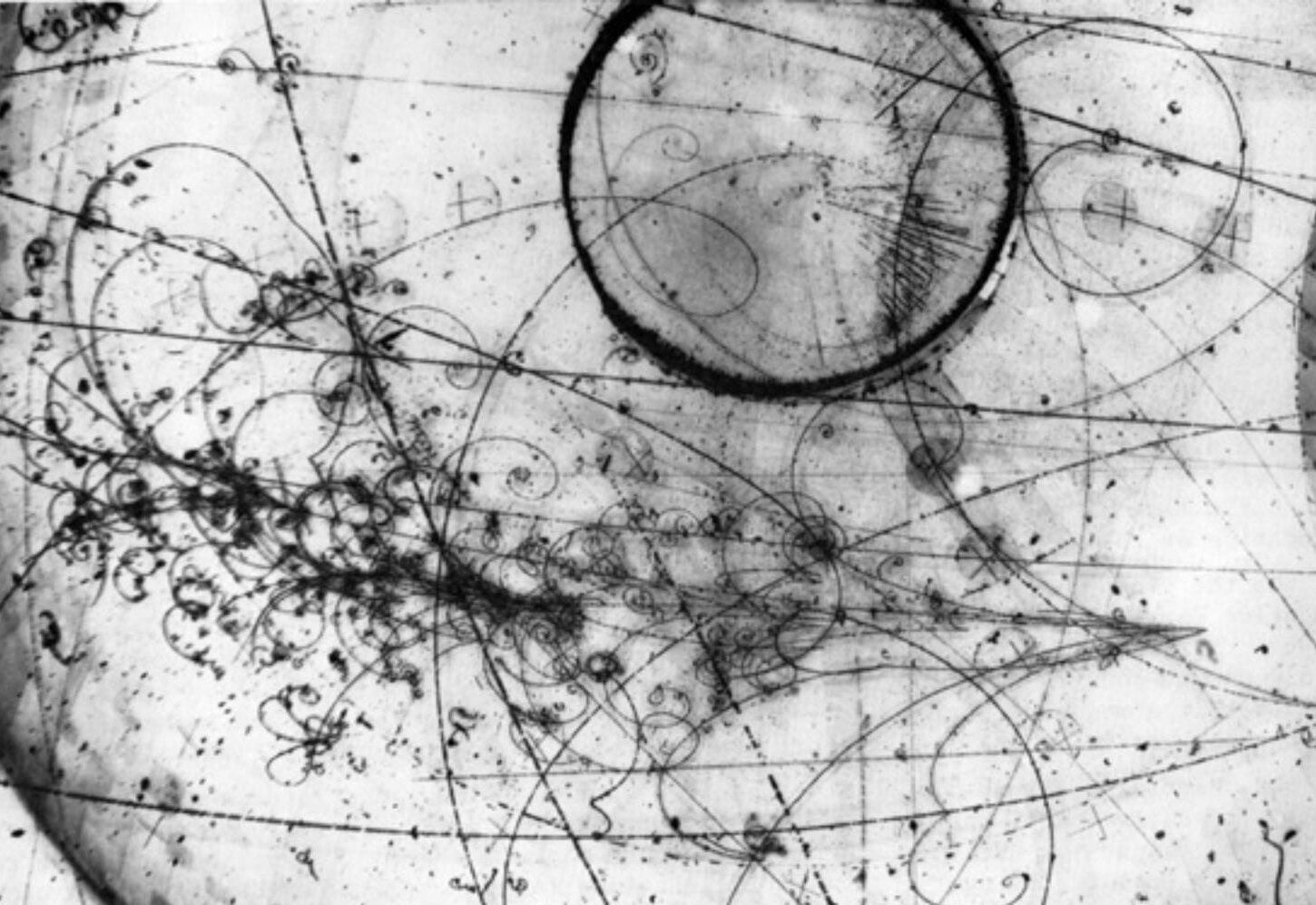
camera a bolle del Fermilab
Image of the interaction of neutrinos in the Fermilab bubble chamber taken in April 1976 (© FERMILAB)
acceleratore LHC
The LHC accelerator at CERN (© CERN)

As the decades passed, however, physics became increasingly collective in nature, driven by large international scientific collaborations. Exploring elementary particles, observing the distant Universe or detecting extremely faint signals such as gravitational waves requires instruments that are ever larger, more sophisticated and more expensive. Particle accelerators, underground observatories, kilometre-scale interferometers and space telescopes have given rise to what is now known as Big Science: research based on major infrastructures, substantial funding and large international collaborations.
Many of the prizes awarded in recent decades have been linked to results obtained through research infrastructures and international collaborations involving thousands of scientists who experimentally confirmed the theoretical predictions that earned the Nobel Prize for the researchers who had originally formulated them. The discovery of the Higgs boson at CERN, the observation of gravitational waves by the LIGO and Virgo collaborations, and the cosmological measurements that helped reconstruct the history of the Universe are clear examples of an increasingly global and interdisciplinary science.

Women and the Nobel Prize: a still limited presence

Another aspect that emerges from examining the Nobel Prize roll of honour concerns the representation of women. Despite the fundamental contribution of women to the development of modern physics, only five women have so far been awarded the Nobel Prize in Physics: Marie Skłodowska Curie in 1903, Maria Goeppert Mayer in 1963, Donna Strickland in 2018, Andrea Ghez in 2020, and Anne L’Huillier in 2023. For more than half a century, between the prize awarded to Goeppert Mayer and that awarded to Strickland, no woman received the distinction.
Across physics, chemistry, and physiology or medicine, 26 women scientists have been awarded a Nobel Prize, including Marie Skłodowska Curie, who received it twice. This figure reflects a broader history in which women’s access to scientific studies, academic positions, and leadership roles in research was restricted for a long time.

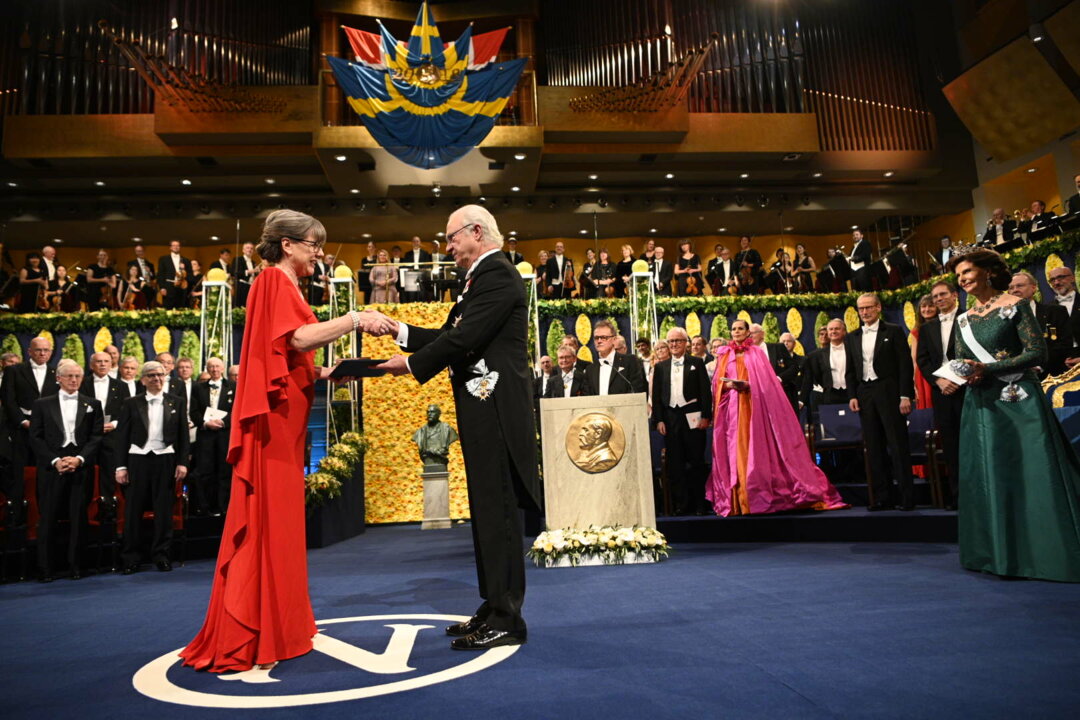
strickland_prizenobel
Donna Strickland receives her Nobel Prize from the King of Sweden. © Nobel Media. Photo: Alexander Mahmoud

Who Wins the Nobel Prize in Physics: Theorists or Experimentalists?

Looking at the entire history of the Nobel Prize in Physics reveals another interesting feature. Although it has honoured some of the most extraordinary theoretical insights in the history of science, the prize tends to be awarded when a new idea finds clear and broadly accepted experimental confirmation, often decades after the original theoretical prediction. Among the 229 scientists who received the Nobel Prize in Physics between 1901 and 2025 are some of the greatest theorists of the twentieth century, from Albert Einstein and Niels Bohr to Werner Heisenberg and Paul Dirac, and later Richard Feynman, Peter Higgs and, more recently, Giorgio Parisi.
At the same time, many prizes have been awarded to researchers responsible for decisive experimental discoveries, such as Wilhelm Conrad Röntgen for X-rays, Guglielmo Marconi for wireless telegraphy, Carlo Rubbia and Simon van der Meer for the discovery of the W and Z bosons, as well as the leading figures behind research on neutrino oscillations, gravitational waves and quantum entanglement.

The distinction between theoretical and experimental physics in Nobel Prizes, however, is often less clear-cut than it may appear. Many of the most important prizes in the history of the award are in fact the outcome of a dialogue between ideas and data that has lasted for decades. A famous example is Albert Einstein. Widely regarded as the father of relativity, he received the Nobel Prize in 1921 not for the theory of general relativity, but for his explanation of the photoelectric effect, a phenomenon that had received important experimental confirmation and helped give rise to quantum physics. The same pattern has been repeated many times throughout the history of the prize. Peter Higgs and François Englert formulated in the 1960s the mechanism that explains the origin of the mass of elementary particles, yet they had to wait almost fifty years before receiving the Nobel Prize, which was awarded only after the experimental discovery of the Higgs boson at CERN in 2012. Significantly, the prize was awarded to the theorists who had predicted the particle, while the ATLAS and CMS collaborations, made up of thousands of researchers who carried out the discovery, could not be honoured because the Nobel Prize rules do not allow the award to be given to large scientific collaborations.

Italian Nobel Laureates in Physics

Italy has a scientific tradition of international excellence in physics. Throughout the twentieth and twenty-first centuries, six Italian physicists have received the prestigious award for contributions that profoundly shaped the development of the discipline. The first was Guglielmo Marconi, awarded the Nobel Prize in 1909 together with Karl Ferdinand Braun for their contribution to the development of wireless telegraphy, a technology destined to revolutionise communications. In 1938, the Nobel Prize was awarded to Enrico Fermi for his demonstrations of the existence of new radioactive elements produced by neutron irradiation and for his discovery of nuclear reactions induced by slow neutrons, achievements that proved fundamental to the development of nuclear physics. In 1959, Emilio Segrè received the prize together with Owen Chamberlain for the discovery of the antiproton, the first experimentally observed antiparticle of a nucleon, whose existence had been proposed in 1933 by Paul Dirac in his Nobel Prize Lecture. The discovery provided crucial confirmation of theories predicting the existence of antimatter and contributed significantly to the development of particle physics. Twenty-five years later, the Nobel Prize returned to an Italian physicist when Carlo Rubbia shared the 1984 award with Simon van der Meer for the discovery of the W and Z bosons at CERN, the carriers of the weak interaction and essential components of the Standard Model. In 2002, the prize was awarded to Riccardo Giacconi, a pioneer of X-ray astronomy whose observations opened a new window onto the Universe and contributed to the birth of modern astrophysics.
More recently, in 2021, Giorgio Parisi received the Nobel Prize for his studies of complex physical systems, work that has found applications across a wide range of fields, from condensed matter physics and biology to climate science. From radio waves to antimatter, from nuclear physics to cosmology, the history of Italian Nobel laureates in physics reflects some of the major directions of development in contemporary physics and testifies to the contribution that the Italian scientific community continues to make to international research.

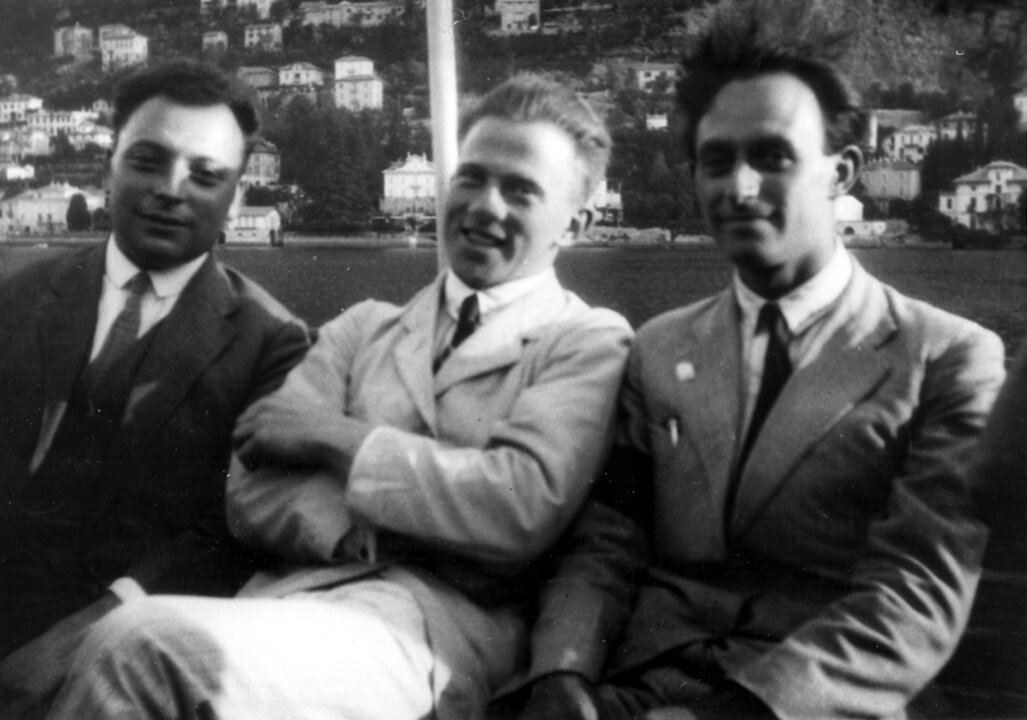
3nobellaureates
The three physics laureates Wolfgang Pauli, Werner Heisenberg and Enrico Fermi on a boat on Lake Como, Italy, in September 1927. Photo: CERN / © Franco Rasetti

Nobel Omissions

The Nobel Prize is the most prestigious scientific award in the world, but it does not always capture the full story behind major discoveries. Alongside the laureates, the history of the Nobel Prize is also marked by important contributions that were never recognised with the award, despite leaving a profound impact on international research.
The rules of the prize stipulate that it can be awarded to no more than three individuals and cannot be granted posthumously. These rules were devised for a scientific world in which research was conducted by individuals or small groups, but today they must contend with collaborations involving hundreds or even thousands of scientists.
The history of physics includes several cases that have become the subject of enduring debate. Lise Meitner, who played a pivotal role in the theoretical interpretation of nuclear fission, did not share the 1944 Nobel Prize awarded to Otto Hahn. Jocelyn Bell Burnell, who as a doctoral student was the first to identify signals from pulsars, was excluded from the prize awarded in 1974 to her supervisor Antony Hewish. Vera Rubin, whose observations provided some of the strongest evidence for the existence of dark matter, never received recognition from the Swedish Academy.
Paradoxically, even Albert Einstein was awarded the Nobel Prize for his quantum explanation of the photoelectric effect rather than for the theory of relativity, whose revolutionary scientific impact has made it one of the most celebrated scientific theories in history.

Italian physics also has its share of Nobel Prize near misses. These are scientists whose contributions were fundamental to the development of the discipline and whom many colleagues and historians of science believe would have deserved the highest international recognition. In some cases, the prize never arrived because experimental confirmation came too late; in others, because of the Nobel Prize rules themselves, which do not allow awards to be made posthumously and, as mentioned above, limit the number of recipients to a maximum of three.
For many physicists, Bruno Pontecorvo represents the most emblematic case. One of the pioneers of neutrino physics, he put forward groundbreaking ideas as early as the 1950s and 1960s on the possibility that neutrinos could transform from one type into another, a phenomenon now known as neutrino oscillation. When the Nobel Prize was awarded in 2015 to Takaaki Kajita and Arthur McDonald for the experimental discovery of neutrino oscillations, many scientists pointed out that the theoretical framework underlying that discovery had been built to a large extent by Pontecorvo. However, the Italian physicist had passed away in 1993 and was therefore ineligible for the prize.
Ettore Majorana, meanwhile, occupies an almost legendary place in the history of twentieth-century physics. Although he published only a small number of papers before his mysterious disappearance in 1938, he left behind contributions of extraordinary depth. In particular, the theory of the particles now known as Majorana fermions continues to influence both particle physics and research into quantum technologies. While it is impossible to know what course his career might have taken, many historians of science believe that he possessed all the qualities required to become one of Italy’s strongest candidates for a Nobel Prize.

cabibboekobayashi
Nicola Cabibbo with Makoto Kobayashi at the CKM Workshop in Nagoya, Japan, 15 December 2006. Courtesy of Marcella Bona, all rights reserved

The case of Nicola Cabibbo is probably the most widely discussed Nobel Prize omission in the field of particle physics, including within the INFN scientific community. In 1963, Cabibbo introduced an idea that would become fundamental to the description of weak interactions: the so-called “Cabibbo angle”, which explains how quarks can transform into one another during certain subatomic processes. This result represented a major conceptual breakthrough and laid the foundations for a more general understanding of quark mixing.
In the 1970s, physicists Makoto Kobayashi and Toshihide Maskawa extended Cabibbo’s work by developing a model that incorporated a third family of quarks and made it possible to explain the violation of CP symmetry observed in nature. The matrix used today in particle physics is known as the CKM matrix, after Cabibbo, Kobayashi and Maskawa.
When the Nobel Prize in Physics was awarded in 2008 to Kobayashi and Maskawa, together with Yoichiro Nambu, the absence of Cabibbo came as a surprise and sparked considerable discussion within the international scientific community. His contribution was, in fact, an integral part of the theoretical framework recognised by the Swedish Academy.
Moreover, the work for which Nambu received the prize had been written together with a young Italian theorist, Giovanni Jona-Lasinio, who was also excluded from the Nobel Prize.

Beyond the Nobel Prize: the Challenge of Big Science

The stories of Meitner, Bell Burnell, Pontecorvo and Cabibbo show how the Nobel Prize, while representing the highest individual scientific honour, does not always succeed in telling the full story behind a discovery. This limitation has become particularly evident in recent decades, as physics has evolved into an increasingly collaborative and international enterprise.
In the days of Röntgen, Curie or Fermi, it was still possible for a discovery to be the result of the work of a single individual or a small research group. Today, by contrast, many of the major achievements in physics require complex infrastructures and collaborations involving hundreds or thousands of researchers from hundreds of institutions around the world. Particle accelerators, neutrino detectors, astronomical observatories and gravitational-wave interferometers are the product of expertise, technologies and investments that no single institution or country could sustain on its own.
The Nobel Prize has attempted to adapt to this evolution, but it remains constrained by the rule limiting each award to a maximum of three laureates. As a result, the Swedish Academy must identify no more than three scientists to receive recognition that is often awarded for theoretical predictions made decades earlier and subsequently confirmed through discoveries achieved by large scientific collaborations.

This is the case of the 2013 Nobel Prize in Physics, awarded to Peter Higgs and François Englert “for the theoretical discovery of a mechanism that contributes to our understanding of the origin of the mass of subatomic particles, and which recently was confirmed through the discovery of the predicted fundamental particle by the ATLAS and CMS experiments at the Large Hadron Collider”.
The discovery of the Higgs boson in 2012, for example, was made possible by the work of thousands of researchers in the ATLAS and CMS experiments at CERN. Similarly, the first observation of gravitational waves, recognised with the Nobel Prize in 2017, was the result of decades of work by the LIGO and Virgo collaborations. In both cases, the prize was awarded to a small number of scientists who played a fundamental role in the achievement, yet behind the award stood much larger scientific communities.
In twenty-first-century physics, major discoveries are increasingly the product of collective efforts in which theoretical ideas, technological innovation and experimental expertise converge in scientific enterprises involving entire generations of researchers. In this sense, every Nobel Prize awarded today tells not only the story of a few individuals, but also that of the large scientific communities that helped make those discoveries possible.

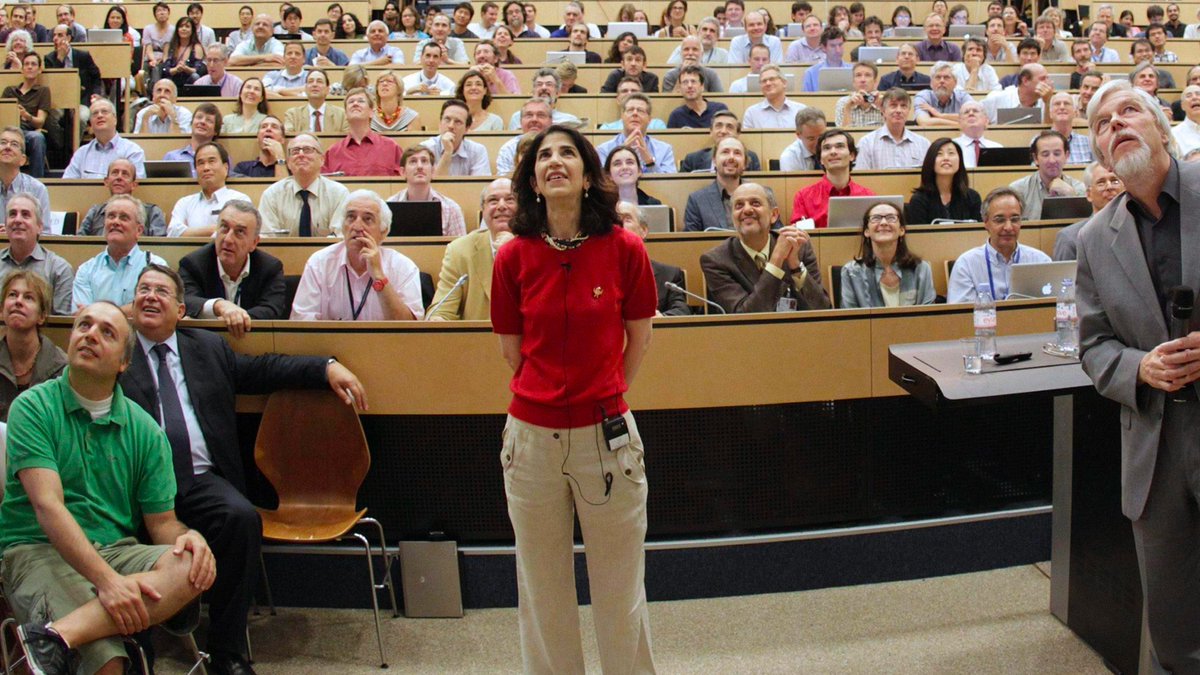
Bosone di higgs
Announcement of the discovery of the Higgs Boson, Cern 4 July 2012 (© CERN)
Muong 2 2017 5
The scientific international collaboration Muon g-2 (2017)

In recent years, other awards have emerged that, in addition to covering disciplines such as neuroscience and mathematics, which are not recognised by the Nobel Prize, have also acknowledged the contributions of entire research teams. One example is the Breakthrough Prize, established in 2012 by entrepreneur Yuri Milner.
In 2015, the Breakthrough Prize in Fundamental Physics was awarded to the ATLAS and CMS collaborations at CERN for the discovery of the Higgs boson. In 2016, the prize recognised the work of the LIGO and Virgo collaborations for the first observation of gravitational waves. In 2020, the award was presented to the Event Horizon Telescope Collaboration, the global network of observatories that produced the first image of a black hole.
More recently, in 2025, the Breakthrough Prize in Fundamental Physics was awarded directly to the ATLAS, CMS, ALICE and LHCb collaborations, bringing together more than 13,000 researchers involved in high-energy physics research at CERN. Finally, in 2026, the prize was awarded to the Muon g−2 collaborations at CERN, Brookhaven National Laboratory and Fermilab for their precision measurements of the muon’s anomalous magnetic moment, one of the most accurate tests of the Standard Model of elementary particles.

The Nobel Prizes of the Future

If the Nobel Prize in Physics tells the story of the great discoveries of the past, it also offers a glimpse of the challenges awaiting the scientific community in the decades ahead. Many of the most important questions in contemporary physics remain unanswered and could well give rise to future Nobel Prizes.
The Higgs boson, for example, has not yet revealed all of its secrets, just as the hierarchy of the masses of the elementary fermions remains poorly understood. Among the greatest mysteries is the nature of dark matter, an invisible component which, according to astronomical observations, accounts for about 85% of all matter in the Universe. Despite decades of research, we still do not know what it is made of or how it interacts with ordinary matter.
Even more mysterious is the origin of the accelerating expansion of the Universe, attributed to dark energy and linked to the cosmological constant that Einstein famously described as “my greatest blunder”.
Neutrino physics also continues to pose fundamental questions. Although it has been established that neutrinos have mass and can oscillate from one type to another, it is still unclear what their absolute masses are, whether neutrinos and antineutrinos are in fact the same particle, and what role they may have played in the evolution of the early Universe.
In the field of gravitational waves, the first detection in 2015 opened an entirely new window on the cosmos. Next-generation instruments such as the Einstein Telescope will make it possible to observe phenomena that are currently invisible and may lead to discoveries capable of transforming our understanding of gravity, astrophysical processes and the evolution of the Universe.
Another rapidly advancing field is that of quantum technologies. Quantum computers, ultra-precise sensors and intrinsically secure communication systems are already moving beyond the laboratory and could give rise to new quantum technological revolutions, following those of the last century, such as lasers and semiconductors.
It is impossible to predict which of these lines of research will lead to future Nobel Prizes. The history of the award nevertheless teaches us that the most important discoveries are often those that no one expects: ideas born from the attempt to answer a fundamental question about nature that ultimately change the way we see the world.

For further insights, explore our YouTube playlist featuring nine interviews with scientists who have been awarded the Nobel Prize in Physics: Waiting for the 2026 Nobel Prize.


a cura di Ufficio Comunicazione INFN – COMUNICAZIONE ISTITUZIONALE E MEDIA


You might also be interested in
Rendering of the ET infrastructure (©INFN)

Towards Einstein Telescope

Synchrotron, the first high-energy accelerator built in Italy at the INFN National Laboratories of Frascati.

75 Years of INFN

borexino lngs

70 Years of Neutrinos

Researchers collaborating on the development of quantum technologies at the SQMS Quantum Garage, one of the quantum research facilities developed by the Centre. ©Ryan Postel, Fermilab

From bit to qubit. The quantum future of computing

FCC map overview

Physics looks ahead to FCC

April 6, 2026 - A close-up view taken by the Artemis II crew of the moon surface. Credi NASA

Moon

30 April 2026 Read more Moon