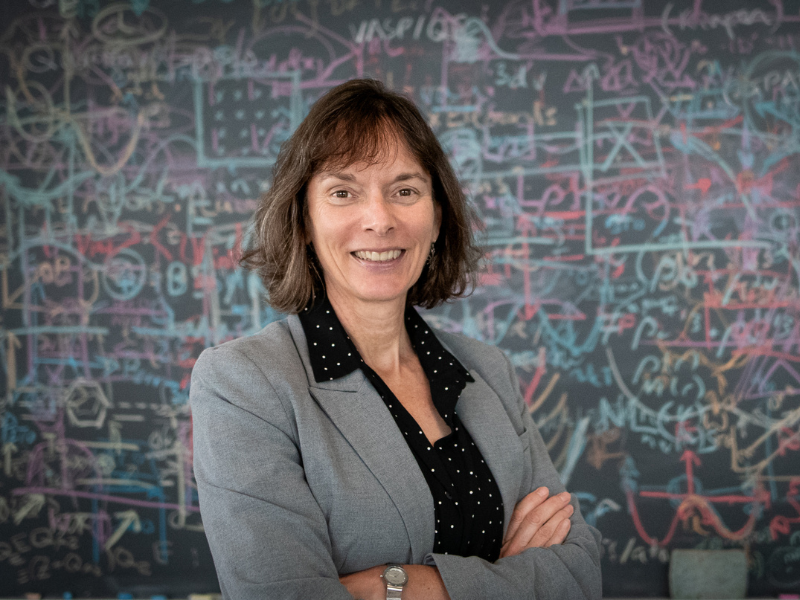
Interview with Nicola Spaldin, Vice-President of the European Research Council and responsible for the Physical sciences and Engineering domain
What are the current strategic priorities of the European Research Council, and how do you see its role evolving in the coming years?
The European Research Council does not set a direction for research or define research priorities. We are a bottom-up organisation, and as such we aim to fund frontier research that comes directly from the community of researchers, without favouring “fashionable” or specific technology-oriented areas. We support science in the German sense of Wissenschaft, or knowledge, and in addition to the life sciences, physical sciences and engineering, the ERC supports research in the social sciences and humanities, again without setting priority directions. Naturally, as Horizon Europe draws to a close and the next EU framework programme for R&I is being defined, we have strategic objectives, aimed at defending researchers’ ability to pursue curiosity-driven frontier research, not targeted to predefined policy agendas. Our main priority is securing sufficient funding, so that we can provide top researchers with the necessary resources to explore the areas that they find most interesting. Unfortunately, from a budgetary point of view, at the ERC we are struggling. We can fund only 60 percent of the proposals that earn an excellent rating, meaning that some 40 percent of the brilliant ideas that could advance human knowledge or transform society go unsupported. Also, we have not been able to adjust our grant sizes for inflation since our launch, so even doubling our budget would be insufficient, and adjustments would still be needed to account for rising costs. Another priority is the autonomy of our governing body, the ERC Scientific Council, and in turn of our evaluation process. In our view, the evaluation of research excellence must remain in the hands of independent research councils, whose priorities and procedures are set by active researchers. As a member of the ERC Scientific Council, I am also a university professor with a research group, and I carry out my ERC activities alongside my usual teaching and research duties. This arrangement is essential to ensure that frontier research is free from political interference.
How do you find the right balance between encouraging “high-risk” ideas and ensuring responsible use of public funds?
I would not speak of “high-risk” ideas, because if somebody has a brilliant idea that is low risk, we will still want to fund it. In general, we look for new and original ideas, that are at the frontier of knowledge, but not so far across the frontier that no progress can be made. We have an established and trusted process for assessing proposals in terms of originality and feasibility. Of course, we use peer review, which, although not perfect, is the best instrument we have. We make extensive use of panels of experts that come together and discuss the proposed work in depth. And we also consider the track record of the investigators, because those who have made important contributions in the past are likely to do so again. Then, it doesn’t work if the idea is brilliant, but the person proposing is not in a situation to be able to implement it, so we also take this aspect into account. We do a lot of benchmarking, and are continuously revising our processes in response. In this way, we do our best to try to identify those proposals that are going to lead to breakthrough discoveries.
Sometimes these discoveries arrive over very long timescales. How do you measure the impact of funding?
That’s a really difficult question. There are certainly short-term impact indicators, such as publications, data sets, infrastructure development, and so on, which we take into consideration when evaluating our applicants’ track records. But I must emphasise that long-term societal impact is not a prerequisite for an ERC grant. That said, we have a programme – the Proof-of-Concept grants – dedicated to grantees who make a discovery with technological potential, to support them in making the first steps towards technology readiness. Here, we certainly see a measurable impact in terms of startups and patents; but in frontier curiosity-driven research, any technologies or socially relevant discoveries often emerge decades later. Nuclear physics, for example, underpins the entire microelectronics industry, because in the 1930s, your community developed electronic circuits to be able to count nuclear particles. And an example dear to the ERC is the development of the foundations of mRNA. That fundamental research, born out of pure curiosity, positioned scientists to develop vaccines for Covid-19 in record time, saving countless lives. And one of our ERC grantees, Ugur Sahin, was behind the Pfizer/BioNTech vaccine that used this technology. So, frontier research leads to extraordinary discoveries, that are often also highly impactful, but this is not the reason why we do research: we do research for the beauty of discovering new things.
As responsible for the Physical sciences and Engineering domain, what do you see as the most exciting or transformative research directions in your field, today?
In my field of Materials Physics, the capabilities that have been unleashed by developments in artificial intelligence (AI) are proving to be transformative. We are really seeing a paradigm shift, comparable, in my view, to that triggered by the advent of the first computers. In Materials Physics, we can now answer questions that were previously out of reach in terms of time-scale, length-scale and complexity, by machine learning the interactions between atoms. In the past, we had to calculate these detailed quantum mechanical interactions every time, which is computationally very expensive, whereas now we train a machine to parameterise the details of the quantum mechanics and are able to perform quantum-mechanical quality calculations at very low cost. At the ERC, we see similar developments across our whole portfolio: most of our peer review panels receive research proposals that, while not centred on AI, use it as a tool. At the same time, we are in the process of establishing a new evaluation panel that will focus on the fundamentals of the computer science of AI, which is a topic that we have funded since the start of the ERC, and in which we see a large increase in proposals.
Are you also seeing growth in interdisciplinary research? How is the evaluation system adapting?
Yes, absolutely. Historically the ERC has been divided into three domains: physical sciences, life sciences, social sciences and humanities, but we start to see increasing numbers of proposals that fall between the traditional domain boundaries. We are now exploring establishing our first interdisciplinary panel, on biomedical engineering, which will cross all three domains. We are analysing the proposals in our portfolio to see which would best fit an interdisciplinary approach, and with the support of AI tools we are identifying effective restructuring strategies, to reflect emerging research trends.
How would you assess Europe’s position in research and innovation compared to other major global players?
It is evident that we are behind. The United States spends €711 billion per year on research and development, China €675 billion and the EU €438 billion. In terms of researchers, China has around 3 million, while the EU stands at about 2.2 million. And whilst spending per researcher in the EU is under €200,000, in the United States it exceeds €400,000. Looking then at the private sector, US tech companies alone spend more than all the EU governments combined. These gaps in public investment translate into fewer future companies, fewer future technologies and less future talent. And if we grow slowly while others invest heavily, the gap only widens. There is political awareness regarding competitiveness, strategic autonomy and security, but without investment in fundamental research and scientific capacity, we will never be able to catch up.
Looking ahead, are there aspects of the European research funding system that should be rethought to keep pace with the rest of the world?
There is no question that the ERC is a global role model, both for its procedures and for the quality of the research it funds; and here the most urgent rethink needed is a drastic increase in the budget. Of course, applied research is essential in the current geopolitical context, but without fundamental frontier research there will be no pipeline feeding the applied research of the future. That is why Europe needs to strengthen the fundamental research component of its funding system, including the Marie Curie programme that supports mobility for young researchers. And it is essential that the ERC is not incorporated into the European Competitiveness Initiative, which would severely curtail the flexibility and independence, and in turn the creativity of researchers.
You mentioned the mobility of young researchers, but there is also a mobility of ideas and results. How does the ERC promote open science and what challenges remain open?
It’s clear that the findings of publicly funded research should be accessible to the public, and the ERC follows the regulations of the European Commission on open access publication, with all research funded by the ERC available under a CC BY license at the time of publication. Our criteria for evaluating the Principal Investigators’ track record include contributions such as open-source software and open data sets, thereby encouraging resource sharing; and, in general, the scientific community itself is evolving towards a culture of openness, with panels expecting projects that develop databases or codes to have an open strategy. Alongside the advantages, however, the current open access publishing model has introduced problems, such as globally inaccessible author page charges and predatory journals. In response, interest in preprints – long widely used in the physics community – is growing, and the overall landscape is rapidly evolving.
Once made accessible to the research community, results must also be understood by a wider public, and the ERC invests heavily in this respect. Can you explain why?
Good communication of scientific research is essential. It is necessary to explain not just what has been discovered, but also the way that science works; that there are uncertainties, and limitations, and changes of opinion, and that this is how science progresses. Until this mechanism is understood, it is hard to build trust in science. The ERC has two initiatives focusing on science communication: the Public Engagement in Research Award, presented to ERC grantees who promote the public understanding of their research, and the Science Journalism Initiative, to support science journalists who are able to reach a wider public – an initiative particularly important at a time when many media outlets are cutting back on their science desk. Because while it is easy to report on the impact of new infrastructures or technologies, which directly improve everyday life, it is more difficult to connect these visible results to the fundamental research that made them possible, often years earlier. Many of the innovations we now take for granted simply would not exist without that curiosity-driven research, and we need to communicate this connection as effectively as possible.
BIO
Nicola Spaldin is a member of the Scientific Council of the European Research Council and has been Vice-President for the Physical sciences and Engineering domain since January 2026. She is Professor of Materials Theory at ETH Zurich and, a passionate science educator, has won multiple ETH Golden Owl Awards for teaching excellence. She is a Fellow of the Royal Society, a Foreign Member of the National Academies of Science and Engineering (USA), the French Academy, the Austrian Academy and the Leopoldina, and has received numerous awards for her research.