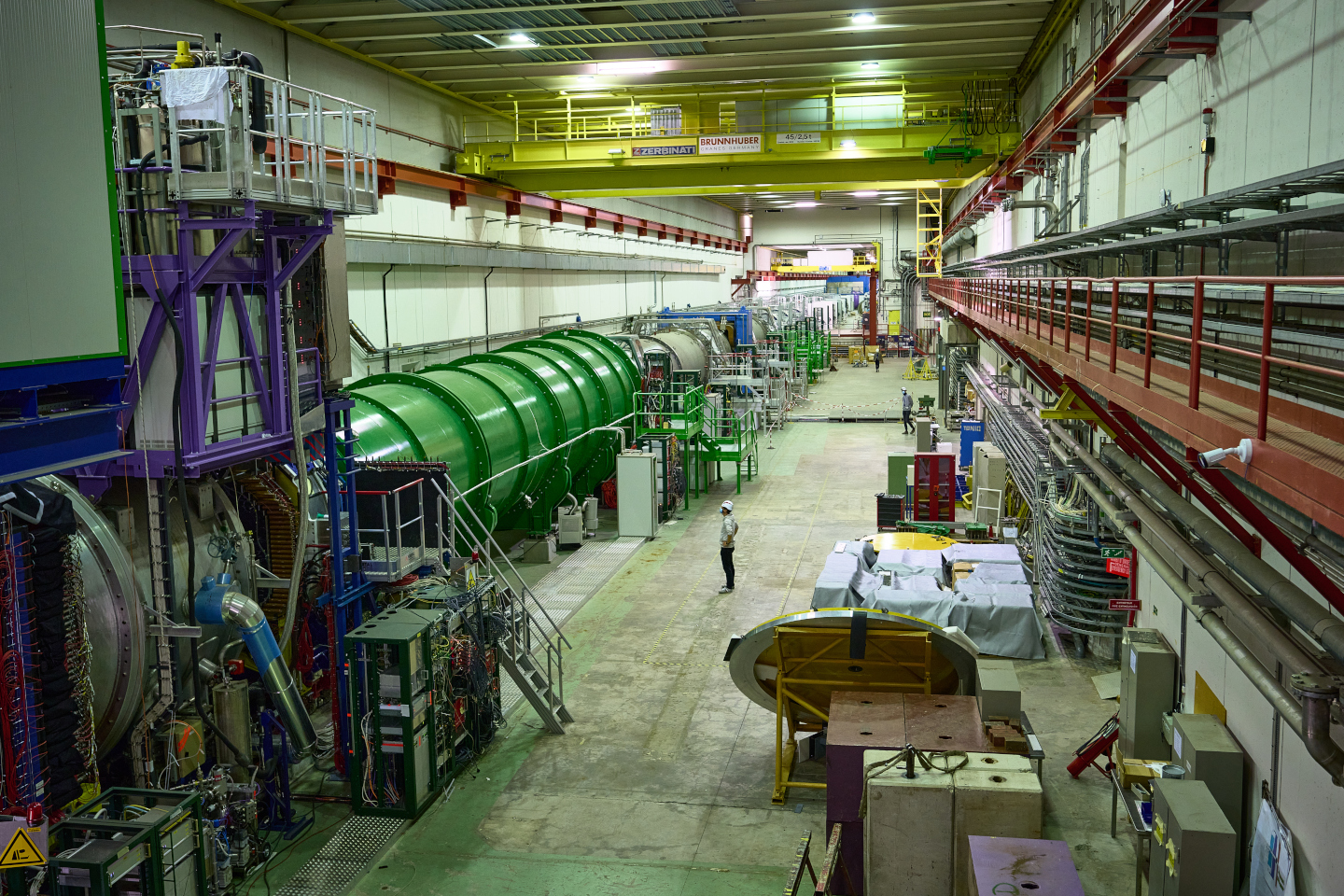
The NA62 experiment at CERN, in which INFN also participates, has succeeded in significantly reducing the uncertainty in the measurement of an extremely rare process that it had already observed in 2024: the decay of a charged kaon into a charged pion and a neutrino-antineutrino pair. The result was presented today, 4 March 2026, on behalf of the NA62 Collaboration by Renato Fiorenza, CERN researcher and one of the main analysts, at the annual conference Les Rencontres de Physique in La Thuile, in the Aosta Valley.
For the search for phenomena of new physics, the study of rare decays is crucial because it makes it possible to probe the theory of the Standard Model of particle physics in depth. And, to understand a decay in great detail, it is essential to determine its so-called “branching fraction”, which describes the probability that that specific decay occurs.
In this specific case, the branching fraction of the process studied by the NA62 Collaboration can be predicted theoretically with a very small uncertainty: this makes this kaon decay extremely sensitive to new physics beyond the Standard Model. With a predicted branching fraction of less than one in ten billion, the process is extremely rare and very difficult to observe.
The NA62 experiment was designed precisely to study this process in depth, and in order to do so it must produce a large number of kaons, which is why it is also known as a “kaon factory”. The kaons are created by directing a high-intensity proton beam from the Super Proton Synchrotron accelerator onto a beryllium target. This produces almost one billion particles per second, about 6% of which are kaons whose decay products can be studied in great detail by the NA62 detectors.
In 2024, the NA62 Collaboration reported the first observation of this process: in measuring the decay it achieved a statistical significance of five standard deviations, which in particle physics represents the “milestone” required to claim a discovery. Now the researchers of NA62 have included in the analysis the data collected in 2023 and 2024 and have used improved analysis techniques based on state-of-the-art machine learning algorithms. This, in combination with previously collected data, has enabled them to refine the study of the extremely rare kaon decay, obtaining an updated measurement of the branching fraction with a significant improvement in the uncertainty, reducing it by 40%.
“This is the data sample with the highest sensitivity that we have analysed so far”, emphasises Francesco Brizioli, researcher at the INFN Perugia division and Coordinator of the physics programme of the NA62 experiment. “The fact that we can clearly observe and precisely measure such a rare process represents a major success from both a scientific and technological point of view”.
At the precision of the current result, the kaon decay appears to occur as predicted by the theory and thus provides strong constraints on new physics beyond the Standard Model.
“This is a remarkable test of the Standard Model, given the extreme rarity and the theoretical precision of the process we have investigated”, explains Giuseppe Ruggiero, professor at the University of Florence and researcher at the INFN Florence division, who coordinates the international Scientific Collaboration of the NA62 experiment. “We have once again demonstrated that our current reference theory of nature possesses an incredible predictive power”.
“The important result has been achieved thanks to the contribution of young and brilliant researchers from INFN. The Italian scientific community has played a fundamental role in this challenging measurement”, comments Monica Pepe of the INFN Perugia division and coordinator of the Italian research groups participating in the NA62 experiment.
The NA62 Collaboration involves more than 200 participants from Europe, the United States, Canada, Mexico and Russia. The Italian community, coordinated by INFN, represents about one third of the Collaboration, with researchers from the INFN National Laboratories of Frascati and from INFN divisions and the Universities of Ferrara, Florence, Naples, Perugia, Pisa, Rome Sapienza, Rome Tor Vergata and Turin.