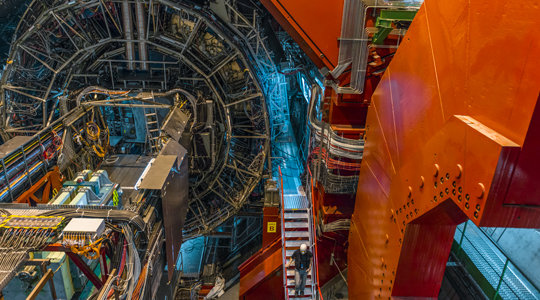
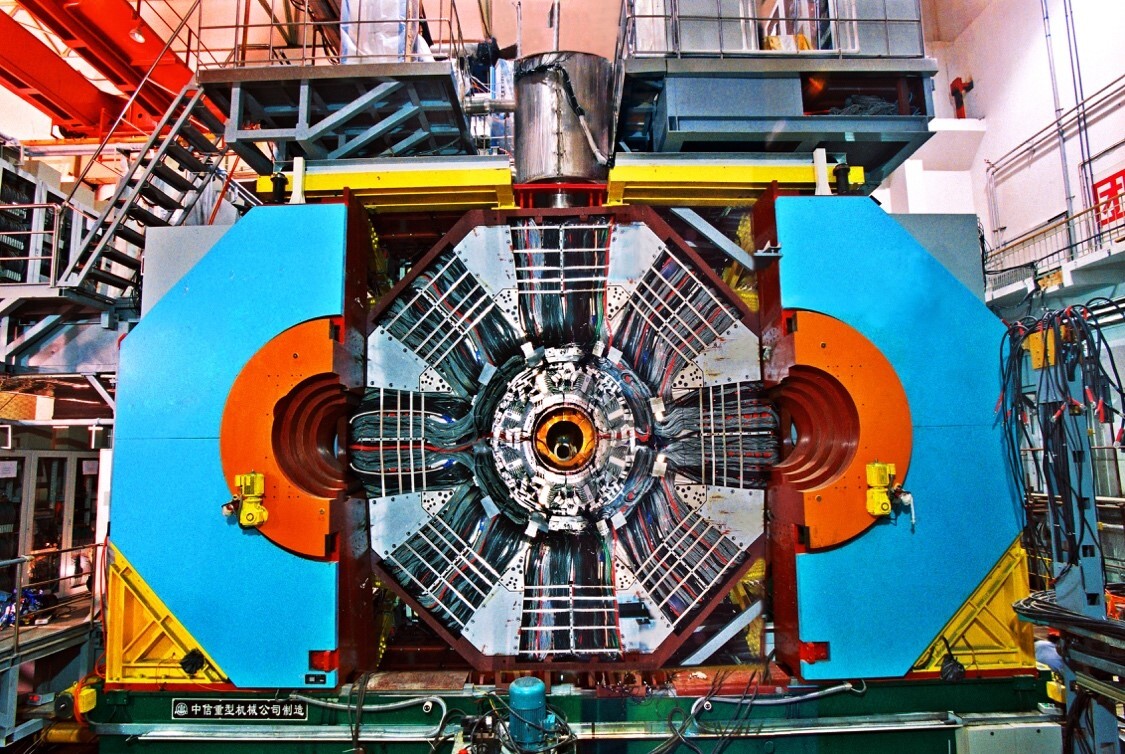
The ALICE experiment at CERN’s Large Hadron Collider (LHC) has identified the dominant mechanism responsible for the formation of light nuclei and antinuclei in high-energy proton–proton collisions. The results, published today, 10 December 2025, in Nature, address a long-debated question in nuclear physics and have implications for astrophysics, cosmology, and the search for dark matter.
At the LHC, protons or heavier nuclei collide at nearly the speed of light. From these collisions, dozens of new particles emerge, including light nuclei such as the deuteron, which are detected by the large detectors surrounding the LHC collision points, like the ALICE detector. The deuteron is the simplest bound nucleus, composed of one proton and one neutron held together by the strong interaction. The binding energy between its constituents is very small, only about 2 megaelectronvolts (MeV). How such fragile systems can form and survive in such an energetic environment has remained an open question for decades.
In this new study, the ALICE Collaboration, to which INFN also participates, applied a technique called femtoscopy, which involves measuring correlations between pairs of particles produced with very similar directions and velocities in the collisions at the LHC. These correlations reveal details about how particles interact and are produced. By studying deuteron–pion pairs created in proton collisions, the researchers identified a distinctive feature: a prominent peak in the correlation distribution.
The ALICE researchers demonstrated that this feature in the data arises naturally if the deuteron is produced after the decay of a short-lived particle known as the Δ resonance, an unstable, excited state of the proton that exists for an extremely brief time before decaying into a proton and a pion. The data reveal that deuterons are formed predominantly through nuclear fusion: a proton originating from the decay of the Δ resonance encounters a nearby neutron and fuses with it to form a deuteron, while the accompanying pion carries away the excess energy, allowing the new nucleus to emerge intact.
“This study confirms that deuteron formation in these collisions is a sequential process”, explains Oton Vazquez Doce, physicist at the INFN National Laboratories of Frascati and member of the ALICE Collaboration. “First, the resonance decays and produces nucleons; then these nucleons combine to form light nuclei. This sequential formation indicates that deuterons emerge at a later, colder stage of the collision, increasing their chances of survival”, Vazquez Doce concludes.
The results indicate that about 90% of the observed deuterons and antideuterons do not originate directly from the collision, but rather from this sequence of resonance decay followed by the fusion of the nucleons, providing clear experimental evidence for the mechanism that governs the formation of light nuclei in nuclear collisions.
“This discovery has implications that go beyond nuclear physics. Light nuclei and antinuclei are also produced in cosmic-ray interactions and may appear as byproducts of dark-matter decay. Understanding exactly how they form can help distinguish ordinary astrophysical processes from potential dark-matter signals”, says Andrea Dainese, researcher at the INFN Padova division and member of the ALICE Collaboration.
“The ALICE detector is designed to study a primordial state of matter, the quark–gluon plasma, in heavy-ion collisions, and it constitutes a unique tool in the international scientific landscape for the study of the strong interaction at high temperatures”, comments Federico Antinori, researcher at the INFN Padova division and national coordinator of the ALICE Collaboration. “The experiment also proves to be a highly versatile tool for more conventional nuclear physics, providing new and valuable experimental insights that extend to astrophysics, cosmology, and other areas of fundamental physics”, Antinori concludes.
Paper Observation of deuteron and antideuteron formation from resonance-decay nucleons