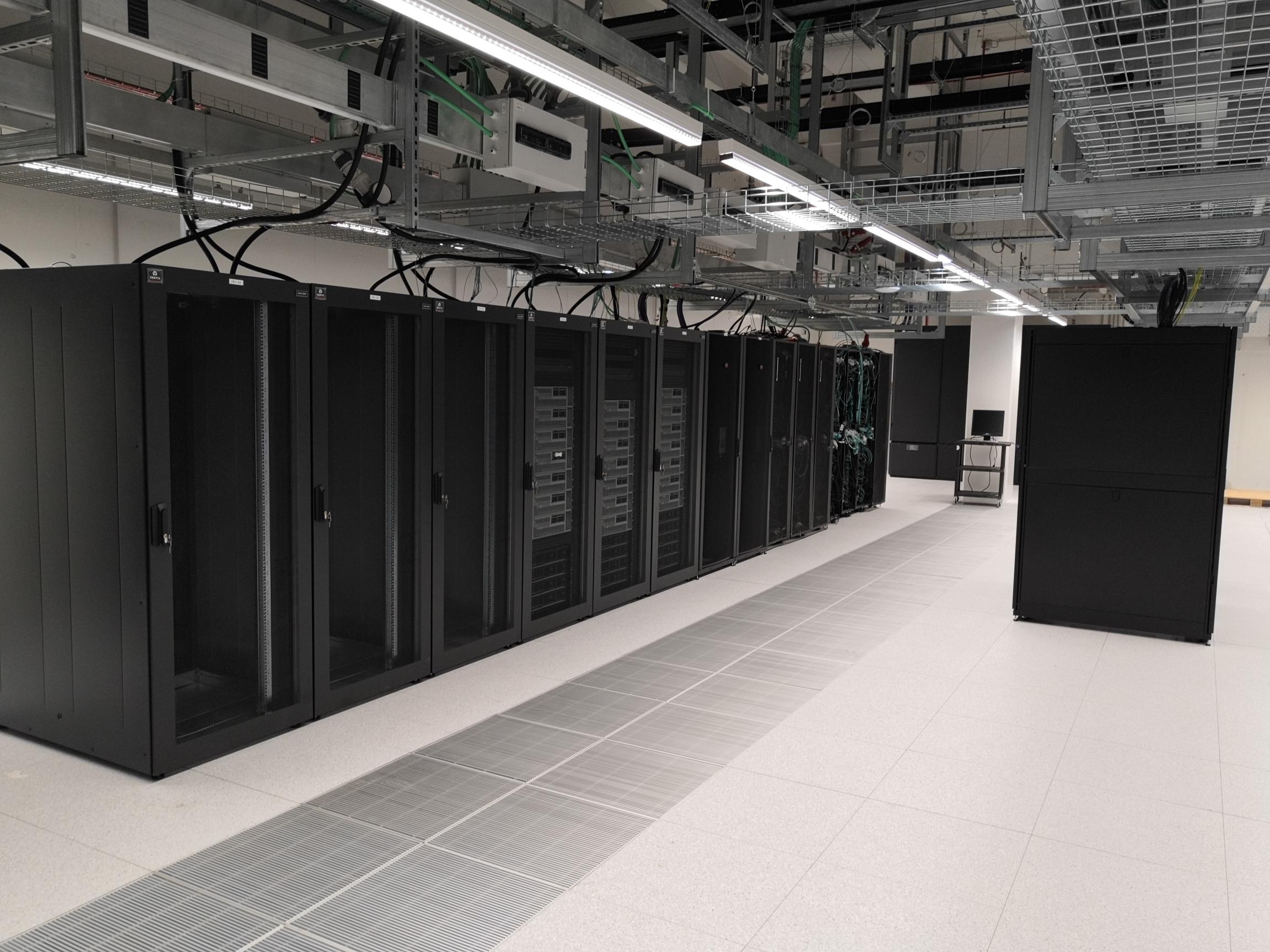
They are called HPC bubbles, that is, high-performance computing bubbles, and they are extremely powerful computers that work together to analyse enormous quantities of data in a short time: it is by adopting this technological solution that INFN has recently strengthened its scientific computing infrastructures, installing a series of high-performance computers at several sites. Thanks to the HPC bubbles, INFN has enhanced its capacity to support national and international scientific projects, contributing to innovation and to the competitiveness of Italian research.
“Overall, the new HPC Bubbles – explains Andrea Chierici, coordinator of the computational resources of INFN’s Tier1 – make available around 40,000 CPU cores and 244 high-performance GPUs, adding significant HPC-type computing capacity to INFN’s distributed computing infrastructure for the storage and analysis of big data, such as those coming from high-energy physics experiments, astroparticle physics and gravitational waves”.
INFN’s HPC bubbles were created thanks to funding from the TERABIT, DARE and ICSC projects, supported by Mission 4 coordinated by the Ministry of University and Research under the PNRR, and now represent a strategic resource for the National research system.
“The HPC Bubbles fill a gap in the computing continuum available to INFN’s researchers, – argues Daniele Cesini, head of INFN’s Tier1 – and position themselves between individual workstations and large computing infrastructures, such as national supercomputers and the INFN Grid, part of the Worldwide LHC Computing Grid that supports the experiments at CERN’s large LHC accelerator”.
The most powerful of these bubbles is installed at CNAF in Bologna, INFN’s national centre dedicated to scientific computing and to the management of data from large international experiments. This cluster, with 7,104 CPU cores and 84 NVIDIA H100 GPUs, has achieved a result of international significance: it has entered the Top500 of the most powerful supercomputers in the world, published in November on the occasion of Supercomputing 2025, ranking 437th. It is the first time in recent years that an INFN HPC cluster has entered the prestigious Top500 ranking, marking a historic milestone for the national scientific community. In addition, its storage infrastructure based on Ceph Brick has been included in the IO500 list, which evaluates the performance of storage systems, achieving 22nd place.
“This milestone – underlines Luca dell’Agnello, director of INFN’s CNAF – bears witness to CNAF’s constant commitment to building computing infrastructures of excellence in support of scientific research and represents not only international recognition, but also the result of a collective effort: from hardware optimisation to software configurations, through the continuous work of CNAF’s technology group and of INFN’s other computing centres. This result strengthens INFN’s mission to stimulate innovation and support advanced research projects on a global scale”.
The result was made possible by the PNRR projects: TERABIT, which focuses on the development of ultra-high-capacity network and computing infrastructures to support scientific and technological research, and DARE, which aims to create a secure digital ecosystem for the processing of sensitive data in the healthcare and scientific fields. Both of these projects are coordinated with the other major PNRR initiative, ICSC, the National Supercomputing Centre, which is at the heart of Italy’s strategy for advanced computing.