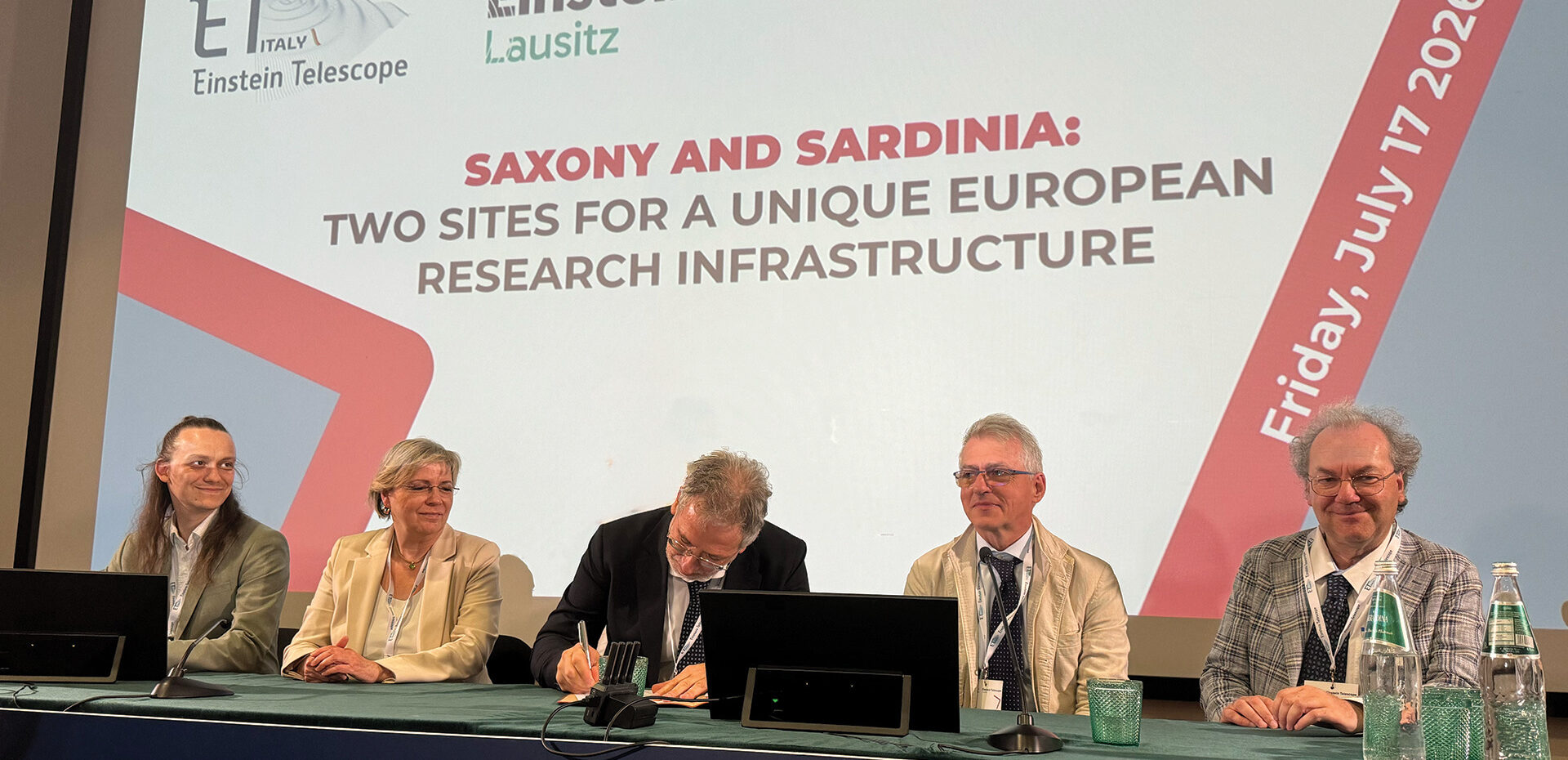
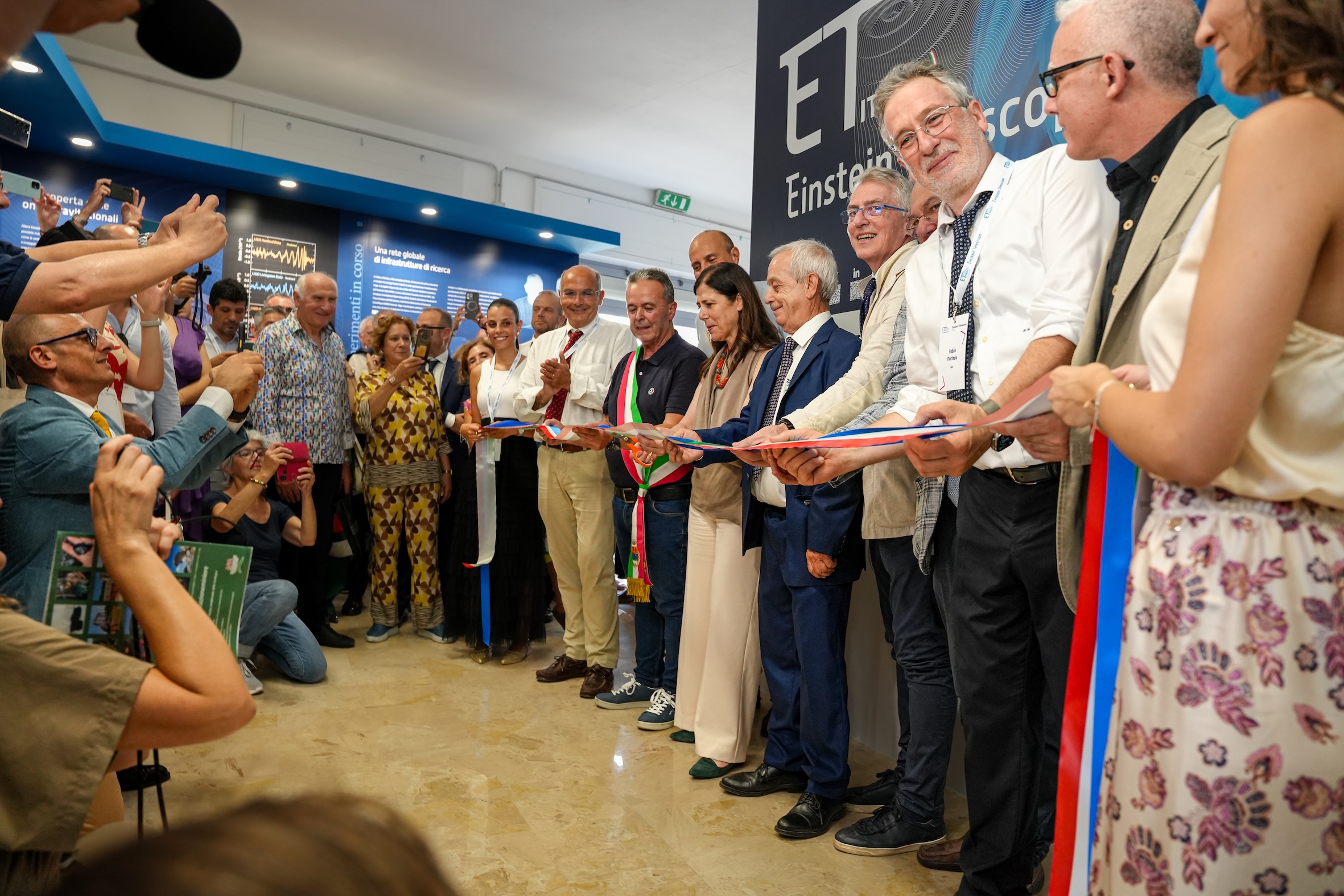
“The signing of this agreement represents a significant step forward because Sardinia and Saxony are reinforcing their shared commitment to present a joint candidacy and cooperate in offering Europe the most scientifically robust and programmatically reliable solution. Based on the studies conducted so far, we are convinced that implementing the Einstein Telescope through two L-shaped interferometric detectors provides the best conditions for the project’s success”, said Antonio Zoccoli, President of INFN. “This vision goes beyond cooperation between the two candidate sites and paves the way for a truly European research infrastructure, involving all partners in the creation of a distributed network for gravitational-wave research, with laboratories, technological facilities and scientific activities across different countries. Each participant will be able to contribute its own excellence and benefit from the collaboration. A major research infrastructure can only emerge from major collaboration: this is how science works, and only in this way can Europe build a unique scientific instrument capable of generating new knowledge and strengthening European leadership in fundamental research for decades to come”.
“Today we are witnessing Europe at its best. By signing this agreement, two of Europe’s most suitable and seismically quiet regions, Sardinia and Lusatia, are joining forces to pursue one of the most ambitious scientific goals of our time through the development of the most advanced technologies for detecting the tiniest ripples in spacetime”, said Roberto Ragazzoni, President of INAF. “The same spirit of curiosity that led Galileo to turn his eyes to the sky continues to inspire discovery and drive technological, economic and societal progress. Our quest to observe the events that have shaped the Universe – from the merger of black holes to spectacular phenomena such as kilonovae – is not only about satisfying humanity’s curiosity. It is also about advancing technology, strengthening European scientific cooperation and creating opportunities whose impact cannot yet be foreseen. This is fundamental research at its best: history has shown that its greatest achievements often surpass our expectations and open entirely new horizons. Working together as a single observatory, the two L-shaped interferometers will reveal aspects of the Universe that have remained hidden until now. The time has come to look to the sky once again, with new eyes”.
“The signing of this Memorandum marks an important step in the path we are building together with our Saxon partners. Major research infrastructures are born not only from scientific excellence, but also from the ability to share expertise, experience and common goals”, said Fabio Florindo, President of INGV. “INGV brings to this collaboration its extensive knowledge of the Earth and subsurface. For an infrastructure such as the Einstein Telescope, geological and geophysical site characterization is essential, and we have been working on it with scientific rigor and a long-term vision for many years. I believe the value of this agreement extends well beyond preparing our respective candidacies. It is a tangible example of how cooperation among research institutions can strengthen Europe’s role in addressing major scientific challenges while creating new opportunities for development and innovation in the regions involved”.