At its 225th meeting, the CERN Council received the recommendations drawn up by the dedicated working group (ESG) for the update of the European Strategy for Particle Physics (ESPP), with the aim of developing a common vision for the future of the field. The recommendations will be examined by the Council over the coming months, and a final decision is expected at the dedicated meeting to be held in Budapest next May.
For the 2026 update of the ESPP, the CERN Council requested that the Strategy should include the chosen option for the next collider at CERN and priority alternative solutions to be pursued should the main plan prove unfeasible or uncompetitive. Following a lengthy evaluation process that began in 2024, the ESG formulated its recommendations at the conclusion of a dedicated meeting held in Ascona, Switzerland, from 1 to 5 December 2025.
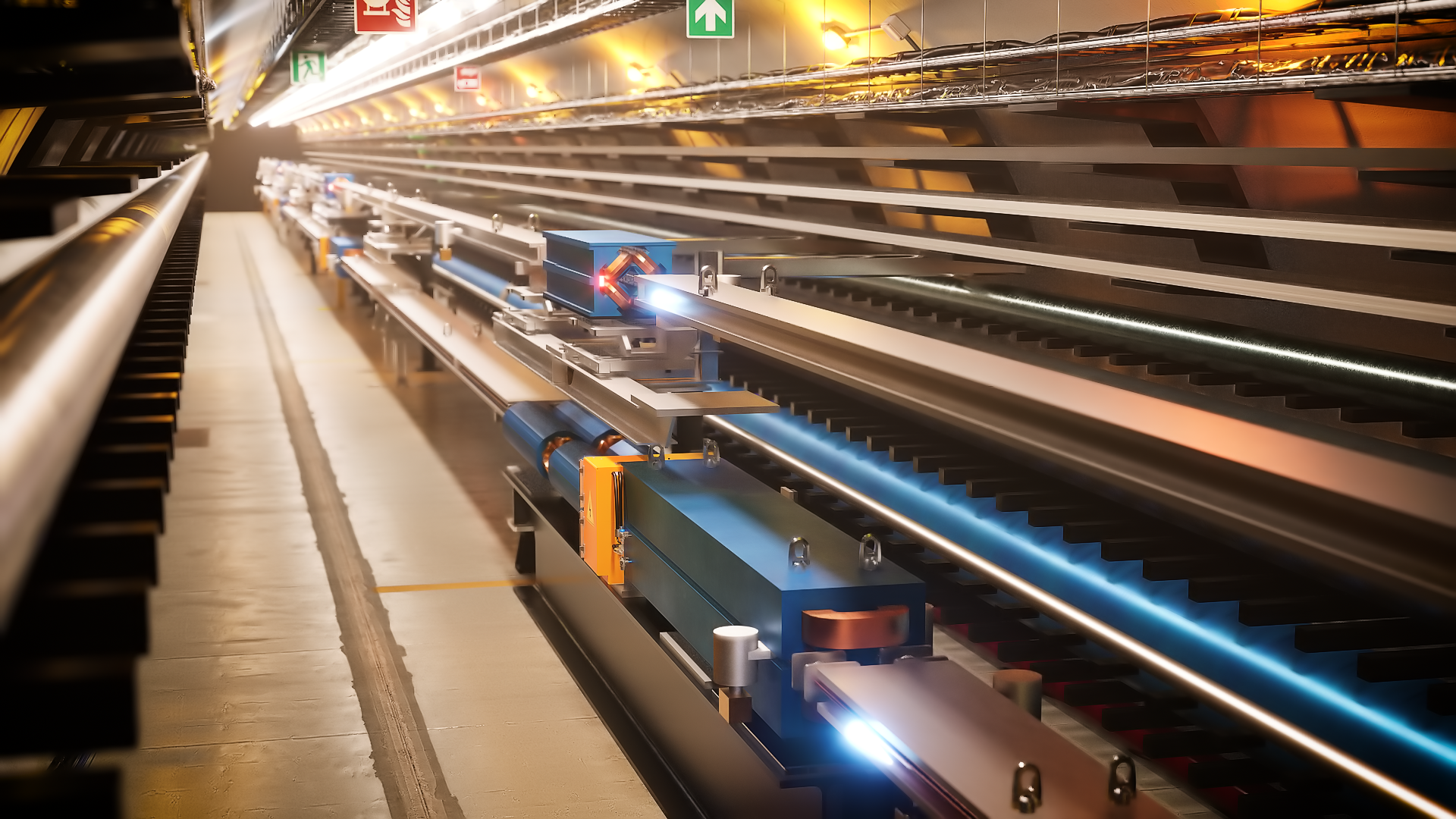
The priority option identified is the electron–positron Future Circular Collider (FCC-ee), which would provide an infrastructure for a physics programme capable of addressing many of the open questions in particle physics, in particular those relating to the Higgs boson, which are fundamental to understanding the foundations of the Standard Model and to opening up new opportunities for the discovery of new physics beyond the Standard Model, while at the same time promoting the development of new technologies, including those with potentially significant impact on society. As an alternative solution, the ESG presented a descoped FCC-ee.
The full set of recommendations is available at this link.
“During the process we witnessed very strong involvement from the European particle physics community and beyond, which expressed its views on the next flagship collider, on other areas of physics and technology, and on issues of importance for our field. On the basis of these contributions, we held constructive discussions which ultimately led to a very clear picture and strong support for CERN to host the electron–positron Future Circular Collider, FCC-ee, as the next flagship project. In addition, many other important recommendations for the future of our field were formulated”, said Karl Jakobs, Chair of the Strategy Secretariat.
“The high-energy physics community has reached an important milestone in the process, converging on fundamental recommendations for the future of the field”, said the President of the Council, Costas Fountas. “We wish to work with the Member and Associate States to define a vision for the future of high-energy physics in Europe that maintains a leading role for CERN and opens up further long-term collaborations with international partners”.
“The recommendations represent a crucial milestone in the Strategy process and for the future of the field”, said CERN Director General Fabiola Gianotti. “The proposed strategic directions, in particular with regard to the next flagship collider at CERN, will inspire the next generation of scientists and ensure that CERN and its international partners remain at the forefront of discovery and technology in our discipline”.
“INFN has played its part in the process of updating the European Strategy for Particle Physics, with a great commitment from our entire community. We also hosted last June in Italy, in Venice, what was probably the most significant moment of discussion for the international scientific community, which then helped steer the recommendations now presented to the Council”, comments Sandra Malvezzi, INFN Vice-President. “Personally, I must say that it was a very interesting experience to take part in this process; I was able to see the strong involvement of the European particle physics community, engaged in a collective effort to shape its future by defining scientific priorities, technological directions and synergies with related fields”, Malvezzi concludes.
The recent FCC feasibility study, just completed, provides the basis for continuing work on multiple aspects of the project. The CERN Council’s decision on the possible construction of the FCC is expected around 2028.