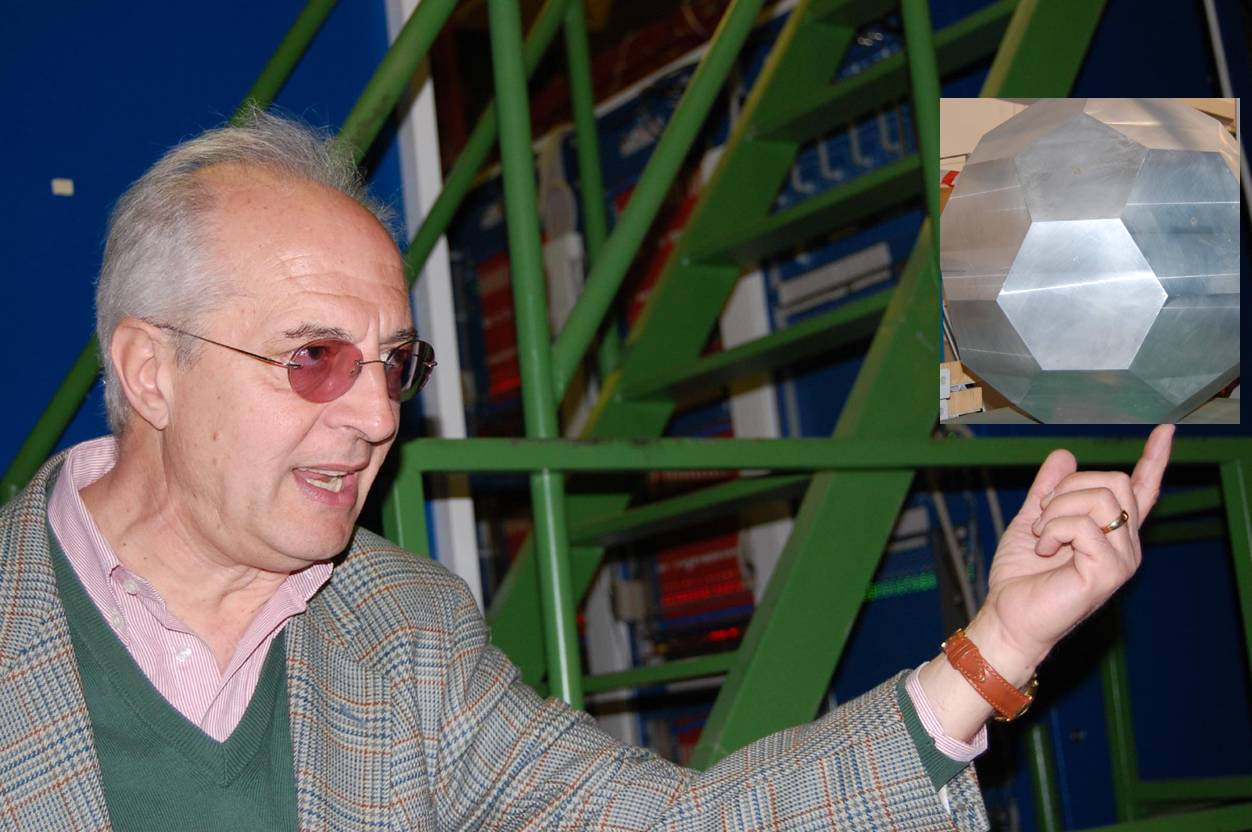
[INFN–CREF News] On the night of February 21, Rinaldo Baldini passed away in Rome at the age of 83. An experimental physicist at the Istituto Nazionale di Fisica Nucleare (INFN), he was a pioneer of Italy–China cooperation in high-energy physics and served as director of the Enrico Fermi Museum and Research Centre (CREF) from 1999 to 2011, during the presidency of Antonino Zichichi.
Rinaldo Baldini held a prominent position in the history of research at the INFN Frascati National Laboratories and in the field of electron–positron collision physics.
“For Rinaldo, electron–positron collisions were a lifelong passion, beginning with the first gamma–gamma experiments at the ADONE collider at the Frascati National Laboratories and continuing throughout his career,” recalls Enzo Iarocci, former director of the Frascati National Laboratories and former INFN president. “In experiments he loved to deal with every aspect, including detectors, but he excelled in data analysis. He loved particle physics and continuously broadened his knowledge.”
He was the creator, promoter, and scientific leader of FENICE, the third and final generation experiment of ADONE. In the subsequent phase of the Frascati National Laboratories, he joined the physics program of the DAΦNE project and later the KLOE experiment, designing -together with colleagues in the group – the experiment’s wire chamber and actively contributing to its construction.
After ADONE, in the field of electron–positron collider physics, Baldini also made significant contributions to the DM2 experiment at the DCI accelerator (Dispositif de Collision dans l’Igloo) at the Laboratoire de l’Accélérateur Linéaire (LAL) in Orsay, France, and to the ALEPH detector at the Large Electron–Positron Collider at CERN.
“Rinaldo was an exceptional experimental physicist, with whom I had the pleasure to work during the construction of BABAR, a major experiment dedicated to the so-called “CP violation”, which collected data in the U.S., at the SLAC National Accelerator Laboratory, in the early 2000s, and in which he played a pivotal role,” recalls Fernando Ferroni, former INFN president. “I greatly appreciated his ability to combine outstanding experimental expertise with brilliant theoretical insight. He was a highly knowledgeable person and a great enthusiast of quantum mechanics.”
From 2008, Rinaldo Baldini worked within the scientific collaboration of the BESIII experiment, which in Beijing collects and analyses data from the BEPC II accelerator at the Institute of High Energy Physics (IHEP) of the Chinese Academy of Sciences.
“Rinaldo’s passing is a tremendous loss to the BESIII Collaboration,” comments Jun Cao, Director of IHEP. “His scientific spirit and outstanding contributions to China-Italy scientific exchanges will forever be remembered in our hearts. We will carry forward his legacy and continue to deepen cooperation between China and Italy in particle physics.”
A pioneer of Sino-Italian cooperation in high-energy physics, Baldini was the first director of the INFN-IHEP Joint Laboratory (I2JL), established to promote and coordinate collaboration between the two leading institutions in fundamental physics research: INFN and IHEP.
“To commemorate Rinaldo’s commitment and effectiveness in strengthening Sino-Italian collaboration, INFN and IHEP have decided to establish a joint award in his name for the best Italian and Chinese PhD theses developed within the INFN-IHEP Joint Laboratory,” explains Marco Maggiora, director of the joint laboratory. “This is a scientific recognition for young researchers, accompanied by a symbolic monetary prize of €1,000, aimed at encouraging and promoting joint research activities in the spirit of Rinaldo’s work and honoring his extraordinary ability to guide and support students, colleagues, and collaborators.”
Rinaldo Baldini was also the first director of CREF during the presidency of Antonino Zichichi, holding the position for over ten years. Under his leadership, CREF promoted numerous initiatives of the highest scientific, historical, and outreach value, including the creation and development of the project “Extreme Energy Events. Science in Schools”, which still fosters a passion for physics among high-school students.
“He was a mentor to researchers and to all the staff of the institution, whom he always supported with care, generosity, and affection,” recalls Angela Bracco, President of CREF. “Colleagues who worked closely with him remember him as a figure very much like a father. Those who have benefited from his work will remain grateful and feel a responsibility to advance the legacy he left behind.”
“I have always been struck by his extraordinary passion for physics and the kindness that distinguished him,” recalls Antonio Zoccoli, President of INFN. “Rinaldo was a brilliant scientist who knew how to build constructive relationships with the people he worked with. He will be deeply missed by the entire INFN community.”