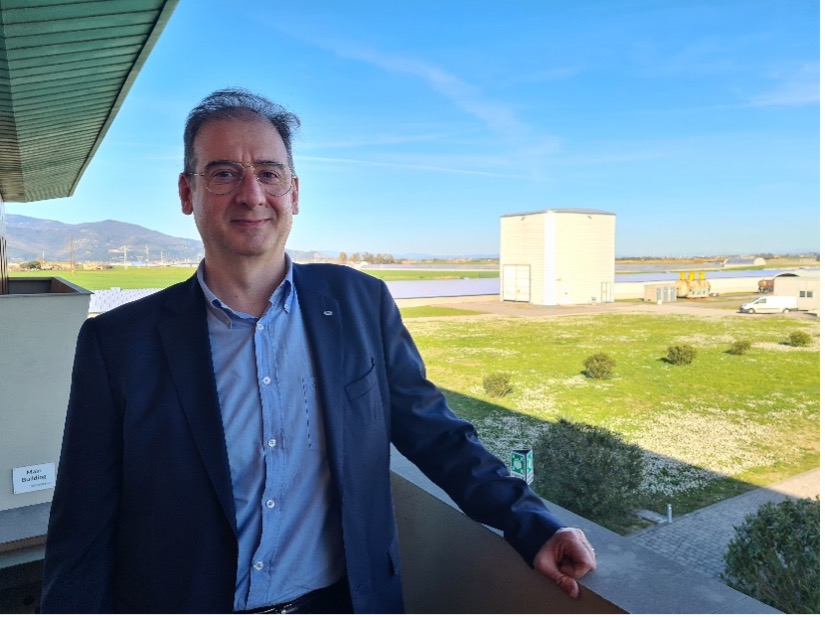
Michele Punturo, INFN researcher and former international coordinator of the Einstein Telescope collaboration, takes up his new role as Director of ICRANet, the International Center for Relativistic Astrophysics Network, today, 14 September. He succeeds Remo Ruffini, formerly Professor of Theoretical Physics at Sapienza University of Rome, who served as ICRANet’s director from its foundation.
ICRANet is an international organisation dedicated to education, training and research in relativistic astrophysics, cosmology, theoretical physics and mathematical physics. One of its main activities is also to promote international scientific cooperation. ICRANet’s members comprise three states and three universities and research centres: Armenia, Italy, Vatican City, the University of Arizona (USA), the University of Tartu (Estonia) and ICRA (International Center for Relativistic Astrophysics).
“It is an honour and a challenge to take on the role of Director of ICRANet, a small research organisation with great potential thanks to its international status”, says Michele Punturo. “In the coming years, ICRANet will need to grow and consolidate its position, becoming more attractive to other countries and to a broader scientific community, while expanding its interests into other areas of astrophysics. For example, I would be very pleased to see ICRANet play a significant role in gravitational-wave research and in the Einstein Telescope project. I will certainly work to foster all possible synergies with the major national research organisations involved in Einstein Telescope, such as INFN, the National Institute for Astrophysics and the National Institute of Geophysics and Volcanology, as well as with universities and with the innovation ecosystem of the city of Pescara, where we are based, and of Abruzzo”, Punturo concludes.
Michele Punturo is a Research Director at the National Institute for Nuclear Physics (INFN), at its Perugia division. He graduated in Physics from the University of Perugia in 1990 and subsequently obtained a PhD in physics.
Early in his career, he worked at CERN on fundamental physics experiments. In 1994, he joined the international Virgo project, contributing to the construction in Europe of the detector that has played a part in many discoveries in gravitational-wave and multimessenger astronomy. Within the Virgo scientific collaboration, he has held various coordination and leadership roles and took part in the first detection of gravitational waves, achieved by the LIGO-Virgo collaboration in 2016. This historic discovery was recognised first with the Breakthrough Prize in 2016 and, the following year, with the Nobel Prize in Physics.
In 2004, Michele Punturo was among the originators of the Einstein Telescope project, one of the major European projects to develop a new large-scale research infrastructure for gravitational-wave science, initially promoted by INFN and the Dutch institute Nikhef. In 2007, he coordinated the Einstein Telescope Design Study project, funded by the European Commission under the 7th Framework Programme. From 2022 to 2026, he served as coordinator of the international Einstein Telescope scientific collaboration, which now comprises more than two thousand people. Punturo also coordinated the ETIC (ET Infrastructure Consortium) project, funded with €50 million by the Ministry of University and Research under the National Recovery and Resilience Plan (PNRR) from 2023 to 2026. The project supported Italy’s candidacy to host Einstein Telescope in Sardinia and the establishment of a network of national laboratories to develop the enabling technologies for Einstein Telescope. He currently coordinates the MUR PON/FESR MITI (Multimessenger Infrastructures and Technologies in Italy) project, which aims specifically to develop the enabling technologies for Einstein Telescope through collaboration with the private sector.
Michele Punturo is the author of more than 385 publications in scientific journals.