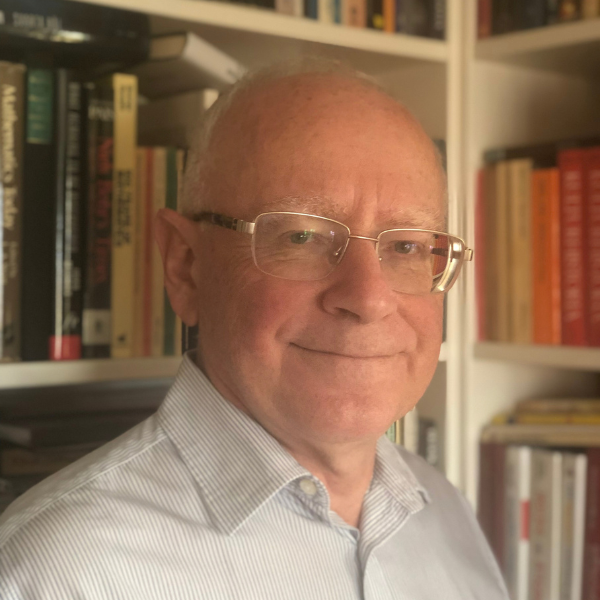
Interview with Mats Larsson, member of the Nobel Committee for Physics in 2013 and from 2016 to 2023
You were a member of the Nobel Committee for Physics for nine years and have shared that your favourite moment has always been hearing the laureates’ reaction when they receive the magic phone call. Is it true that you call them only a few minutes before the public announcement? Which of those calls do you remember most vividly?
That is such an interesting experience, and every phone call is special in its own way. We call the laureates a few minutes after the decision has been made, although we do not always manage to reach them. Once we have finished the call, we line up for the press conference, and that is where we make the announcement. We are always happy if at least one of the Nobel laureates attends the press conference, because journalists have a lot of questions. But, as I said, sometimes we cannot speak to the winners, or we only manage to reach them in rather roundabout ways. In 2023, when we called the French-Swedish laureate Anne L’Huillier, we could not reach her. But it turns out that her husband is also a member of the Academy, so we called him and asked how we could get in touch with Anne. He immediately understood what was going on, and suggested that we wait a few minutes, because Anne was teaching at the time. Ten minutes later we were on the phone with her: she told us how delighted she was to hear that we had awarded her the prize, and then she dismissed us with a “Well, now I have to get back to teaching.”
The Nobel call always comes as a surprise: you cannot nominate yourself and the nominations are kept confidential. How does the nomination process actually work? And who is entitled to submit a nomination?
There is a list of the people that are allowed to send nominations, which includes, first and foremost, all members of the Royal Swedish Academy of Sciences and professors of Physics in the Nordic countries. We then send a request for nominations to various universities, asking for each nomination to be submitted by a single qualified individual (we don’t want, for example, to have a faculty meeting where everyone is invited to vote), and we have also drawn up a long list of competent people who can submit nominations. Last but not least, former Nobel laureates are always invited to nominate someone. And usually, even going back through the archives, nominations submitted by really distinguished people carry a lot of weight. Then the quality of the nominations can vary considerably. There are very careful nominations, in which strong arguments in favour of the candidate are presented precisely, and extremely brief nominations, such as those sometimes submitted by Einstein. Naturally, if you are not a very prominent person, simply giving a name and a few lines doesn’t carry all that much weight, a well-considered motivation makes the difference.
Nominations remain confidential for 50 years, and even longer if the nominees and the laureate are still alive. What is the thinking behind such a long period of confidentiality?
In fact, in the past, the period was actually infinite: the archive would never have been opened. And I think the idea was to ensure that those submitting nominations had total freedom. It’s different when, for example, you act as a peer reviewer: of course, you are critical of some papers and more favourable towards others, but you always maintain a certain balance, a degree of diplomacy. By contrast, when you are writing a nomination or what we call a “special report” – that is, a report that we on the Committee can request in order to find out more about a particular subject, or to obtain a qualified opinion from someone of a very high standing – it is essential to be very open.
Once all the nominations have been collected, what happens? How do you narrow the field from about 3,000 nominations to the areas and candidates that the Committee will investigate further?
It’s correct that we send out around 3,000 letters inviting nominations, but the response rate is not that high: we receive maybe 400 or 500 nominations. We go through every one of them and map any people and subjects that are nominated quite a lot. We then start requesting special reports on certain subjects and candidates, and collect between 20 and 30 special reports. Sometimes the material we gather is so extensive that someone from the Nobel Committee is asked to write a condensed report, to ensure that everyone has an overview and to understand how to proceed. In June, the Nobel Committee narrows down the shortlist of nominated subjects and potential laureates even further, and focuses on them over the summer. Then, in August, the Committee retreats to a quiet and isolated place and engages in the lengthy discussions that will lead to a conclusion. The procedure for the Physics prize has remained essentially unchanged since the beginning of the prize. What has changed is the discipline itself, which today encompasses a vastly broader field of research than it did in the early years. Media attention has also grown, although the Swedish media have always followed the Nobel Prize closely.
Has it ever happened that experts asked to prepare special reports reached completely opposite conclusions about the same discovery or candidate? How does the Committee deal with such disagreement?
Throughout the history of the prize, there have certainly been conflicting views about whether it should be awarded. When I began looking into this a few years ago, I discovered that within the Swedish Nobel Committee there had been different opinions even about figures such as Schrödinger, Heisenberg and Dirac; and there were definitely different opinions about Einstein. The same thing happens today. When experts reach different conclusions, we read all the documentation carefully and try to determine whether one of the assessments might be influenced by some kind of bias. These are fairly difficult discussions, even for members of the Nobel Committee. Then there are misunderstandings. In September 2015, for example, the first observation of gravitational waves took place, and as early as 2016 there was speculation that there might be a prize. But the prize could not be awarded because the result had not yet been published. An announcement or a presentation at a conference is not enough: there has to be a solid publication, which in the case of gravitational waves did not appear until February 2016, signed by the LIGO and Virgo collaborations. 2017 was the first year in which the prize could be awarded, and so it was.
In the past, you described the Committee’s discussions leading to the shortlist as “open, sharp, frank and sometimes emotional, but never hostile”[1]. If we could sit in on one of those discussions, what would surprise us?
First of all, all the discussions are in Swedish. You might imagine that they are in English, but they are not, we speak Swedish. So if you were sitting there and understood Swedish, I think you would be able to follow the thread of the discussion for a while. After that, there would not be much else to surprise you: once the shortlist has been defined, each member of the Committee spends the summer working individually on their own recommendations ahead of the final meeting in August, without exchanging emails or phone calls with their colleagues. And because everyone can come and see you in your office, you take the work home, where it is easier to maintain the utmost confidentiality. You know, for my family, my children, my parents, my siblings, the Nobel Prize is the banquet, the celebrations – which my sisters have always asked to take part in! –, whereas for my wife it is the kitchen table during the summer: covered with documents and reports.
What happens if someone on the Committee has changed their mind by August compared with June?
It has happened that I have changed my mind, it’s not a big deal. From June to August, everyone follows their own method. For me, for example, I like to think, write, and perhaps sit down in the evening with a glass of wine and get some other ideas. Then, the following morning, ask myself: was it a good idea or a bad idea? Should I come up with new ones? It really is a process. And in August, when we meet, we put all these ideas together and arrive at the final decision. We then draw up the report in which we propose a prize to the Academy of Sciences. The entire Physics class, consisting of around 35 people, discusses the report in two separate meetings in September, to decide whether to support our proposal or put forward a different one. The Committee therefore defends the proposal, first before the Physics class and subsequently before the Academy as a whole. In the meantime, we turn to a rather demanding and hectic task: preparing the material that will be made public once the decision has been taken, namely the report for the press conference, the public information about the prize and a scientific background piece. The latter, in particular, is very difficult to write because it is read very carefully by specialists, and it has to be produced within a short period of time. It cannot be a complete review containing 300 references, but while you are writing it, you also know that anyone who does not find themselves cited will be disappointed. So you have to strike the right balance: produce a background piece that is accessible, as comprehensive as possible, without making it overwhelming. And, despite taking great care, sometimes something inevitably slips through the net.
Speaking of difficulties, what does it feel like when you recognise that a scientist’s work is extraordinary, but in the end decide not to recommend them for the prize?
It is really difficult. Every year you can award the prize to only three people in Physics. You can have two different motivations, even if they are not closely connected – sometimes they are, but they don’t have to be. And you always find yourself in a situation where, once you have identified a subject deserving of a Nobel Prize, there are many more absolutely qualified candidates than you can award the prize to. You then have to narrow the field, and it is a painful process, because you know that those who are left out will immediately realise that their opportunity has passed and will be very disappointed. You usually don’t award the prize in the same area twice. Quantum mechanics is an exception, having received several prizes, but it is precisely that – an exception.
Let us stay with this constraint, three people, while major discoveries in physics are increasingly the result of large collaborations. How is the Committee addressing this issue?
We have been asking ourselves this question for several years. So far, the Committee and the Academy have not found themselves in a situation where it has had to award a prize to a collaboration or an international organisation; we have always managed to narrow the field down to a certain number of individual candidates. But it is certainly a complex issue and one that is under discussion.
Are there any scientists or discoveries that you regret never seeing recognised with a Nobel Prize?
Yes, of course. The first name that comes to my mind is Madame Wu, who should have been awarded the prize for the experimental discovery of parity violation in weak interactions: her failure to be recognised was a clear mistake by the Nobel Committee. Lise Meitner should also have been awarded the prize for her fundamental theoretical contribution to the discovery of nuclear fission. Among the men, certainly Lester Germer. Germer had conducted an experiment together with Clinton Davisson to detect electron diffraction. Both were nominated several times, but in the end only Davisson received the prize. I have read the files very carefully – they are now open, as more than 50 years have passed and the people concerned have died – but it is impossible to understand from the archive why Germer was excluded. In 1937, only Davisson and George Paget Thomson were awarded the prize; the third place, which remained vacant, could have gone to Germer, but it did not. A clear error, in my view. As for discoveries that should have been awarded a prize but were not, they are harder to identify. There are certainly discoveries that have been awarded prizes and that, in hindsight, can be called into question. For example, Gabriel Lippmann discovered how to produce colour photographs, but by the time he was awarded the prize, in 1908, the technique was already almost obsolete. In general, however, I think there are not all that many questionable prizes in Physics. And I also think that the very first prize, awarded to Wilhelm Conrad Röntgen for the extraordinary discovery of X-rays, was particularly well judged. X-rays have been hugely important, and they still are. In Swedish we even have a verb that we use when we go to the dentist: “röntga”, from Röntgen, meaning to have an X-ray.
After so many years on the Nobel Committee, what do you take away from that experience?
It was a very exciting period of my life. I certainly would not have wanted to miss it, but I have no particular desire to go back to it. There is no easy way to work on the Nobel Prize, it requires an enormous amount of commitment. And, in order to maintain the prestige of the prize, the margin for error is extremely small. Over the course of your career, you can make several mistakes, and they can often be corrected. If, for example, you are on a committee selecting young researchers, you have to draw up a ranking and set a threshold. But you also know that for those who fall below that threshold, it is not an irreparable tragedy: they will come back, apply again, and have a career. With the Nobel Prize it is different. If you make a serious mistake, especially if you know that you have not done your task properly, it is a very serious matter. It is perhaps the only context in which you cannot afford to be superficial. Today I follow the prize without working on it, and I devote myself to the history of science. I have just finished a book on quantum mechanics through the Nobel Prizes, and I already have several projects for the future. I will soon be speaking in China about the prize for the discovery of weak interactions awarded to Tsung-Dao Lee and Chen Ning Yang, the latter of whom died last October at the age of 103. I loved having access to the archive, which had remained closed until less than a year ago, being able to read the documents and knowing that I could write and tell the whole story. It is a fantastic feeling, after years of confidentiality.
BIO
Mats Larsson is Professor of Physics at Stockholm University and, from 2011 to 2020, was Director of the AlbaNova University Center in Stockholm, a joint scientific centre of the Royal Institute of Technology (KTH) and Stockholm University. He served on the Nobel Committee for Physics in 2013 and from 2016 to 2023. His research interests include laboratory astrophysics and its importance to astrochemistry, free electron laser research targeting small molecules and, more recently, molecular chirality and chiral interactions.