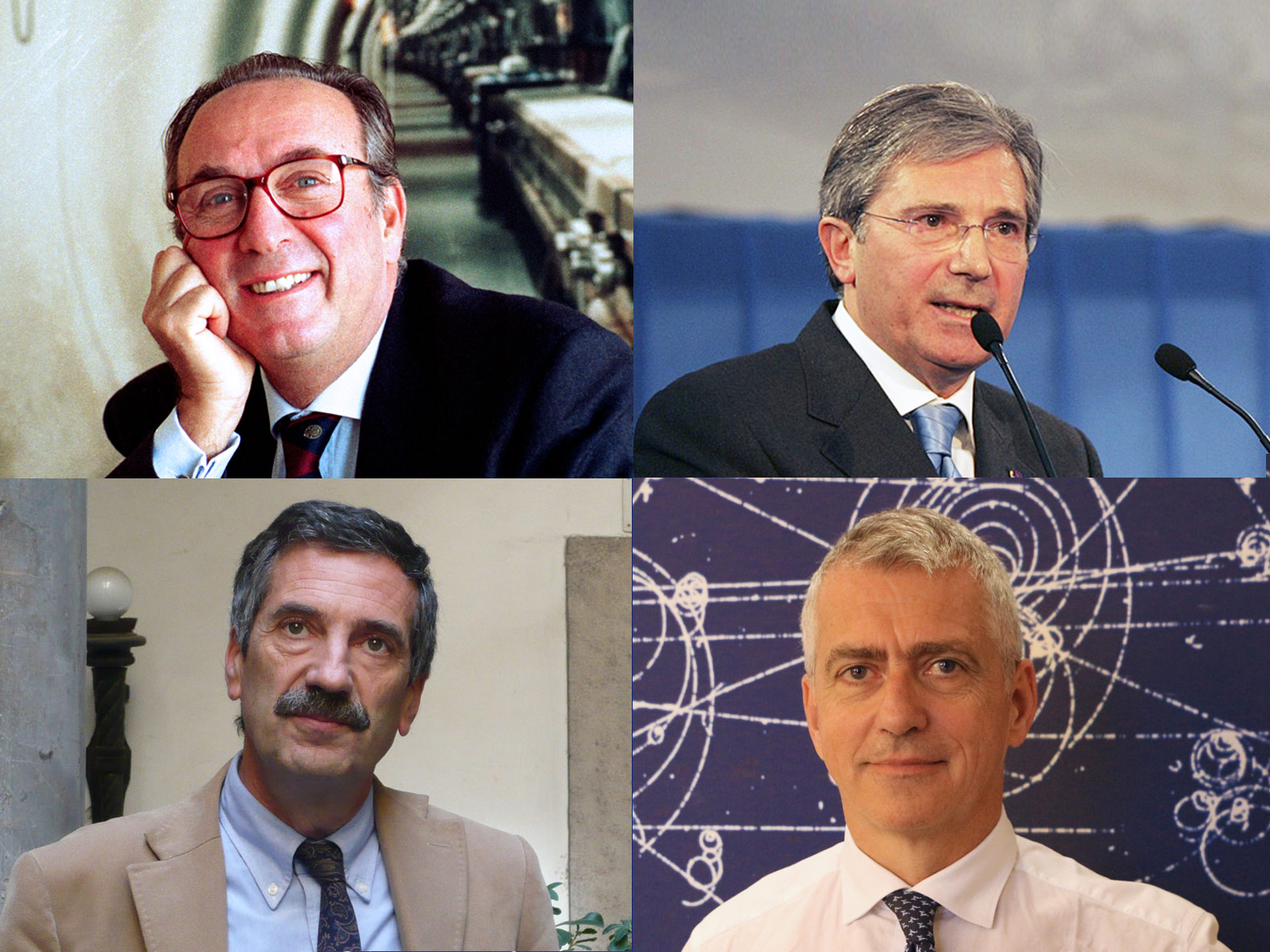
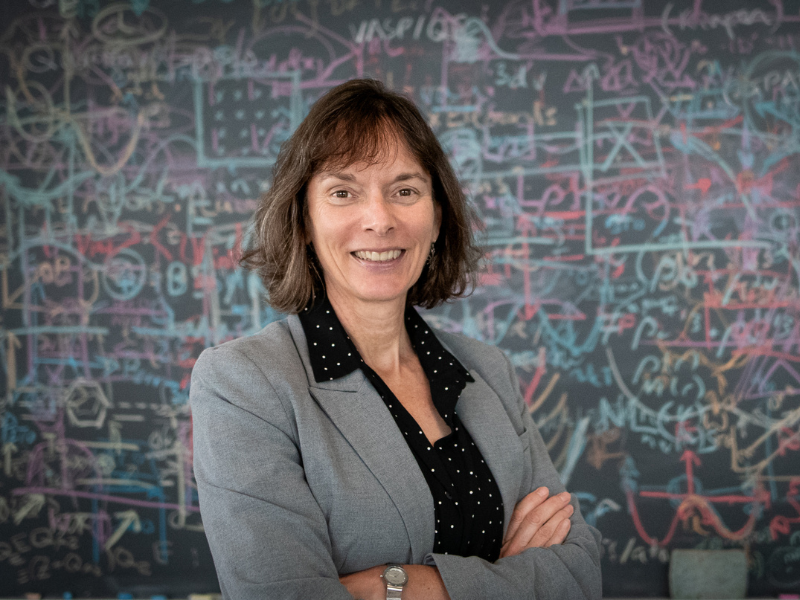
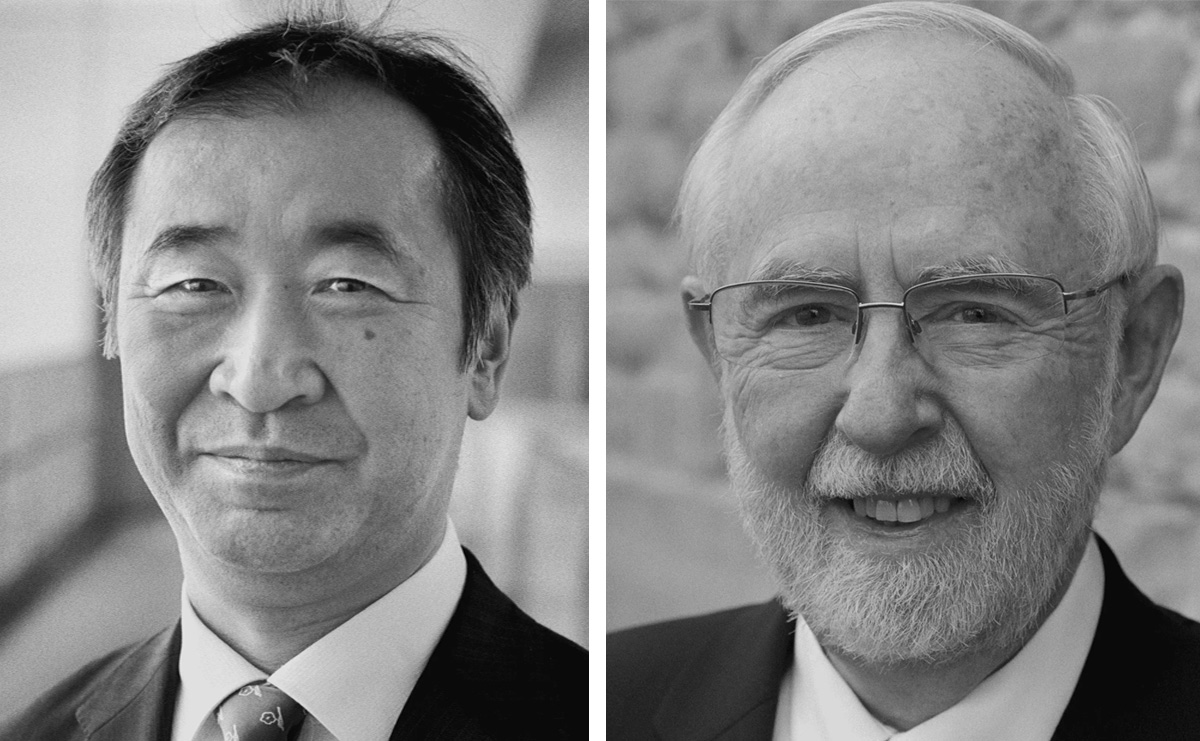
Interview with INFN Presidents Luciano Maiani (1993-1998), Enzo Iarocci (1998-2004), Fernando Ferroni (2011-2019), Antonio Zoccoli (2019-present)
If you were to recount your period at the helm of INFN through the moments that left the deepest impression on you, which ones would you choose?
[Luciano Maiani] INFN is a complex organisation, and a complex one to lead. Many aspects must be taken into account, and above all one must be able to rely on efficient, loyal and committed collaborators; and I was very pleased with the members of the Executive Board appointed by the Board of Directors – A. Bettini, M. Cerdonio, L. Mandelli, E. Migneco and P.G. Picozza – who provided me with valuable support. Among them, Cerdonio carried out extremely valuable work for the organisation of Virgo, the interferometer for the detection of gravitational waves built at Cascina by a French-Italian collaboration. This was a completely new undertaking for INFN, and also a new one for gravitational-wave research, which in Italy had until then been pursued using the technology of resonant bars. Virgo marked a paradigm shift, and followed a similar project, LIGO, developed in the United States on an even larger scale. It was not without criticism within the institute: from researchers, who feared that this new area of research would divert funds away from particle physics, and from the Board of Directors, which had not approved the project when it had been proposed by my predecessor, Nicola Cabibbo. But I returned to the issue, and it was a success. During my presidency, following once again Cabibbo’s example, who had approved the installation of experiments for the detection of solar neutrinos at the INFN Gran Sasso National Laboratories (LNGS), the Borexino experiment was approved at the LNGS, a large detector designed to observe solar neutrinos using a new technology. Borexino achieved excellent results, which motivated the development of a second-generation replica, JUNO, which began operation this year in China; and it was my first approval of a major scientific project at INFN, therefore an important milestone also on a personal level. Even more important was the management of INFN’s participation in the Large Hadron Collider (LHC) at CERN, the largest and most powerful particle accelerator in the world. It was necessary to organise INFN’s presence in the experiments planned for the LHC, and to secure Italian industrial participation in the construction of the large superconducting systems (the machine’s magnets and the detector magnets). In the end, Italy’s participation in the complete project was outstanding. Alongside the scientific challenges, I would finally like to mention one entirely internal to the institute, linked to the introduction of the time card. INFN personnel had never been required to clock in, but during my presidency the Government issued a directive in this regard. This was followed by an endless series of discussions: between those who argued that Enrico Fermi had never had to clock in and walk around with a watch around his neck, and the management, which had to implement this provision. In reality, I was convinced that a measurement of working time needed to be introduced – and I did so – and I also had a small personal vindication of the criticism I had received when, the following year, the European Union requested funds back from French research institutions because, not having a time clock system, they had been unable to demonstrate the actual use of the funding they had received. In short, they were six very interesting years, which began with the phrase of the Minister for Public Administration Sabino Cassese: “In Italy there are only two institutions that work, the Bank of Italy and INFN”, and ended without compromising the high reputation of the institute built by my predecessors, Antonino Zichichi and Nicola Cabibbo.
[Enzo Iarocci] In the early 2000s there were two significant scientific discoveries, both in the field of matter-antimatter symmetry violation, a truly fundamental area of research because it concerns understanding why the universe is practically devoid of antimatter. The first, namely the discovery of the direct violation of matter-antimatter symmetry in the decays of neutral K mesons, came from the NA48 experiment at CERN’s Super Proton Synchrotron, a highly sophisticated experiment with a strong (and decisive) INFN contribution. The second – the discovery that matter-antimatter symmetry is also violated in mesons containing the beauty quark – came from the BaBar experiment, also with a strong INFN contribution and carried out at the B-Factory (or B-meson factory) of the SLAC laboratories in Stanford, California, namely in an electron-positron collider capable of producing large numbers of B-type mesons and therefore suitable for precision measurements. In 2001, experimentation with DAFNE began, the Φ-Factory at the INFN Frascati National Laboratories, which was also partly dedicated to the study of matter-antimatter symmetry, since the Φ meson predominantly decays into K mesons. DAFNE continued the tradition of the electron-positron colliders at the Frascati Laboratories, from AdA to ADONE, which it had effectively replaced; and after 2001 it achieved record performances, bringing success to its subatomic physics experiments KLOE, DEAR and FINUDA. In particular, it enabled KLOE to carry out an accurate measurement of the Cabibbo angle, for which Cabibbo himself, as President of the Institute, had also been the first advocate of the project. Today DAFNE is about to give way to an accelerator of a different type, EuPRAXIA, with the aim – recurring throughout INFN’s history – of maintaining excellence in accelerator science. But there are also activities at the Institute that do not involve the use of accelerators and that have produced equally significant results. At the end of the 1990s, the MACRO experiment at the Gran Sasso National Laboratories showed evidence of atmospheric muon neutrino oscillations, promptly confirming the discovery of the phenomenon announced by the Japanese Super-Kamiokande experiment in 1998. And, with the aim of carrying out a conclusive experiment in this line of research, in 1999 the CERN Council, together with INFN, approved the CNGS project, “CERN Neutrinos to Gran Sasso”, proposed by Director General Luciano Maiani. One of the objectives of the founder of the Laboratories, Antonino Zichichi, was thus realised: not by chance, he had wanted the three experimental halls of the Laboratories to be oriented towards Geneva. Later, thanks to that neutrino beam, the OPERA experiment was able to demonstrate the appearance of tau neutrinos resulting from the oscillation of muon neutrinos during their journey from CERN to Gran Sasso. The CERN neutrino beam was also used by ICARUS 600, the pioneering large-capacity liquid-argon imaging detector conceived by Carlo Rubbia. In 2000, the ICARUS collaboration reached one of the project’s milestones: the 300-tonne semi-module of the experiment entered operation in Pavia, producing spectacular tracks of cosmic muons almost 20 metres long. The director of Pavia printed them in a 1:1 scale format and hung them in the INFN Presidency headquarters in Piazza dei Caprettari in Rome, on the walls of the Board of Directors’ meeting room. It was great fun. And finally, I would close with gravitational waves and, in particular, with two episodes: the creation of the Italian-French consortium EGO (European Gravitational Observatory) in 1999, for the management of the Virgo interferometer at Cascina, near Pisa; and the inauguration of the interferometer itself in 2003, attended by the Italian and French Ministers for Research and by Barry Barish, who, after ten years of work on the MACRO experiment, had taken over the leadership of the pair of US LIGO interferometers, and who, remembering the Italian experience, would later facilitate the LIGO-Virgo collaboration.
[Fernando Ferroni] Over so many years as president, there have been numerous key moments: major results, great emotions, and events that have had an impact on the future of the institute itself. The first, obviously, is the discovery of the Higgs boson in 2012. I was very fortunate to experience this moment as President, to witness the culmination of many years of investment in the Large Hadron Collider at CERN and of the efforts of hundreds of physicists – from the senior researchers who had dedicated their lives to this endeavour without certainty that they would ever see its conclusion, to the young people who embarked on this adventure precisely as we were approaching the discovery. The second – and here too I must admit that I was very fortunate – was the first detection of gravitational waves produced by the coalescence of two neutron stars, in 2017. The Virgo interferometer was an INFN jewel, and also a source of suffering. I reached the point of threatening to close the entire experiment if we did not observe a gravitational wave. But Virgo not only detected and contributed in an essential way to determining the position of the 2017 event; it also received confirmation of that signal, through the electromagnetic counterpart detected by Fermi, a satellite whose detectors were largely built by INFN. And this episode provides an example of how INFN understood the importance of pursuing different scientific directions, which then proved successful in combination with one another. But alongside the scientific results, I would also like to mention two important transformations that affected the institute itself: the creation of the Gran Sasso Science Institute (GSSI) and the transformation of the Galileo Galilei Institute (GGI) into an INFN structure from what it had previously been, namely an appendage of the INFN Florence division and the University of Florence. GSSI and GGI were established as higher education institutes, officially certifying for the first time that INFN is not only a research organisation, but also an institution for advanced education and training. We have always devoted ourselves to the training of PhD students and post-doc researchers, but it was important to engage with the Italian university system and become part of this pathway. Naturally, the credit for all these achievements does not belong to the President: for the experiments, it belongs to the hundreds of researchers and technologists and technicians who spent their nights building beautiful projects and making them work; for GSSI, much of the credit goes to Eugenio Coccia, who had the intuition; and in the case of GGI, it was Fabio Zwirner who recognised the opportunity to transform the institute. People are always important.
[Antonio Zoccoli] My mandate falls within a period of epochal change, a time in which the world has changed from an economic and political point of view, and new technologies have profoundly transformed society. I would describe it as a mandate characterised by major investments looking towards the future: in research infrastructures, in personnel, and in projects, both consolidated and new. We have sown seeds in many different fields, and I am convinced that we will see some flowers bloom. If I look at the external events that have marked these years, never would I have imagined, only a few months after taking office, that I would have to face the pandemic. It was a real challenge to keep the organisation together and safe, to avoid interrupting activities, to understand the situation and to promote initiatives to address it. After the pandemic came the PNRR, which allowed us to make strategic investments in projects already under way and to achieve a genuine qualitative leap. Then came the war in Ukraine, the energy crisis, tensions in scientific relations with Russia and, more recently, with China and the United States: all episodes that have influenced our international scientific collaborations. And it is within this context that the main scientific achievements of my mandate should be placed. I mentioned the major investments in infrastructures, including all our National Laboratories, the EGO Consortium for gravitational waves, computing infrastructures, the EuPRAXIA project for the construction of a new generation of compact plasma accelerators, and the KM3NeT underwater observatory, with which we detected the most energetic neutrino ever observed. At the Gran Sasso Laboratories, we invested in dark matter and neutrinoless double beta decay – initiatives with scientific potential worthy of a Nobel Prize. In the field of gravitational waves, we worked extensively on Einstein Telescope, which in 2021 entered the ESFRI roadmap. It is an international project with worldwide impact that Italy is a candidate to host in Sardinia, and in which INFN has always played an important scientific role as well as a role in coordination and promotion, also thanks to the strong support of the Ministry of University and Research and, in particular, of Minister Anna Maria Bernini. We played a fundamental role in the approval of the European Strategy for Particle Physics and in identifying the Future Circular Collider as the next flagship project of CERN and of Europe as a whole. But in this era of change, I would also like to mention technological investments. At the end of November 2022, the first version of ChatGPT was launched, and it is interesting that this happened only one week after the kick-off meeting of the National Research Centre in High Performance Computing, Big Data and Quantum Computing, ICSC – which, as INFN, we lead and built thanks to PNRR funds – and the inauguration of the Leonardo supercomputer at Cineca – in which INFN played a key role. This coincidence shows how INFN had already invested with foresight in sectors destined to become central and, naturally, we continue to do so: allocating funds for high-performance computing and artificial intelligence – both in fundamental research and with an eye to applications benefiting society – and for quantum sensors and quantum computers, whose direction, evolution and impacts we will see develop over the coming years. I would also like to mention the major investment in high-temperature superconductivity, a field in which we are among the most advanced countries, and in which we work in very close contact with companies to build both high-temperature superconducting magnets and energy transmission cables. In short, there are countless projects that we have carried forward during this mandate, many more than I had imagined at the beginning, and under conditions completely different from those expected. But this is what makes research beautiful: not knowing the final result. It is somewhat similar to the role of President: you begin, unexpected events arise, possibilities open up, science gives you indications of where to go, you follow them, and you always try to ensure that INFN plays a leading role. Indeed, what makes me most proud is the way in which our Institute – which is made up of the great INFN community, researchers, technologists, technicians and administrative staff – has responded to all these challenges. INFN has managed to consolidate its reputation and establish itself as a reference point at national and international level, not only in fundamental research, but also in the relationship between science, technology and society. And in an era of such rapid transformations, it is essential that scientific knowledge continues to play a central role.
What is the result, or perhaps the choice, that you now consider the symbol of your mandate and that gives you the greatest satisfaction?
[Luciano Maiani] INFN’s opening up to gravitational-wave research is one of the choices of which I am most proud in my entire scientific career. Virgo inaugurated a new horizon for INFN and, despite the many concerns that it would not succeed in detecting gravitational waves, it ultimately achieved the goal. It was a success for physics, but it also showed the outside world the versatility of the INFN scientific community: it demonstrated that we are not only particle physicists, and that if there is an important problem in the physics of the universe, INFN is capable of addressing it – a quality, this plasticity, that is not common to all research organisations.
[Enzo Iarocci] Without a doubt, the achievement that makes me most proud is having promoted INFN’s participation in the creation of CNAO, the National Centre for Oncological Hadrontherapy in Pavia. The operation took concrete shape in 2003, with the framework cooperation agreement between INFN and the CNAO Foundation, signed together with the Foundation’s President, Erminio Borloni. INFN provided knowledge and technologies, took on the coordination of the construction of the accelerator complex, developed specific components, and contributed to the training of CNAO personnel, thanks to the involvement of its three accelerator laboratories – Frascati, Southern Laboratories and Legnaro – as well as numerous divisions. It therefore became an institutional participant in the CNAO Foundation, whose creation it had already contributed to through ATER, the programme for “Applications of Electronic Technologies to Radiotherapy” promoted by INFN’s National Scientific Committee 5, which deals with technological and interdisciplinary research. Within the same area of activity, CATANA, the Centre for Advanced Nuclear Therapy and Applications, was also created at INFN’s Southern Laboratories, developed in collaboration with ophthalmologists from the University of Catania. Thanks to this project, in 2002 the first oncological hadrontherapy treatments in Italy were carried out. Specifically, CATANA treated eye tumours by exploiting the proton beam of the superconducting cyclotron at the Southern Laboratories, which had an energy of 60 MeV, ideal for crossing precisely the thickness of the eye.
[Fernando Ferroni] I would like to talk about science, and there would certainly be the opportunity to do so, but I cannot avoid recalling an episode. I had become President only a few months earlier when a minister came up with the idea of merging all research organisations into a single entity, which could have been called the “National Research Centre”. I had no doubts, and neither did my collaborators: the operation would have meant the end of INFN as it had been conceived, as it had evolved, and as it could still function as a leading organisation in Italian fundamental research. The prospect of a merger was distressing, and when the news was published, from Paris, where I happened to be, I asked Rai for an interview to be broadcast on Tg1, in order to express my views on the matter. Someone recognised the significant impact of this proposal, and I was therefore given the opportunity to clearly state what I thought: that it was an unjustified choice, and that it was unacceptable to erase the history of an organisation created by Edoardo Amaldi, which had contributed to building the image of Italian research throughout the world. The Council of Research Organisations fully endorsed my position, we were all united, and it was the President of the Republic himself who, on a public occasion, using very strong words, dismissed “the disastrous initiative of the minister”, as he described it. There was nothing personal about it, it was a matter of pure institutional policy: a strategic mistake was being made for the future of Italian research, and I took action within the limits of my modest means to prevent it. And I believe that my initiative saved INFN from a completely different future and, in my opinion, a far less positive one.
[Antonio Zoccoli] Since my mandate has not yet ended, I will choose two initiatives of which I am proud, one completed and one still developing. The first is the approval of the European Strategy for Particle Physics and therefore the identification of the Future Circular Collider as the next flagship infrastructure for European particle physics, within a complicated international context full of discussions. The other initiative, the one still developing, is Einstein Telescope. Einstein Telescope is, in fact, the scientific project that has evolved the most during my presidency. It has great prospects, but we still do not know whether we will succeed in hosting it in Italy or not. In one year, perhaps two, we may be able to say that it was the flagship project of my presidency, or that we tried our very best – which I hope will never be the outcome. Regardless of the result of the choice of the host site, I nevertheless believe that Einstein Telescope will make a major contribution to the evolution of gravitational-wave research and will bring us significant results.
What message or wish would you like to entrust to INFN, to its community and to the new generations of researchers?
[Luciano Maiani] My opinion is that INFN is a fantastic organisation, one that works and that has a reference community that is motivated and, above all, honest. I have never experienced episodes that called into question the correctness or integrity of INFN, and my wish is that it continues in this way. Difficult times lie ahead, but INFN has broad shoulders, and I believe it can face them successfully.
[Enzo Iarocci] INFN’s structure and organisation are rather diverse. The Institute is made up of large and small structures – laboratories, divisions, associated university groups and activity centres – and scientific programmes are defined through five research lines with a strong bottom-up character, meaning that they are governed from below, to which any special projects activated by management may be added. It is a complex organisation, which in practice gives the Institute an unparalleled capacity for adaptation and evolution, as demonstrated by its history. It is enough to remember that INFN managed to move rapidly and without major difficulties from a position of leadership in accelerator-based subatomic physics to a position at the forefront of the emerging field of astroparticle physics, and in the process became increasingly effective in transferring knowledge and technologies to other disciplines. By contrast, other foreign laboratories have undergone profound and imposed reorganisations of scientific programmes, with consequences sometimes dramatic for the original research communities, that appear completely unimaginable at INFN. My wish for the organisation, therefore, is that it preserves this ability to evolve and adapt to the new, in harmony and without shocks for the research community.
[Fernando Ferroni] The world of research has changed. When I began carrying out experiments in this field, they were conducted in small groups of ten people. Later, I followed with interest and passion the expansion of these experiments to 100, 500 people, and eventually to several thousand at the LHC. And this is neither a positive nor a negative fact; it is simply the result of an evolution. The world changes, research changes, experiments become more expensive and complex, and they require greater participation. There is, however, an aspect that is not equally neutral: today, the construction of a new project requires decades. The future CERN project, the one that will follow the High-Luminosity LHC, and which should be the Future Circular Collider, will be a machine that in its first phase will operate at the end of the 2040s, perhaps even later. And in its second phase, which is everyone’s dream – a 100 TeV hadron collider – it will operate in 2070. These are extremely long timescales, and they are frightening. The world today is transforming faster than it ever has in the past, and thinking about designing an experiment that will begin operation forty years from now, without even being able to imagine everyday life forty years from now, is disorienting. So my wish for INFN and for its community is to succeed in crossing these deserts, one after another, each unfortunately longer and broader than the previous one, while maintaining a high level of interest and the ability to transmit knowledge, and also rethinking the possibility of integrating enormous global-scale projects with smaller-scale projects, at national level or involving only a few countries, in other words, with a dimension that allows people to continue exercising their hands and minds while major projects take shape. There is no point in hiding the transformation under the carpet: we must instead find tools capable of turning an objective problem into an opportunity.
[Antonio Zoccoli] I believe ours is the most beautiful profession in the world. We must be proud to do this work and aware of the importance it has. But above all, we must be able to enjoy ourselves while doing research, to be amazed and to dream of continuously pushing the frontiers of knowledge further forward. This is the wish I make for the organisation, and for the young researchers who will become part of it: to always believe in their own dreams, because only by dreaming can we move forward.
BIO
Luciano Maiani was President of INFN from 1993 to 1998, and Director General of CERN from 1999 to 2003, where he led the decisive phase that resulted in the development of the Large Hadron Collider. A theoretical physicist and professor at the University of Rome La Sapienza, he is known for the GIM mechanism, formulated together with Sheldon Glashow and John Iliopoulos, which led to the prediction of the charm quark. From 2008 to 2011 he chaired the National Research Council of Italy.
Enzo Iarocci was President of INFN from 1998 to 2004, and of the CERN Council from 2004 to 2006. Professor of experimental physics at the University of Rome La Sapienza, he directed the INFN Frascati National Laboratories from 1990 to 1996 and was chairman of the Large Hadron Collider Committee at CERN from 1996 to 1998. He made fundamental contributions to particle physics and cosmic radiation physics, developing in the 1970s streamer tubes, detectors used in numerous international experiments.
Fernando Ferroni was President of INFN from 2011 to 2019. Professor of experimental physics at Sapienza University of Rome and at the Gran Sasso Science Institute, he has carried out extensive international research activity, participating in experiments such as CHARM and L3 at CERN and BaBar at SLAC in Stanford. At the INFN Gran Sasso National Laboratories he worked on the CUORE experiment and, thanks to an ERC Advanced Grant, on LUCIFER. He has been a member of numerous scientific committees in the field of high-energy physics and has taken on coordinating roles in international initiatives for the development of Einstein Telescope.
Antonio Zoccoli has been President of INFN since 2019, of CoPER (Council of Presidents of Public Research Organisations) since 2021, and of the ICSC Foundation – National Research Centre in High Performance Computing, Big Data and Quantum Computing since 2022. Professor of experimental physics at the University of Bologna, he has been a member of the INFN Executive Board and Director of the INFN Bologna division. He has taken part in numerous international collaborations, including ATLAS at CERN, which played a leading role in the discovery of the Higgs boson in 2012.